
Strategy is an organisation's choice about what it aims for and how it will get there. The word is used so much that its meaning easily gets blurred. In one meeting strategy means the management team's document, in another a list of development projects, and in a third what the company promises its customers.
This page covers what strategy means in both companies and public organisations, how it differs from vision, mission and values, what the stages of the strategy process are and why strategy execution is the hardest part of the whole process. The examples come from organisations that have done strategy work together with their employees using Topaasia.
What does strategy mean?
Strategy means an organisation's long-term direction and the choices through which it moves in that direction. A good strategy answers three questions: where are we now, where do we want to be, and what will we do differently to get there?
A few definitions from the management classics help to understand what strategy is about. In his Harvard Business Review article "What Is Strategy?" (1996), Michael Porter wrote that strategy is the creation of a unique and valuable position, and that it requires a different set of activities from those of competitors. His best-known line is that the essence of strategy is choosing what not to do. Without giving things up, a strategy is a wish list.
Marco Mäkinen, a marketing veteran who has helped Finnish organisations with strategy work for 30 years, takes the idea further in his keynote Is strategy work a prisoner of the past? In his view, the most important question in strategy is not always how to beat the others. Often it matters more to ask what our own path is, our own category. Red Bull created an entirely new beverage category, and Airbnb came up with a different way of thinking about accommodation.
In his book Good Strategy Bad Strategy (2011), Richard Rumelt gives a practical definition of strategy. According to him, the kernel of a good strategy has three parts:
- Diagnosis: what is the challenge we are facing?
- Guiding policy: what overall approach will we take to deal with the challenge?
- Coherent actions: which actions carry out the policy and support each other?
Rumelt also describes the hallmarks of bad strategy. The most common are fluff, failure to face the challenge, and mistaking goals for strategy. "We will grow 20 per cent" is a goal. A strategy explains why that growth has not already happened and what will be done about it. In his later book The Crux (2022), Rumelt condenses the start of strategy work into one question: which part of the challenge is both critical and solvable?
As early as 1985, Henry Mintzberg and James Waters pointed out (Strategic Management Journal) that realised strategy is always a combination of the deliberate and the emergent. Part of the plan never comes true, and part of the strategy emerges from everyday decisions that nobody wrote down. That is why strategy cannot be made around the management team's table alone. What employees do in their daily work is part of the realised strategy in any case.
The same observation comes up in Mäkinen's interview Winning strategy. There are many ways to document a strategy, but the document alone does not solve anything. "The point is whether the whole team has internalized the thoughts on the basic issues and how bright they are in everyone's minds." According to Mäkinen, strategy comes down to three basic questions:
- why do we exist?
- what do we do differently and better?
- what will we do next?
Strategy, vision, mission and values: what is what?
Strategy, vision, mission and values often appear in the same document, which is why they are easily mixed up. They answer different questions, though.
Mission says why the organisation exists. A company's mission describes its purpose for customers and society, and it usually stays the same for a long time. In a public organisation the mission is often already written into law or the organisation's charter.
Vision describes the desired future state: what the organisation wants to be in, say, five or ten years. Vision and mission go hand in hand: the mission gives the purpose, the vision gives the direction.
Values describe how the organisation acts along the way. They guide choices when there is no rule. We have written separately about company values and how to build them together.
Strategy says through which choices the organisation moves towards its vision and fulfils its mission. It includes priorities, strategic objectives and the things the organisation decides to give up.
Strategic objectives make strategy measurable. They are objectives set over a few years, and their progress is followed with metrics.
You can structure your own strategy document by asking which question each sentence answers. A sentence that states the organisation's purpose and stays the same from one strategy period to the next is the mission. A sentence that describes a desired state over a given time span is the vision, and the time span often shows in the name. For example, the conversation game made from the City of Turku's strategy is called "Turku in the 2030s". Priorities and decisions about what to give up are strategy, and a number whose progress is tracked is a strategic objective. If the document does not contain a single thing the organisation has decided to give up, it usually contains a vision but not yet a strategy.
The stages of the strategy process
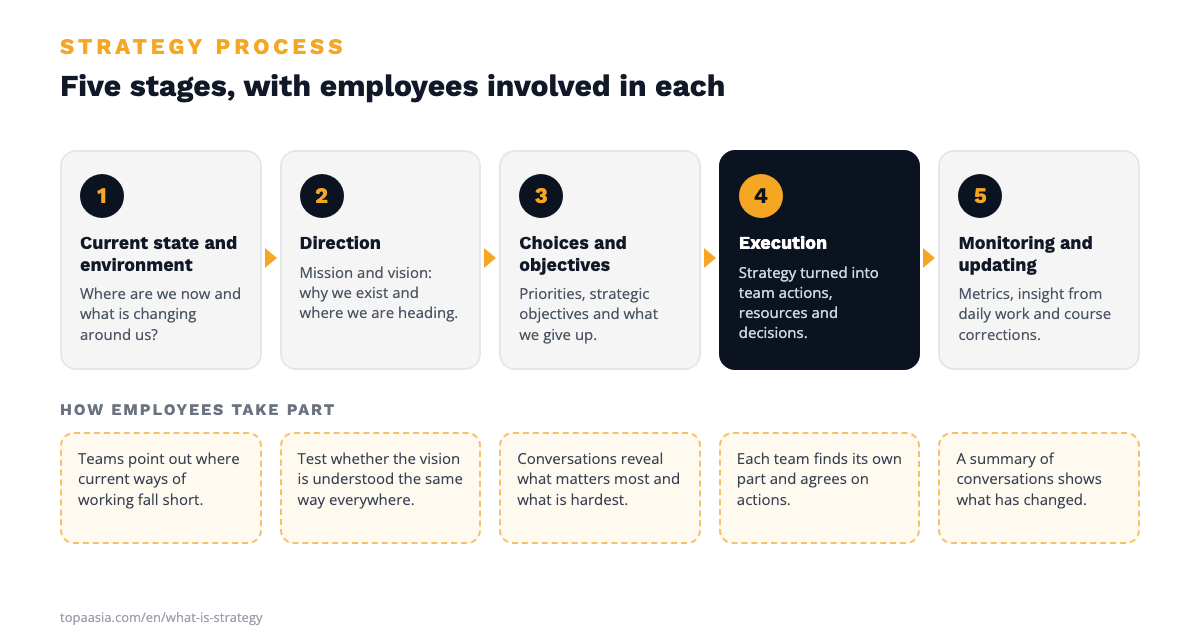
In most organisations strategic planning goes through the same stages, even though there are many models and names for them. The five-stage breakdown below covers both strategy formulation and execution.
Alongside the stages, it is worth planning the social process of strategy work, meaning who needs to be involved at each stage. This is also called participatory strategy work. Strategic management expert Anneli Valpola writes about it in her guest post Strategy work needs a room. She builds on the advice of MIT professor Richard Beckhard: the most important method of leading change is always to get the necessary people into the same room, around the same conversation.
1. Current state and environment
Strategy formulation starts with where the organisation is now and what is changing around it. Common tools include an analysis of the operating environment, customer and employee surveys, and financial and operational indicators. Employees often know best where the current way of working falls short, so their views are worth collecting at this stage. Consultants are also often used to build a picture of how the industry and the rest of the relevant environment, such as technology and competitors, are developing.
2. Direction: mission and vision
Next, the mission is reviewed and the vision is formulated. If the mission is in good shape, it does not need to be rewritten every round. The vision, on the other hand, is worth testing by asking whether it inspires people and whether it is understood the same way across the organisation. Values, meaning how the organisation acts to fulfil its mission and reach its goals, are often reviewed together with the direction as well.
3. Choices and strategic objectives
This is the core of strategy work. The organisation decides on its priorities, sets strategic objectives and agrees on what it will give up. Many organisations gather their choices into a strategy map. Some emphasise the importance of their own differentiation, their own category and blue oceans.
4. Execution
In execution, strategy is translated into actions, resources and decisions for units and teams. It includes communication, leadership, resourcing and the teams' own conversations about what the strategy means in their work. Different ways of executing strategy are covered in the article four ways to implement your strategy.
5. Monitoring and updating
Strategy is monitored with metrics and updated when the operating environment changes. In practice, Mintzberg and Waters' observation means that monitoring should also look at what has emerged in daily work outside the plan. Some of it is the most valuable information for the strategy. Some of it is best used locally, while some things can benefit the whole organisation.
At Granlund, which employs more than 1,200 people, strategy implementation proceeded in rounds. After each round of conversations, the discussions were analysed, the results were reviewed with management, and the topics for the next round were decided on that basis. Marketing Director Molli Nyman explains: "With the feedback and analysis from each round, we selected one Group-wide development target."
Why strategy execution is the hardest part
Strategy formulation usually gets the most attention, but most strategies stumble in execution. Many companies have a perfectly good strategy that simply is not carried out consistently over time. Donald Sull, Rebecca Homkes and Charles Sull studied strategy execution with a survey of nearly 8,000 managers in more than 250 companies (Harvard Business Review 2015). The results showed that the problem lies somewhere other than is often assumed.
The first finding concerns collaboration across units. As many as 84 per cent of managers said they could rely on their boss and their direct reports all or most of the time. Only 9 per cent could rely on colleagues in other functions and units all the time. Strategy almost always crosses unit boundaries, and that is where collaboration fails.
At PostNord Finland, the reviews of the new commercial strategy were deliberately held in mixed teams with Topaasia. The commercial management led ten conversations in groups of 5 to 7 people. Josefina Honkanen, responsible for commercial development, says: "We got so many new different viewpoints this way." More than 90 per cent of participants rated the sessions 4 or 5 out of 5.
The second finding concerns responding to change. Only one manager in ten saw it as a problem that the organisation does not adapt at all. Instead, 29 per cent said the organisation responds so slowly that opportunities pass by, and 24 per cent said it responds quickly but loses sight of the strategy in the process.
Both findings point in the same direction. Strategy is realised when people across the organisation understand it well enough to make decisions in line with it, even when the plan does not say directly what to do. Minna Rantama, Strategy Manager at HSL, says the same in practical terms: "You can't just start executing, first you need to understand together. When you think about how much energy has gone into creating the strategy, it's foolish to skimp on the implementation."
Strategy in public organisations
In a public organisation, strategy is often not optional. In Finland, for example, the Local Government Act (410/2015, section 37) requires every municipality to have a municipal strategy in which the council decides on the long-term objectives for the municipality's operations and finances. The act also requires that the strategy is based on an assessment of the current situation and changes in the operating environment, that it defines how its implementation is evaluated and monitored, and that it is reviewed at least once during each council term.
A municipal strategy also differs from a company strategy in content. For their book Strategiaopas kuntien päättäjille (A strategy guide for municipal decision-makers, 2020), professors J. Tuomas Harviainen and Janne Tienari interviewed municipal experts across Finland. They identified three special features of municipalities:
- Statutory obligations. Alongside them, the municipality's own traditions and the strong needs of residents also carry weight.
- Location. A company can move from one place to another, a municipality cannot.
- Brand in a broad sense. The image of a municipality can decide whether someone looking for a new home chooses it.
Harviainen and Tienari recommend talking about strategy as a verb. Strategy is realised only when it is done, and the fact that a strategy has been made together often matters more than what the final document says.
A public organisation's strategy has more owners than a company's. Elected officials, civil servants, employees and residents are involved, and often other organisations too. HSL, for example, prepared its strategy for 2026–2029 with its nine owner municipalities, its officials, political decision-makers, customers and stakeholders. At the Helsinki Parish Union, a shared strategy was created for all 19 parishes in about six months, and as many as 1,400 people took part in the process.
A common challenge in public organisations is that the strategy is a council decision, but it is realised in the daily work of thousands of employees. Rami Savila, Director of Strategy and Development at the City of Turku, describes the situation at the start of a new strategy: "We have a new strategy and people haven't quite taken it as their own yet. We had the previous strategy for a long time, since 2014."
The Municipality of Laukaa employs about 1,200 people, and the health and social services reform brought many new employees to the municipality. Municipal Manager Linda Leinonen describes the goal: "We wanted to create a strategy that does not end up lying on the employees' break room table, but would genuinely be something people can identify with, whether they work in the municipality as a supervisor, a sports facilities caretaker, a cleaner or a teacher."
Employee engagement in strategy work
Engagement makes execution easier, because people understand a strategy better when they have been able to influence it. According to Rantama, the whole strategy process should be participatory, and she puts it directly: "There's no point in making the strategy with the management team in a corner office and hoping it gets put into practice."
Marco Mäkinen illustrates the problem of a strategy dictated from the top with the story of the Spanish Armada. At the end of the 16th century, King Philip II drew up a fine plan to conquer England and did not listen to his admiral's or the Duke of Parma's concerns about practical problems. When the opponent did not behave according to the plan, the finest fleet in the world fell apart. Mäkinen is not suggesting that everyone should decide everything. A shared direction is still needed, and within it people must have the chance to understand the direction and discuss it. In his words: "They do not necessarily want to be rolled out upon. They want to be heard."
Engagement can mean surveys, workshops or working groups. In a large organisation, their challenge is the effort they require. At Hoivatie, which employs about a thousand people, employees were engaged in the first strategy process through surveys and working group tasks. When the strategy was due for an update, Development Director Mikko Oranen looked for a less laborious way. Hoivatie played 59 conversations with its own strategy deck, lasting an average of one hour and 20 minutes. Oranen describes the structure of the conversation: "I think of Topaasia as an aid to conversation that structures and focuses. It does not, however, dictate what is said. It defines what is talked about, but not the content of the discussion."
Vincit involved its employees already in developing the strategy. "We were reforming our strategy and wanted to engage our employees into the strategy development process", says CBO Anssi Kuutti. Vincit invited employees to open sessions in four groups based on their interests, and during the autumn about 20 sessions were played with more than 100 participants in Finland and the United States. Director of Organisational Development Mari Jokiranta sums up the experience: "In our experience, Topaasia is a simple game to play and gives important structure to a strategy development."
At the Helsinki Parish Union the goal was ambitious. Eeva Salonen, Leading Specialist in development work, describes the starting point: "The challenge was how to engage people in a fairly fast-paced strategy process in such a way that the strategy could reach all the way to the heart and influence the work of every one of us." The game was used already in the planning phase of the strategy, and the conversations took place in ordinary team meetings.
Engagement also produces information that the strategy makers would not otherwise have. At the City of Jämsä, nearly 90 per cent of the roughly 650 employees discussed the strategy, and the material gathered from the conversations now forms the basis for the strategy's key actions. City Manager Jori Reijula describes the change: "Jämsä previously had no data-based evidence of what the strategy is founded on."
HR strategy and other functional strategies
An organisation's strategy is often refined with functional strategies, such as an HR strategy, a digital strategy or a customer strategy. An HR strategy describes what kind of competence, leadership and work culture executing the organisation's strategy requires and how they will be developed. A good functional strategy is derived from the organisation's strategy and does not compete with it for attention.
The same applies to functional strategies as to the strategy as a whole: they are realised only when employees understand what they mean in their own work. Alongside the city strategy, the City of Turku has also created conversation games for its HR strategy and for work ability, and they are played in development meetings, working groups and networks.
Strategy work as a conversation across the whole organisation with Topaasia
Topaasia is a conversation game that brings strategy into conversation across the whole organisation at every stage of the process. Your strategy, or a draft of it, is condensed into your own card deck, and with an organisation licence the deck is created with AI in minutes. Managers or other game leaders then lead the conversation in their own team in about an hour. In the formulation phase the conversations bring out employees' views on the current state and direction, and in the execution phase they help each team find its own part in the strategy. Every conversation is documented on the platform, so management gets a summary of what came up.
You can also explore the content of your strategy with a ready-made deck. Winning Strategy was created together with Marco Mäkinen, and its 52 cards are divided into four themes: purpose, own category, competitive advantages and value creation. Mäkinen recommends that a management team play it once a quarter to see how the situation has changed.
More than 35,000 people have taken part in Topaasia sessions, and they have rated them 4.2 out of 5. You will find the customer stories below. More about the approach is on the Topaasia for strategy work page.
If a strategy process is about to start or a new strategy is waiting to be executed, book a demo and we will walk through how strategy conversations could work in your organisation. You can also try the game yourself with a free 30-day trial. During the trial you can try all the decks and create your own deck; the AI editor becomes available once you have met our customer service.
Frequently asked questions about strategy
What does strategy mean in simple terms?
Strategy means an organisation's choices about what it aims for and how it will get there. It includes priorities, objectives and also the things the organisation decides to give up.
What are vision and mission?
The mission says why the organisation exists, and the vision says what it wants to be in the future. The strategy says through which choices the organisation moves towards the vision, and the values say how it acts along the way.
What are the stages of the strategy process?
The strategy process usually has five stages: an assessment of the current state and operating environment, a review of the direction (mission and vision), choices and strategic objectives, execution, and monitoring and updating. Employees should be involved at every stage.
How often should a strategy be updated?
A strategy is typically drawn up for a period of three or four years. It is still worth reviewing every year and whenever the operating environment changes significantly.
Who creates the strategy?
In a company the strategy is approved by the board or management, and in a municipality by the council. Employees should be involved in creating it, because they know the daily work and because strategy is ultimately realised in their everyday decisions.
Customer stories on strategy work
- HSL brought its new strategy into the daily work of 400 employees
- The City of Jämsä brought its strategy into conversations with 600 employees
- Implementation of the strategy in the City of Turku
- The Helsinki Parish Union engaged its entire personnel in strategy work
- Bringing strategy into everyday work in the Municipality of Laukaa
- Granlund implemented its strategy digitally for an organisation of over 1,000 people
- PostNord Finland: energizing strategy sessions with gamification
- Vincit implements strategy successfully with employees at the center
- Hoivatie: a spot-on tool for strategy work