
The company values are on the wall. Usually they are variations on the same themes: integrity, customer focus, teamwork. They were polished by the leadership team, printed in the lobby and added to the onboarding material. And still everyday work goes on as before: corners are cut under pressure, customers are promised too much, and the quietest people in the meeting say nothing. The values do not guide behaviour, and they do not work as a target state either.
This is not the exception, and it is not only about values. In almost every organisation there is a gap between words and actions, and research shows it is wider than leadership assumes.
This article covers what company values are and what they are not, where the values gap comes from and what research says about it, and how to close the gap so that values start showing up in decisions and not only on posters.
What company values are
Company values are the principles an organisation acts on even when it costs something. Jim Collins and Jerry Porras defined them in their classic 1996 Harvard Business Review article as an organisation's enduring tenets, the ones it would hold on to even if they became a competitive disadvantage. In the long-lived companies they studied, core values typically numbered three to five, not ten.
Values differ from mission and vision. The mission says why the organisation exists. The vision says where it is going. Values say how it behaves on the way. Strategy and practices change, values do not.
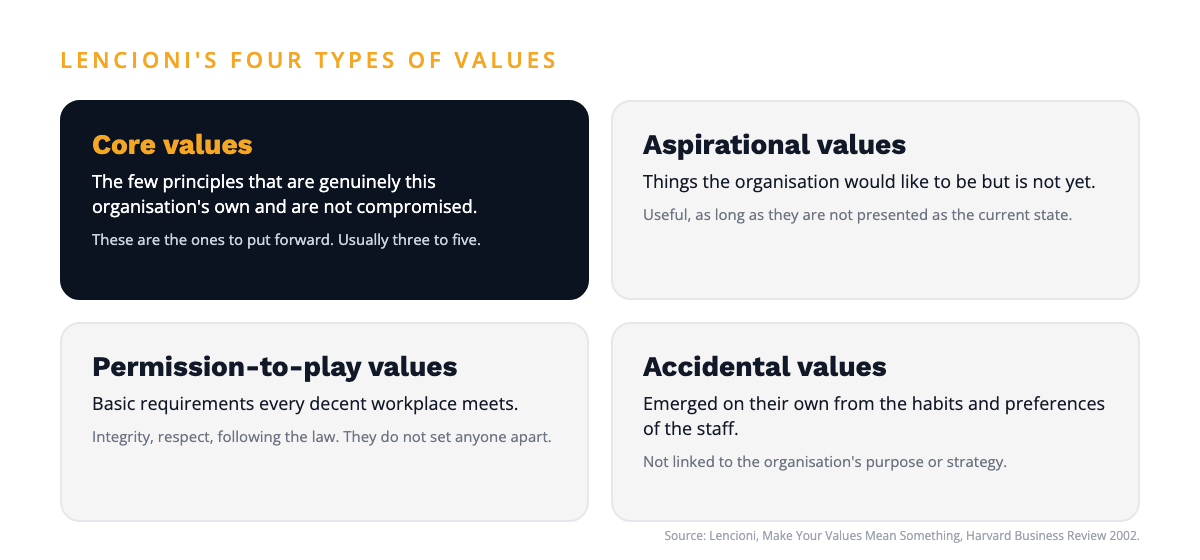
Patrick Lencioni divides values into four types. The division explains why so many value lists feel empty:
- Core values are the few principles that are genuinely the organisation's own and are not compromised.
- Aspirational values are things the organisation would like to be but is not yet. They are useful as long as they are not presented as the current state.
- Permission-to-play values are the basic requirements every decent workplace meets: integrity, respect, following the law. They do not set anyone apart from anyone else.
- Accidental values have emerged on their own from the habits and preferences of the staff, not from the organisation's purpose.
Most value lists consist of permission-to-play values and aspirational values that have been labelled core values. That is why they sound the same everywhere.
The values gap: the target state and actual behaviour are not the same thing
Values are meant to set a target state and give guidance for behaviour. They say what kind of organisation we want to be and how we hope its members will act. But the target state is not the same as behaviour. The difference between words and actions is called the values gap.
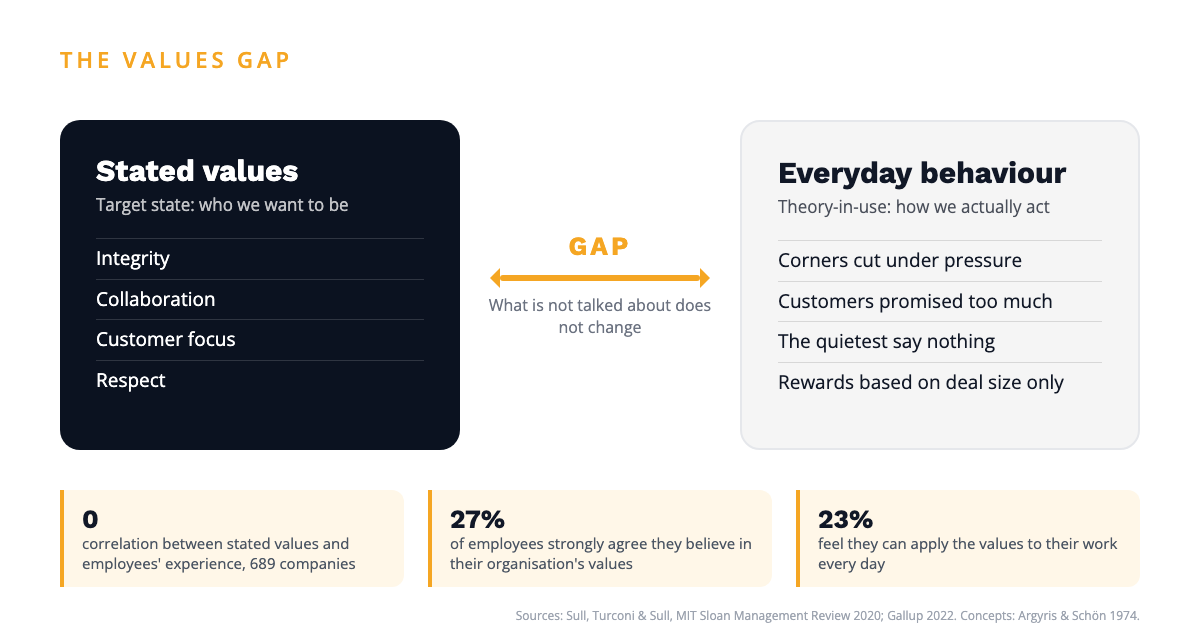
The gap is not a new observation. Chris Argyris and Donald Schön described it as early as 1974: people and organisations have an espoused theory of how they act, and a theory-in-use that actually governs behaviour. The two almost always differ. The problem is not the difference itself, but that the difference is not talked about. It goes unsaid, and what goes unsaid does not change.
More recent research has measured the gap. In a 2020 study in MIT Sloan Management Review, Donald Sull and colleagues went through the official values of 689 large US companies and compared them with how the companies' own employees rated the culture. The most common stated values were integrity (65 percent of companies), collaboration (53 percent) and customer focus (48 percent). The result was blunt: there was no correlation between stated values and employees' experience. A company that proclaimed collaboration was not, in its employees' view, any more collaborative than a company that never mentioned it.
According to Gallup, only 27 percent of US employees strongly agree that they believe in their organisation's values, and only 23 percent feel they can apply them to their work every day.
The best-known example of a values gap is Enron. Its values were communication, respect, integrity and excellence. Lencioni's article was written after Enron's collapse, and its message was that an empty values statement is not harmless. It makes employees cynical, because everyone sees every day that the words have no backing.
So a values gap is not a sign of a bad organisation. It is a sign of an organisation where the values have been written but not dealt with. The question is not whether the gap exists, but whether you know where it is, whether it is being addressed, and in the end, what is done about it.
Why values stay on the wall
"Values are posters on the office wall, and that is where they stay" is an old office joke. There are four reasons why values and values work are not always taken seriously in organisations and end up as "just posters": generic wording, values defined by leadership alone, and values that carry no weight in decisions and everyday actions.
The words are everyone's words. When the values are integrity, customer focus and teamwork, they say nothing about what is different in this particular organisation. In Lencioni's terms they are permission-to-play values, not core values. Nobody can be against them, and so nobody does anything for them either.
The values were made by the leadership team and communicated downwards. When staff have not been involved in putting them into words, the values are leadership's values. They can be accepted, but they cannot be owned. Lencioni recommends that values are not decided by consensus, but that does not mean they should not be discussed with the whole organisation. Deciding and discussing are different things. Likewise, an older organisation may have values that predate its current staff, in which case their creation is naturally not revisited with today's employees, but what those values mean for us today should certainly be worked through with them. Do we act on them in everyday work, why, why not?
Values do not show up in decisions. A value exists only when it affects who gets hired, who gets promoted, what is tolerated and what is given up. If customer focus is a value but salespeople are rewarded only on deal size, the value is a poster. Gallup's recommendation is the same as Lencioni's: values must be tied to hiring, evaluation and reward, or they are not real.
Nobody has asked how the values show up in everyday work. This is the most common reason and the easiest to fix. The values gap is usually common knowledge in an organisation, but it is not discussable. In Argyris's words, it has been made undiscussable. The first step is not a new list of values but a conversation that asks: where does this value actually hold here, and where does it not?
How to close the values gap
Five steps that work both when defining new values and when old values need to be brought back to life.
1. Separate your own values from permission-to-play values
Go through the current list with Lencioni's typology. What is genuinely this organisation's own, what is an aspiration, what is a given? Three real values are better than seven beautiful ones. If a value is an aspiration rather than the current state, say so out loud. An aspirational value presented as the current state is where the gap begins.
2. Measure the gap by talking, not with a survey
A survey tells you a value scores 3.4 on a scale. A conversation tells you in which situations it holds and in which it does not, and who has seen it. There is a lot of qualitative information and context around a value. Ask three things about each value: where does this show best here, where does it fail to materialise, and what prevents it. At Vastuu Group, one purpose of the values work was exactly this: to find out how well the values were already being lived. That is a different question from whether the values are good.
3. Turn values into verbs and situations
A noun does not guide behaviour. Integrity does not tell me what to do when a customer asks about a schedule that cannot be kept. A verb does. At Vastuu Group, three pairs of values crystallised in the conversations into three verbs: Dare, Care, Deliver. A verb is a promise whose fulfilment can be checked.
4. Take values into decisions and structures
This is where most values processes end, and that is why they change nothing. A value becomes real when it is a criterion in hiring, a theme in development discussions and the grounds for what is given up. For each value you should be able to name one decision from the past year where it was decisive. If you cannot, the value is not yet in use.
5. Return to the values regularly
A values gap does not close in one go. It closes when the same question is returned to: where have we moved forward, where have we not. A working rhythm is a values conversation with the whole organisation once a year, and values as one theme in every development discussion. At Vastuu Group, at the end of the values conversation everyone said what they themselves could start doing, and the promises were taken into development discussions for follow-up.
Example: Vastuu Group
Vastuu Group is a 75-person company that renewed its strategy and worked through its values with the whole staff at the same time. The values had been crystallised into three pairs: courage and enterprise, respect and humanity, caring and responsibility. Alongside them a fourth, deliberately surprising theme was added: growth.
The conversations were held as a Topaasia conversation game on a game day for the whole staff, with game masters trained from the company's own people rather than an outside consultant. Three things came out:
- A large share of the topics chosen came from the growth theme, not from the ready-made values. That shifted the priorities of the culture work.
- The wording of the values developed in the conversations into three verbs: Dare, Care, Deliver.
- Everyone said at the end what they would start doing themselves, and the promises were taken into development discussions.
When staff were asked whether they would like to keep playing, 96 percent said yes. In the words of Chief People Officer Heli Lallukka, this was not a top-down exercise, and that is why it worked. The full story is in the customer story.
Values conversations with cards
The hardest part of a values conversation is getting the whole staff to talk honestly about where the values are not being lived. In a workshop the most talkative people fill the space, and in a survey the answers stay as numbers.
In a Topaasia values conversation each participant picks from the cards the things where the values show and where they do not, and explains their choices. The game master can be anyone from your own organisation. A session takes an hour, ends with one most important thing and a concrete action, and the documentation is created during the game. When the same game is played in every team, the organisation sees where the values gap is widest. More than 35,000 people have taken part in Topaasia sessions, with a participant rating of 4.2 out of 5.
How a values conversation is run for a whole organisation is described in more detail on the values conversations page.
Frequently asked questions about company values
What are company values?
Company values are the principles an organisation acts on even when it costs something. They say how to act when strategy and circumstances change.
How many values should a company have?
Three to five. If there are more, some of them are probably permission-to-play values or aspirations, not core values. A list nobody can remember does not guide behaviour.
What does the values gap mean?
The values gap is the difference between stated values and actual behaviour. Research shows it exists in almost every organisation, and in the MIT Sloan Management Review study there was no correlation at all between stated values and employees' experience. The gap is not a problem if it is talked about. The problem is a gap that has been made undiscussable.
What is the difference between mission, vision and values?
The mission says why the organisation exists. The vision says where it is going. Values say how it behaves on the way. Mission and values stay, vision and strategy change.
How do you embed company values?
Not only by communicating, but by talking and deciding. Staff go through where the values hold and where they do not, values are turned into verbs and situations, and they are tied to hiring, development discussions and reward. After that, they are returned to regularly.
Values become real in action, and they can be worked on in a shared conversation
Company values are not the words on the poster but the decisions made on their basis. The gap between words and actions exists in every organisation. The difference between good and poor values work is whether the gap is spoken about out loud and whether something is done about it.
Sources
- Collins, J. C. & Porras, J. I. (1996). Building Your Company's Vision. Harvard Business Review.
- Lencioni, P. M. (2002). Make Your Values Mean Something. Harvard Business Review.
- Sull, D., Turconi, S. & Sull, C. (2020). When It Comes to Culture, Does Your Company Walk the Talk?. MIT Sloan Management Review.
- Gallup (2022). Are Your Company Values More Than Just Words?
- Argyris, C. & Schön, D. A. (1974). Theory in Practice: Increasing Professional Effectiveness. Jossey-Bass.