
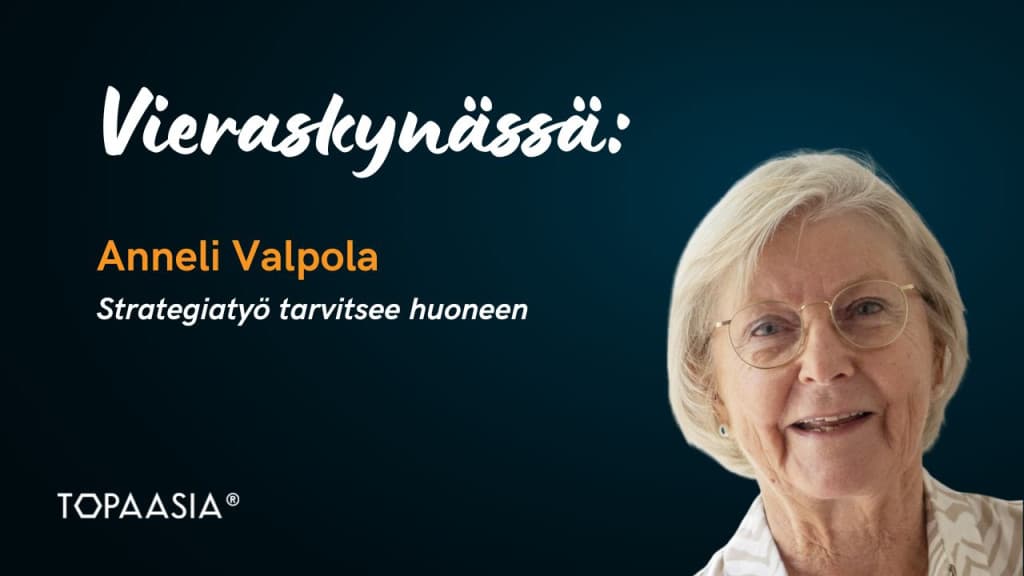
Anneli Valpola is a strategic management professional who has played a part in many changes in working life. She has written several books with practical advice, including Toimiva johtoryhmä (A Functioning Management Team) and Keskusteleva viestintä strategiatyössä (Conversational Communication in Strategy Work). Her latest work is Kysy, kerro, kuuntele (Ask, Tell, Listen), published in 2024, which is also the opening volume in ProPublishing's mini-book series ProInsight.
In this guest post, Anneli opens up the ways of doing strategy work and the forums, or rooms, that a successful strategy process needs.
STRATEGY WORK NEEDS A ROOM
A strategy draws on a vision of the future, an understanding of the work community's abilities and culture, and a brutally honest picture of the current situation. To help, there is the strategy process, which is often depicted as an annual clock with its different phases of activity and their timings. It is worth thinking through the social process of strategy work with the same care: who is needed at each stage, who ensures both the knowledge and the commitment to the strategy. In this way, the steps of both the strategy's content and participation can be thought through.The advice of the late MIT professor Richard Beckhard has carried me through many challenging situations. The elderly American professor sat comfortably in his chair, smoked a big cigar and told of his many change initiatives. We attendees wanted practical advice, we wanted to learn the secret wisdom of the world's guru. In answer to our questions he said that the most important method of change management is getting the necessary people into the same room. You must work out the reason that would bring the necessary people into the same room. Everything starts from there.
What if we considered who is needed in the same room at the different stages of strategy work, in the form of meeting and event invitations? By investing in the same room we give trust a chance to emerge, and enable an open exchange of ideas that can withstand different views and interpretations of information. At its best, the same room is a shared physical space, but fortunately we can also bring the necessary people together using the possibilities offered by new technology.
THE FIVE STAGES OF STRATEGIC MANAGEMENT
Strategic management divides into five stages: understanding the core of the operation, the strategic management perspective, strategic analyses, strategic decisions and communication, and implementing the strategy. All of them need their own rooms, their own forums.In deeply understanding the operation, it is important to know the drivers of your own (business) operations, the competitive field, your own strengths, and the ability to learn and replicate successful activity. This requires unrestricted interaction with different stakeholder groups both inside and outside the organisation. In other words, where do we meet, whom do we meet, so that we get information about the success factors of the operation and how we are doing on them?
The strategic management perspective chooses the key management means for success. They can be strict planning, big product development investments, rapid replication of concepts, or fast learning from both your own and others' experiences. Who is needed to adopt the vision and focus crystallised by the perspective?
Strategic analyses are done in many different ways. In some organisations, specialists prepare analysis data for management's use according to an agreed list, and management draws the necessary conclusions with their own experience-based criteria. In others, analyses are done as part of coaching programmes and study trips, while others make cooperation agreements with other companies and research institutes. Do we invite a diverse range of experts to produce the strategy analyses and to solve the key opportunities and problems?
Strategic decisions and communication are the test of critical decisions and of telling people about them. If management has worked on the strategy only among themselves, the recipients may question it or stop to ponder mainly the risks and difficulties of implementation. Or the recipients listen to the strategy presentations in silence, approaching the implementation as passive listeners. In other words, is the strategy known in the work communities, and does every team member take part in the discussion about the strategy's impact on their own role and tasks?
ROOMS IN STRATEGY WORK
Here are a few examples of the kinds of rooms that can be used in strategy work in addition to ordinary meetings and info sessions:A one-day sprint
The analyses can be done by the management group in a concentrated push, so that over one or two days the analyses are done in various small groups and presented to the others. A surprising number of customer and subcontractor interviews can be done in a few hours, even visiting partners. Likewise there is time to gather fresh information on best practices for recruiting skilled people, to get acquainted with artificial intelligence, and to examine the key figures from different angles.
Putting training participants to work
Give the participants real tasks, either as longer-term projects or as two-hour group assignments. The goal is to produce solution proposals for the strategy. Ask participants for help in developing customer satisfaction, delivery reliability, replication of concepts, and leadership.
Reverse mentoring
A new kind of role division is used to source necessary content for the strategy. Each member of management gets a young mentor; willing young people in the organisation can apply for the role. The conversations open up new perspectives and ensure that different competence or age groups do not live in their own bubbles, but find a space for exchanging ideas.
Learning cafe
Communicating the strategy can be carried out as cafe conversations, so that each table represents one theme of the strategy. A member of management acts as host, telling about the strategy theme for their part and discussing the theme's content and implementation with the members of the work community visiting the table. The discussion can be guided with questions such as: what could we do more of, what could we do less of, and what could we do differently in order to succeed in this strategy theme? And the answers would be collected and saved for everyone to help with the implementation!
The results of a strategy are assessed years later. Only then do the effects of the changes become visible. But already the first months signal whether people have understood the point of the strategy and eagerly taken up the necessary new work. Asking questions shows a desire to know and understand the strategy. Silence and slowness are effective strategy killers. Without shared rooms and the conversations in them, the strategy will not be realised!
Source reference: Organizational transitions: managing complex change by Beckhard and Harris; Addison-Wesley 1977
Thank you Anneli!
Olorin