
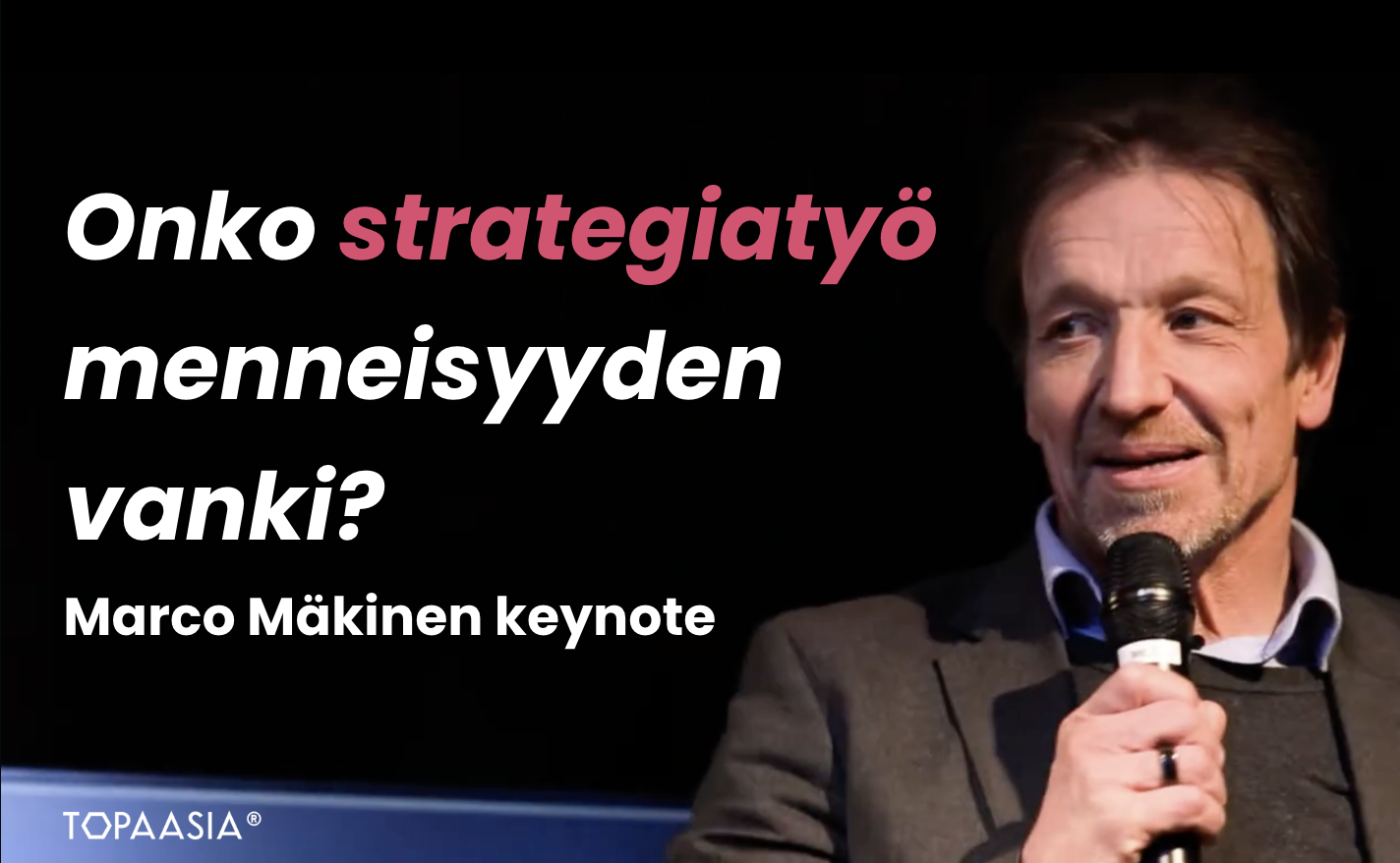
When Jussi got in touch and asked whether I would come and speak at a Topaasia event, the idea felt great. Then I heard that Esa Saarinen, my former teacher whom I greatly admire, would also be performing.
The situation felt a bit absurd. A bit like you had Pena's band and the Rolling Stones were coming to perform. And then someone asked whether Pena's band could be the warm-up act. Of course I immediately said "absolutely!"
After that I started to wonder what on earth I would talk about.
Since I have known Topaasia and Jussi for a long time, and Topaasia has from the very beginning been strongly connected to strategy work, I decided to go back a little. What has happened to strategy work over the last 30 years? And above all: could strategy be thought of in some other way?
Strategy was serious business
About 30 years ago I was a humanist who had learned from Esa Saarinen about humanity and many fine things. Then I got it into my head to go into business.
I went on an MBA course and as part of it I visited Harvard. There I was taught that strategy is the most important thing of all.
For a humanist, the strategy literature was rather odd reading. I came across The Art of War, On War and all kinds of very warlike imagery.
I learned a few things about strategy as if they were given truths.
First of all, strategy is extremely serious business. It is nothing short of a matter of life and death. People talk about the Cola Wars. Companies attack, defend, conquer markets and kill their competitors.
The second lesson was that strategy is not made democratically together. It is dictated from the top down. At the top is a genius who knows what needs to be done. Then the rest of us execute his vision: Don't think. Do as I command.
And finally, of course, the strategy is rolled out. The word itself says quite a lot about the way of thinking: someone at the top decides, and after that the strategy is pushed down into the organisation.
I listened to the teaching, thought what a peculiar way of doing things, took notes, and of course started to put it into practice myself.
Have we actually got very far from this?
The same basic model is still visible in organisations. The board, in its great wisdom, defines the strategy. The management plans what it means in practice. After that, the enthusiastic and empowered employees execute it.
Over the years I have been involved in various boards and organisations, and at some point I started to wonder how well this actually works.
History interests me a great deal. When I started to look at strategy through that lens as well, I came across a slightly awkward observation:
This kind of top-down strategy has never really worked very well.
So it is not a question of it no longer working because millennials have entered working life or because the world changes so fast these days.
The problem is much older. One of my favourite examples of this is the Spanish Armada.
The Spanish Armada's fine strategy, until reality got in the way
At the end of the 16th century, King Philip II of Spain had a problem. England had broken away from the Catholic Church, and Queen Elizabeth I was in power. Philip decided to settle the matter.
Spain was an enormously rich empire. So the king did what strategists often do: went to the drawing board and built a fine plan: build a superior fleet, the finest and largest ships in the world.
The fleet sails towards England. Meanwhile, the Duke of Parma assembles a large land army in Holland. The fleet picks up the troops, the army crosses the English Channel, and England is restored to Catholicism.
A fine strategy.
After that, the king gave his subordinates precise instructions.
The admiral tried to point out that the plan had a few practical problems.
The answer was, in effect: shut up.
The Duke of Parma also had questions, for example about how his troops and barges would in practice be joined up with the Spanish fleet.
Same answer. SHUT UP.
The strategy had been decided. All that remained was the rollout.
And then something unpleasant happened.
Reality got in the way.
The other side had not read the strategy
When the Spanish Armada arrived in English waters, it met an enemy that did not behave according to Philip's plan.
The English also had a very different way of leading. Queen Elizabeth's approach could perhaps be summed up like this: "If Esa is a competent employee, then off you go, Esa, and handle it somehow. If it goes well, I will thank you."
The English fleet had characters like Francis Drake. A famous pirate who took orders from hardly anyone, but was loyal to the queen.
When the situation changed, the English did not wait around for new detailed instructions. They thought about what could be done. One idea was to send burning ships towards the Spanish formation, roughly like this:
"Let's set a few of our own ships on fire, send them over there and see what happens."
The Spanish panicked, because burning ships were not in the strategy. The formation broke apart, and in the end things went rather badly for the finest fleet in the world.
To me, there is something very essential about strategy here. The plan can be excellent. The problem arises at the point when the world does not behave according to the plan.
...And the world rather rarely behaves according to the plan.
Strategy books have changed, but has the thinking changed?
Now, 30 years later, we of course have a new kind of strategy literature. People talk about agile strategy, fast strategy, scenarios and continuous reaction to changes in the environment.
Much has changed, but when you look more closely, one thing is surprisingly persistent:
Strategy is still very often made from the top down.
And we still use the same warlike language. We attack markets, beat competitors and roll out the strategy.
At the same time, organisations have a fundamental problem: people do not necessarily know the strategy or understand what it means in their own work.
In my talk I brought up research figures according to which only two percent of employees can explain their organisation's strategy and only 13 percent of management team members can define it.
The question is not necessarily whether a strategy exists. Nor even whether it is good.
The problem is that it is not known or understood.
But not everyone should decide everything
From here it would be easy to jump to the other extreme: If top-down strategy does not work, let everyone just do what they want.
That does not really work either. A person working at the Prisma checkout can be very good at their own job, but they do not need to single-handedly decide what S Group's e-commerce strategy should be.
A shared direction is still needed.
Perhaps a better model can be found somewhere between Queen Elizabeth and Francis Drake. They had a shared understanding of what was being pursued. But within it there was room for discussion, decisions and reaction.
Drake could say:
"Could you give me a bit more money for warships?"
The queen replied:
"Actually, funds are running low."
Drake said:
"Okay. I'll go and plunder those ships over there, then."
A shared goal, but at the same time continuous dialogue.
Less of Philip's style of "shut up, I am not listening" leadership.
There could be something in this.
What if companies are not actually at war?
Another thing I have started to ponder concerns the war metaphor of strategic thinking as a whole.
What if companies are not actually at war with each other?
What if the best way to succeed is not beating the competitor, but finding your own path?
Many great success stories look exactly like this.
Red Bull did not set out to make a slightly better Coca-Cola. It effectively created an entirely new beverage category.
Apple did not go into smartphones thinking, now let's kill Nokia. It did something completely different.
Airbnb did not build a better hotel. It created a different way of thinking about accommodation.
Perhaps the most important question of strategy is not always:
How do we beat the others? But rather: What is our own path?
If we should fight for anything, it is for people
If we really should fight for anything, then perhaps for people.
For people, who should understand what the organisation is pursuing and why.
They do not necessarily want to be rolled out upon. They want to be heard.
And here, in my view, we get to the heart of strategy work. A winning team talks together about goals, priorities and choices.
Not so that everyone should decide everything. But so that people have the opportunity to understand the shared direction, discuss it, and form an idea of what it means in their own work.
When things have been talked about together, there is also an entirely different opportunity to commit to them. Imagine, say, Drake and the other Englishmen in discussion:
"The Spanish Armada is coming. What do we do?"
"Shall we flee?"
"That feels a bit poor, since mum still lives here too."
"Well, what do we do then?"
"What if we counterattack and burn their ships?"
"Good idea. Let's do that."
An exaggerated example, but it contains the essential difference.
Strategy is not just something that someone tells others; strategy becomes something that is talked about together.
This is when I understood the idea of Topaasia
When Jussi cold-called me back in the day, he told me about a business idea that could do in an hour what McKinsey takes three months to do. The idea sounded ambitious, to say the least.
And when it also involved some kind of board game and cards, I wondered how on earth something like this could get, say, an arrogant business executive to join the conversation.
Over the years, however, I have seen what is actually done with Topaasia. And I have understood that the cards are not really the point. What is essential is that they give people an instrument for having a conversation.
If King Philip were alive today and in the same situation, it might be worth his while to play some kind of Topaasia game with his admiral and his other leaders before the fleet sets sail. Then it would become clear:
What is our goal?
What do we need to take into account?
What does the admiral see that the king does not see?
What do we do if the plan does not work?
How do we know we have succeeded?
It may be that, as a result, the course of history would have been different.
A winning team creates, shares, develops and executes strategy together
When I have observed organisations where things are genuinely discussed together, I have seen an essential change.
Strategy does not remain the business of just a few people! At first, maybe 20 percent of people understand it. Then suddenly you are in a situation where everyone knows what our thing is, and that is valuable.
And that is exactly why I believe that strategy work should shift away from rollouts and towards shared conversation.
Strategy is still needed. A shared direction is still needed. But a winning team does not just receive the strategy from above.
A winning team creates, shares, develops and executes strategy together.