
In this blog you will learn:
-What is a software development team's retrospective?
-What are the 6 common problems of retrospectives?
-How to easily run an effective retrospective, also remotely, with the help of Topaasia® serious games?
-How CityDevLabs and Vincit have made use of Topaasia games in retrospectives and other team meetings?
What is a retrospective?
A retrospective is a session where a development team goes through its own recent work and assesses what has gone well, what has gone badly, and what should be done to improve. Retrospectives are a familiar concept in the software development world and have become known especially through the Scrum framework, but retrospectives have also become more common in other fields in recent years. Retrospectives, or more casually retros, are an important part of agile software development, but one that often gets trampled underfoot due to busyness. The importance of retros is nevertheless widely recognised.
We collected a 60-minute retrospective agenda, the most common mistakes and a comparison of tools on one page: Retrospective meeting: a 60-minute agenda, common mistakes and tools.
Retrospectives have a few common problems:
- No facilitator can be found for the retro due to scheduling problems (or there are too few retro facilitators in the organisation)
- The group lacks the skills to steer the discussion (facilitation)
- Not everyone gets to speak or take part in the discussion
- Retros drag on
- Retros are not inspiring or fun
- People are remote, and the retro fails because of remote-work problems (concentrating on the discussion, connection issues, steering the discussion does not work as well as in person).
- People get bored with retros because they are too similar.
- The retro facilitator changes the retro format too often and the focus goes into learning the new method.
Topaasia® - A serious game for running a retrospective
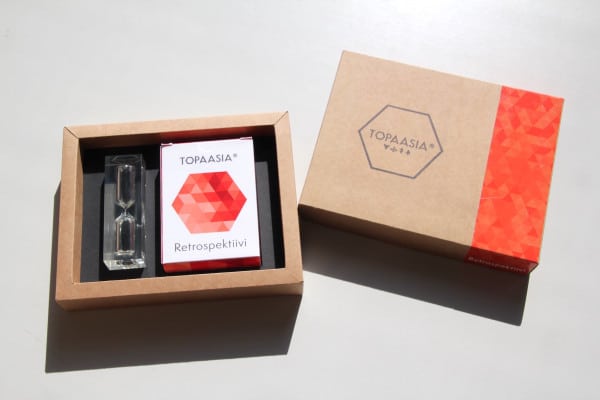
Topaasia: Retrospective is, as its name suggests, a serious game developed for retrospectives. It is a card game that lasts about 60 minutes and is intended for 2-14 players. In teams of more than 8 people, it is played in pairs. Thanks to the game's simplicity and rules, a team can play independently. The benefits of Topaasia:
- Thanks to the game's structure, the retro does not need a separate facilitator. It is easy to run independently and proceeds smoothly.
- The group does not need top-level facilitation skills, because the game takes care of the rhythm and progress of the discussion.
- The game has time limits within which the discussions take place. In these discussions everyone gets to speak, because no one can fill the discussion space alone.
- Thanks to the time limits and progression, the game stays on a set schedule.
- Discussion through the game brings fun and enthusiasm to the situation.
For remote teams,Topaasia's digital service includes, in addition to the retrospective game, 40 other Topaasia game contents.Read Sanoma's customer story about using digital Topaasia in retrospectives.
How does the game work?
Below is a description of how a Topaasia game session proceeds. You can also watch a video of how a game session unfolds.
How to play:
1) Choose the topic you want to discuss. In a retrospective, the topic is often naturally the project, in other words "the success of the development project", but it can be more specific, such as which burning problem you want to solve. The chosen topic serves as the context of the game.
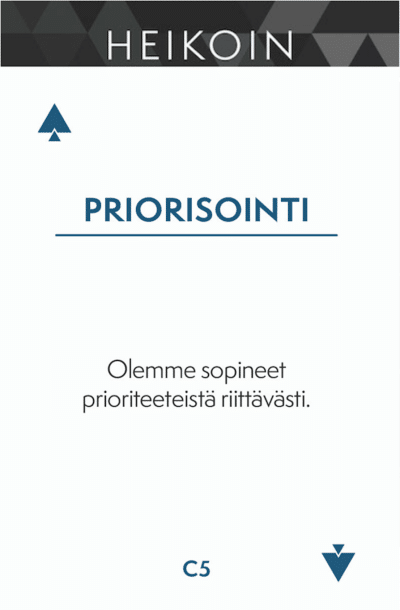
2) Discuss the topic from different perspectives with the help of the hand cards. Good choices for perspective cards are, for example, the strongest, the weakest, and the most likely risk. Each player is dealt five cards.
Below are a few examples of different perspective cards, and beneath that, of the hand cards held by the players.
Game rounds are repeated until all perspectives have been played.
Finally, the Topaasia is chosen, in other words the matter that will actually be acted upon to improve things. The outcome is crystallised into an action plan. Below is an example, and you can also download the canvas used for the crystallisation here.
What is the desired change?
What could help move the matter forward?
What will be done?
Who will do it?
By when?
Case examples: City Dev Labs Oy and Vincit Oyj

At City Dev Labs Oy, Topaasia games have been used in retros and the results have been remarkable. Niko Jokinen says in his customer story that:
"With the help of Topaasia, the whole company's perception of the retro has been changed. Now it is looked forward to and it stays in the calendar."
"At City Dev Labs, after every game we have found good areas for improvement, at a very practical level"
"With Topaasia, the retro gets the team to pursue the common good through natural discussion and helps find the ways in which your own work can be that little bit more pleasant."
“I would hope that this wonderful tool would be found in the toolbox of everyone working in teams.”
Read the full customer story here.

Topaasia games have also been used in retrospectives, as well as in project kick-off meetings, at Vincit, the best workplace in Europe (GPTW 2016).
Vincit's HR Director Johanna Pystynen explains in her interview how Topaasia games have been used at Vincit:
"Raising issues and discussing them becomes easier under the guise of a game"
"Playing helps to effectively identify risks, opportunities and each other's strengths alike. Things identified through playing can be put into practice quickly"
Read Vincit's customer story here.
The problem with remote teams' retros?
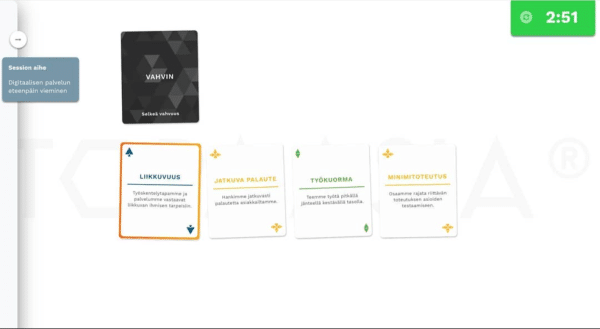
We have developed a digital version of Topaasia to support the leadership of distributed teams and the facilitation of discussions. The game works digitally and helps a dispersed team achieve the benefits of Topaasia. You can try digital Topaasia free for 30 days.
Read more about the digital Topaasia service.
You can order Topaasia games directly from our online shop
The Retrospective game is also available in English!
Other closely related decks for software development are Successful Project, Value Creation, Lean and Agility. These, and also the General deck, work very well and versatilely in retrospectives and other software development forums.
You can also ask for more from game man Jussi Galla 040 -0246626 or galla@topaasia.com
Did the article help you? Did you get ideas or other benefits? Was this the longest X minutes of your life? Give feedback on the article to ville@topaasia.com
Customer stories Online shop Blog040 0246626
asiakaspalvelu@topaasia.com