
The development day was held. An outside facilitator, a good lunch, a wall full of sticky notes. The mood was good, and everyone agreed that this was the start of something. Two months later the notes are in someone's drawer, and the meeting is about the same problem as before the day.
This is the most common form of workplace development and its most common outcome. This page covers what developing a work community means, why it so often stops at the development day, how to spot the need for it, which areas are worth looking at and how to involve staff so that change happens in everyday work and not on sticky notes.
What workplace development means
Workplace development means that a work community regularly examines its own way of working together and changes it. The object is collaboration, not an individual person or an individual process: how decisions are made, how information flows, how conflicts are handled, how a new person is brought in.
Three distinctions help to see what workplace development is and what it is not:
- It is broader than team development. Team development concerns one group with a shared task. Workplace development concerns a whole unit or organisation with several teams and the interfaces between them. The means are the same, the scale is different.
- It is not the same thing as wellbeing at work. Wellbeing is the outcome. Workplace development is the work that produces it. A thriving work community comes from collaboration that works, not the other way round.
- It is continuous work, not a single event. A development day, a wellbeing survey and a team day are moments, and the actual development happens between them.
Why most development initiatives never get past the development day
There are three reasons, and they repeat from one organisation to the next. They come from the way development is organised, not from the people.
Development is separated from everyday work. When development happens once a year at a separate event, it loses to everyday work. After the day everyone returns to the same meetings, the same rush and the same habits, because none of them has changed.
The work community is left with no way to continue by itself. An outside facilitator makes the day a good one, but if the work community is left with no way to continue by itself, the next step waits for the next day and the next budget.
Staff do not choose the topics. Management or HR decides what is developed, and staff take part in working on a given topic. People then talk about what they are asked to, not about what really chafes in their everyday work. This is often called participation, but it is pseudo-participation, and staff spot the difference immediately.
Anna Kaisa Ojala, Work Ability Manager at the City of Turku, describes the same from a large organisation's perspective in her customer story: development is often done at such a high level that it stays distant from teams and individuals. Everyday development becomes realistic only when the actions are broken down into small enough pieces.
What these three have in common is that development is not the work community's own activity. When it becomes the community's own habit, it continues between the development days as well.
How to tell that a work community needs development
The need for development rarely shows as a crisis. Most often it shows in the same things repeating.
- The same item is on the meeting agenda for the third time. It gets talked about, but nobody owns it.
- Teams blame each other for the same problem. Each is right from its own perspective, and nobody sees the whole.
- The wellbeing survey results are the same as last year. The survey was run, the results were presented, nothing happened.
- There is an interface between teams that everyone complains about and nobody has invited to the same table.
- The survey response rate drops year after year. People stop answering when answering leads nowhere.
- The manager hears about problems last. It is a sign of a lack of psychological safety, and it is the first target of workplace development.
If you recognise three of these, there is knowledge in the work community that is not reaching the table. The job of development is to get it there.
Four areas of workplace development
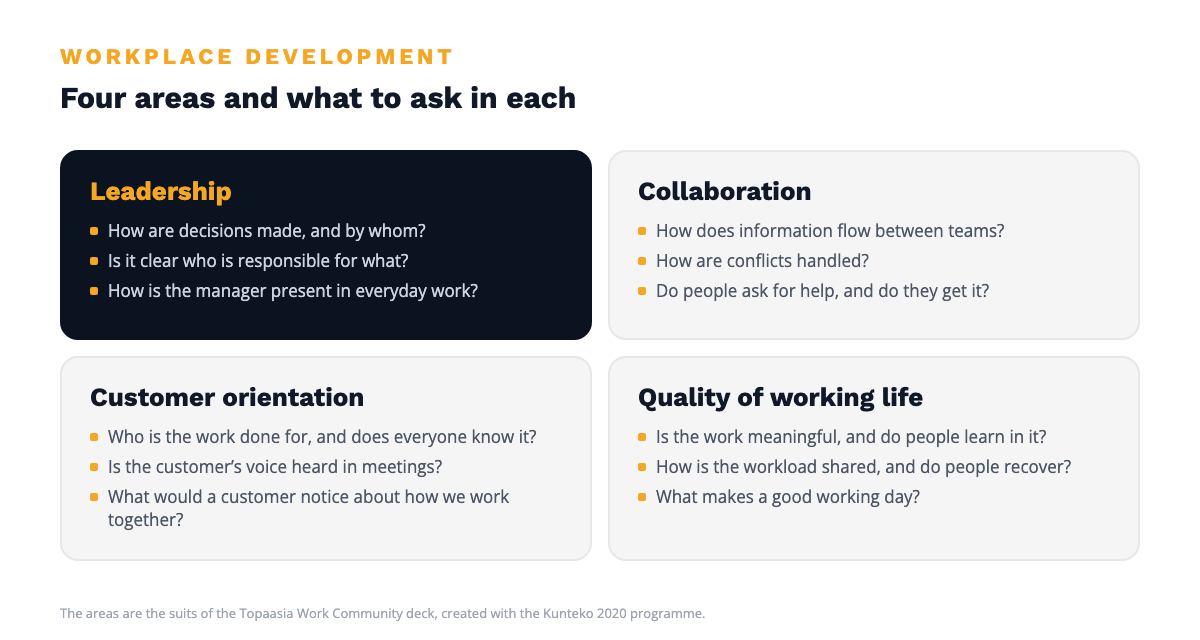
When a work community starts developing itself, the first question is what to talk about. Four areas cover almost everything, and they are the same ones the content of the Work Community deck was built on together with the Kunteko programme.
Leadership. This looks at how decisions are made and communicated, how the manager is present in everyday work and whether it is clear to everyone who is responsible for what.
Collaboration. Does information flow between teams, how are conflicts handled, do people ask for help and do they get it. Most work communities start here, because problems in collaboration chafe most visibly.
Customer orientation. Who is the work done for, does everyone know it, and is the customer's voice heard in meetings. A work community that only talks about itself easily develops itself in the wrong direction.
Quality of working life. This includes how meaningful the work is, learning, workload and recovery. Wellbeing surveys measure exactly this area, and it is largely a consequence of the previous three.
Not all four are handled at once. The work community picks the one that chafes now and returns to the others on later occasions.
Participatory workplace development: five principles
Participatory means a simple thing here: staff do the development themselves rather than being its object. The following five principles separate real participation from pseudo-participation.
1. Development happens in everyday work, not on a development day. An hour once a month as an extension of the weekly meeting produces more than a day once a year, because the previous decision is checked the next time. At the Maunula daycare centre the teams added a development conversation to their monthly weekly meeting, which is then half an hour longer. The manager's job is to reserve that time.
2. Staff choose the topics. The topics are not handed down by management or HR. When everyone gets to raise what chafes in their own everyday work, and the work community chooses the most important one together, the right thing gets handled, and it is often different from what management would have chosen.
3. Structure distributes the turns. Without structure, a development conversation is a conversation between the two most talkative people. Everyone writes or chooses first, everyone speaks in turn, nobody comments until everyone has been heard. This is the basic structure of facilitation, and anyone in the work community can run it.
4. One change at a time. The wall of a development day has thirty sticky notes, and few of them come true. One chosen thing, with an owner and a schedule agreed, does come true. The principle is the same as in a retrospective: selection separates development from a complaints round.
5. Results return to where they came from. When a development conversation is held, its result is written down so that everyone sees the same text, and it is checked the next time. If the work community is large, the teams' results are collected and management responds to them. Staff who see their suggestions move forward will suggest again next time.
Workplace skills are the community's skill, not the individual's
Workplace skills are often talked about as an individual trait: a good colleague, a bad colleague. In practice they are a skill the team practises: how to ask for help, how to give feedback, how to react when someone makes a mistake.
Sonja Kivilehto, director of the Maunula daycare centre, describes in their story why workplace skills are needed especially in work where situations change all day: "When work flows together, the team does not rush or panic even in a tight spot, because things get sorted out together." At their best, colleagues have communicated in a surprising situation with small gestures, without saying a word.
At Maunula the skills are practised by playing once a month at the start of the team meeting. After a few sessions the staff felt that equality had increased, because everyone gets to say their opinions out loud, and that team members had grown closer. Those who were shyer about sharing their thoughts became more active. Doctoral researcher Kata-Riikka Kumpulainen, who studies teamwork in early childhood education, sums up the mechanism: "A virtuous circle begins when we understand how significant the things that seem small really are."
According to Kivilehto, good workplace skills are also a recruitment asset. She takes job applicants round the teams so that they see what the atmosphere at the daycare centre is like: "When people are asked what matters most for coping at work, almost everyone puts a well-functioning team at the top."
This is the core of workplace development: a skill develops when it is practised together and regularly, and talking about it once a year is not enough.
Four examples of how it has been done
The following four examples show what development in everyday work looks like in organisations of different sizes.
City of Turku: in small pieces, as a process. The City of Turku has used gamified development conversations in its welfare division, education division, strategic HR and occupational health, and the single largest use has been workplace development: refining everyday ways of working, bringing out strengths and developing the future. According to Anna Kaisa Ojala, the greatest value has been strengthening team interaction, and teams have said how good it is to hear views from the quieter people too. With one team the first conversation was broad and value-laden, and a second one a couple of weeks later refined it into a small, concrete everyday development item that was taken forward. Read the City of Turku story.
Jollas Institute: from a workplace study to actions. In S Group, about 40,000 employees answer the annual workplace study, and debriefing the results is a yearly challenge. Jollas piloted the debrief as a gamified conversation in small groups with its whole staff, and concrete development items were found in the results. Read the Jollas story. The same model has been turned into a service, from employee survey to employee conversations.
Maunula daycare centre: once a month in the weekly meeting. At Maunula, development is part of the ordinary weekly meeting, as described above, and the chosen themes were psychological safety and systems intelligence. In Kumpulainen's words, half an hour of playing once a month tunes the team straight into the team meeting and makes it more effective.
The Kunteko programme: work communities in municipal workplaces. The Work Community deck was created with the Kunteko 2020 programme, and its four areas are the same as on this page. Programme manager Anna-Mari Jaanu explains in an interview why development work does not need an outside consultant when the structure is ready.
Tools for workplace development
A tool does not do the development, but it decides whether development happens once or every month.
Wellbeing survey. A survey tells you where you are, but not what should be done. It is a good starting point if the results are debriefed in conversation. Without the debrief it is an annual reminder of the same things.
Development day. A day works well for a start and for big turning points. As the only method it is not enough, because everything described above is left undone between it and the next day.
Conversation cards. In a deck of cards, each card is one area or perspective of the work community. Everyone picks from their hand the cards that best describe the work community, presents them in turn, and the group finally chooses one to act on. The cards contain the five principles ready-made: the topics come from staff, the structure distributes the turns, one thing is chosen and the agreement is written down. A session takes an hour, and anyone in the work community can run it.
The Topaasia Work Community deck was made for exactly this, and alongside it there is the digitally played Thriving Work Community deck, made with JAMK University of Applied Sciences for wellbeing themes. For working on diversity there is a game of its own. How Topaasia fits team and workplace development more broadly is described on the team development page.
Frequently asked questions about workplace development
What does workplace development mean?
It means that a work community regularly examines its own way of working together and changes it. The object is collaboration: decision-making, information flow, handling conflicts and bringing in new people.
Who is responsible for workplace development?
The manager is responsible for there being time and a structure for it. The work community itself is responsible for the content. Development done by someone other than the work community stays at the development day.
How often should a work community be developed?
An hour once a month is a good rhythm. Less often than once a quarter, the previous decision has been forgotten before it is checked.
What is the difference between team development and workplace development?
The difference is scale. Team development concerns one group, workplace development a whole unit and the interfaces between teams. The means are the same.
Does workplace development need a consultant?
For a big start or a sensitive conflict a consultant is often needed. For continuous development one is not needed if the structure is ready. A structure that anyone can run is what makes development continuous.
How is workplace development measured?
A wellbeing survey measures the outcome once a year. Development itself is measured by how many agreed changes have come true since last time. It is a number the work community sees for itself every month.
Development is what happens between the days
Workplace development does not require a big budget or a separate project. It requires an hour a month, a structure where everyone speaks, and one change that is checked the next time. A development day can be a good start, but everyday work decides whether development continues.
If you want to start with your work community next month, the Work Community deck gives the conversation ready-made topics and a structure, as a physical deck or digitally on a free trial. If the topic concerns the whole organisation, book a demo and we will walk through how the conversations reach every team. More than 35,000 people have taken part in Topaasia sessions and rated them 4.2 out of 5.