
A new plan is presented in a meeting. One team member spots a flaw in it but says nothing, because last time a remark was brushed off with a shrug. Two weeks later the flaw is found by a customer. Nobody lied, nobody was lazy. It simply was not safe in that team to say out loud what you saw.
This is a lack of psychological safety, and it costs organisations more than any single skills gap. This page covers what psychological safety means and what it does not, how to recognise it in your own team, how to measure it and how to build it so that it shows in the next meeting.
What psychological safety means
Psychological safety is a team's shared belief that it is safe to take interpersonal risks in the group: to ask, to admit a mistake, to present a half-formed idea or to disagree without being humiliated or punished. The definition comes from Harvard professor Amy Edmondson, who studied the phenomenon in hospital teams in the 1990s and published the concept in 1999.
Three things in the definition matter:
- It is a property of the team, not the individual. The same person can be open in one team and silent in another. Psychological safety is created by how the group reacts when someone takes a risk.
- It is a belief about the future. It is about what a person expects to happen if they say something. The expectation is built from past experiences, which is why one shrug can silence a team for months.
- It is everyday. Janetta Ekholm of Futurice says in our interview that every situation has some level of psychological safety. It is a property of every meeting, not a separate project.
Why psychological safety decides a team's results
Google's internal Project Aristotle studied more than a hundred teams to find out what separates an effective team from the rest. The result surprised the researchers: the members' skills, experience or personalities did not explain the difference. The single most important factor was psychological safety, and it was a precondition for the other four (dependability, structure and clarity, meaning and impact).
The reason is simple. A team exists because different people know different things. That knowledge helps nobody if it is not said out loud. Hanno Nevanlinna of Futurice sums up the same point in the interview: different expertise is of no use unless people dare to put themselves on the line.
In practice, psychological safety shows in three things every manager will recognise:
- Mistakes are found early. Edmondson's original finding was that the best hospital teams reported the most errors. They did not make more mistakes, they talked about them.
- Quiet knowledge reaches the table. A new employee who notices something the veterans no longer see says it only if they know they will not be thought stupid.
- Change moves forward. Strategy implementation and values conversations require people to say where the new way of working does not work. Without safety they nod and carry on as before.
What psychological safety is not
The term is used so much that it has started to mean anything pleasant. Three common misunderstandings:
It is not niceness. In a psychologically safe team people disagree more often, not less. Safety means that disagreement can be said out loud. A team where everyone always agrees is usually a team where nobody dares to disagree.
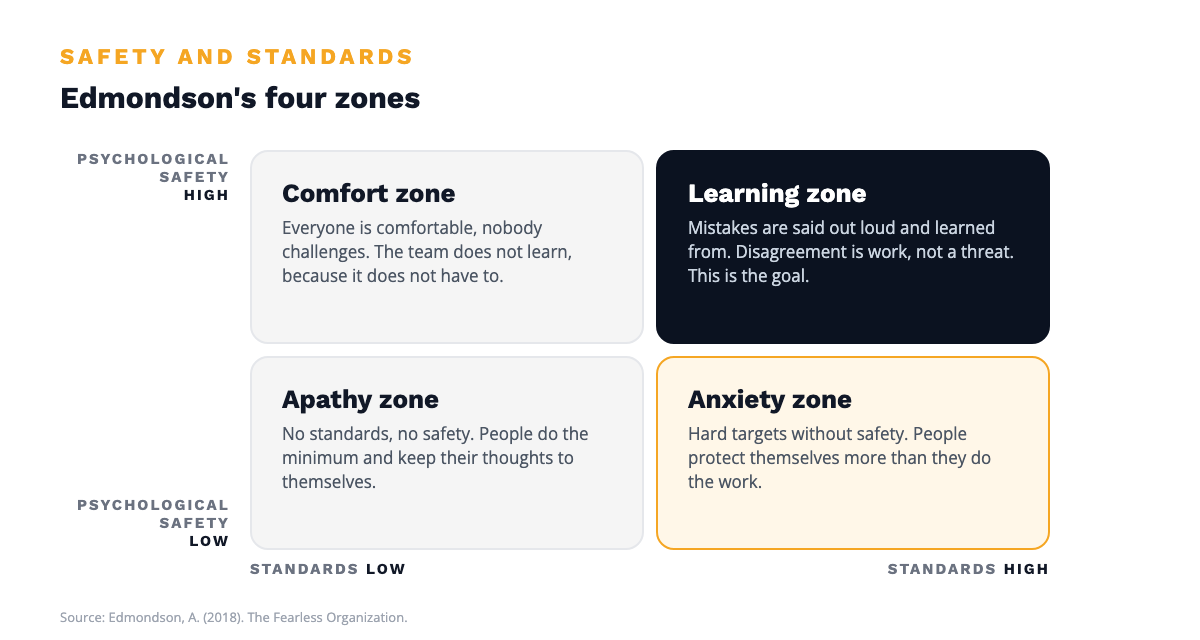
It is not low standards. Edmondson describes four zones: high safety and high standards produce a learning team. High safety without standards produces a comfort zone. Standards without safety produce anxiety, and you recognise it when people protect themselves more than they do the work.
It is not something the manager builds alone. The manager's reactions weigh the most, but psychological safety is created by everyone's reactions. A team member who rolls their eyes at a colleague's question does the same damage as a manager would.
How to recognise a lack of psychological safety
The lack does not show as shouting. It shows as silence. Six signs that repeat in teams where safety is low:
- Few questions are asked in meetings, and the ones that are asked are confirmations, not challenges.
- Mistakes come to light afterwards, often through a customer or another team, not from the person who made them.
- The corridor conversation differs from the meeting. The real conversation happens one to one after the meeting.
- New people go quiet within a couple of months. They arrive with questions and quickly learn not to ask.
- Ideas are presented finished or not at all. Nobody dares to show a half-formed thought.
- The manager hears about problems last. When this happens repeatedly, the cause is rarely the flow of information.
If you recognise three of these, there is probably knowledge in your team that is not reaching the table.
The psychological safety scale: Edmondson's seven statements
Psychological safety is most commonly measured with the seven-statement survey Edmondson published in 1999. Each team member rates the statements on a scale of 1 to 7, and the team's average shows the level. The statements:
- If you make a mistake on this team, it is often held against you. (reverse-scored)
- Members of this team are able to bring up problems and tough issues.
- People on this team sometimes reject others for being different. (reverse-scored)
- It is safe to take a risk on this team.
- It is difficult to ask other members of this team for help. (reverse-scored)
- No one on this team would deliberately act in a way that undermines my efforts.
- Working with members of this team, my unique skills and talents are valued and utilized.
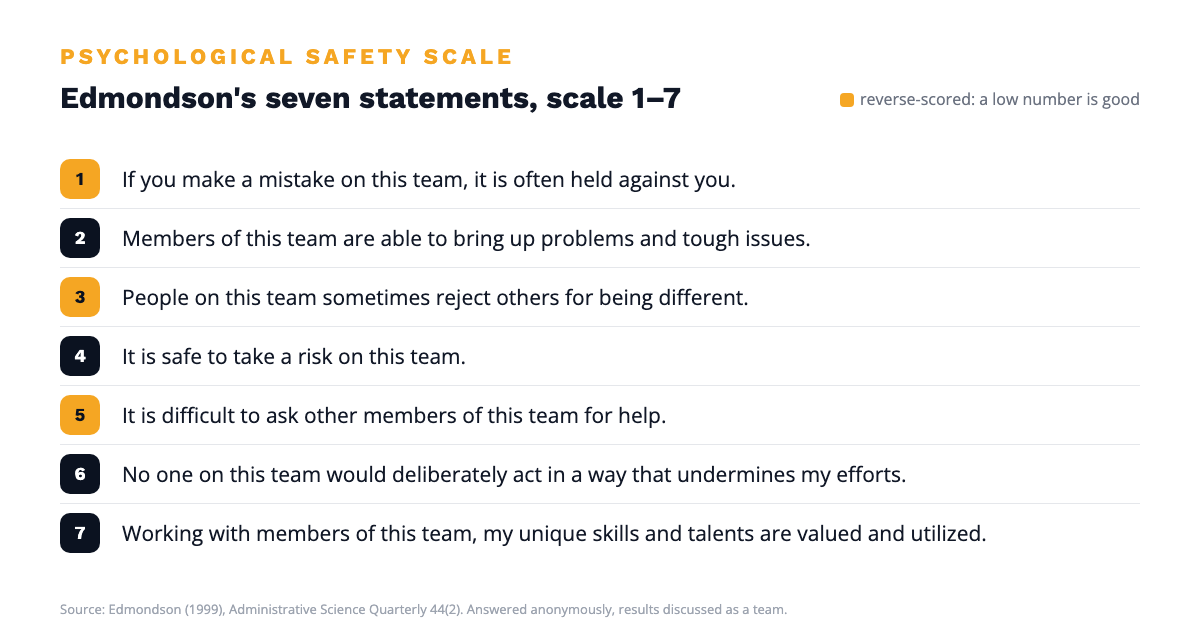
Two things are worth remembering about the scale. First, the number is a starting point, not a result. A team with an average of 4.2 gains nothing from that figure until it discusses why statement 5 got a two. Second, the survey itself is a risk: if the team is not safe, the answers are polished. That is why measuring is best done anonymously and the results debriefed in conversation, not in a manager's monologue. The same applies to employee surveys in general: numbers turn into actions only in conversation.
How to build psychological safety
Edmondson divides the work into three tasks: framing the work as learning, inviting participation and responding productively. All three start with the same person. The team reads the level of safety from the manager's reactions, and what the manager does weighs more than what they ask of others. In practice, building it comes down to five things a manager can start in the next meeting.
Lead by example: say out loud that you do not know. Safety begins when the most influential person in the team takes the risk first. A manager who admits uncertainty, tells about their own mistake or asks the question they fear is stupid gives everyone else permission to do the same. "I am not sure this works, which is why I want to hear what you see" opens the door in a different way than "any questions". The team does not believe talk about openness. It believes what it sees the manager do.
Ask, and do not wait for answers to appear. Inviting participation means named questions to named people: "What worries you most about this?" A general "comments?" produces silence, because answering it is a risk nobody is obliged to take.
React to a mistake by thanking first. When someone reports a mistake or bad news, the first reaction decides whether they report the next one. "Good that you said it" before anything else. Analysis and correction come after.
Build the conversation so that everyone speaks. Psychological safety is not created by asking the quiet ones to speak up. It is created by a structure where everyone writes first and speaks in turn, and nobody comments until everyone has been heard. When the structure distributes the turns, taking a risk does not depend on an individual's courage. More on this in our facilitation guide.
Work on it regularly, not once. Psychological safety drops every time someone feels passed over, and rises every time a risk is rewarded. A monthly retrospective is a natural place to ask what has not been talked about.
If there is no safety yet: start with small steps
In a team that has gone quiet, a big opening backfires. A survey on psychological safety or a development day on "let's talk openly" is a risk the team members are not ready for, and the answers get polished. Safety is then built the same way it was lost: one reaction at a time, over weeks and months.
- Start with yourself, not the team. The first weeks are only about the manager's own behaviour: share one mistake of your own each week, ask one genuinely open question in each meeting and thank people for every piece of bad news before reacting to it. Do not ask anything of the team yet.
- Choose low-risk topics. The first conversations are best held about things where disagreement costs nobody anything: meeting practices, tools, the rhythm of the week. When the team sees that disagreeing about these is safe, it tries something bigger next.
- Reward the first risk visibly. At some point someone asks that question or pushes back. That moment decides the next months. Thank them out loud and do something about what was said, even a small thing, so that everyone sees it.
- Be consistent when it is hard. Safety is measured on a bad day. One irritated reaction in a hurry wipes out a month of good work, because the team remembers the exception, not the rule.
- Bring structure before the topic. Once the team is used to everyone writing first and speaking in turn on everyday matters, the same structure carries when the topic is sensitive. Only at this point are the scale and a conversation about psychological safety itself possible for the team.
Expect this to take months, not weeks. It is still the fastest route, because there is no shortcut.
Cards as a tool: the Psychological Safety deck
A conversation about psychological safety is sensitive for a team, because the topic is the very thing that is hard to talk about. That is why it helps to have a structure that does not depend on the facilitator's memory.
The Topaasia Psychological Safety deck was created in content collaboration with Hanno Nevanlinna and Janetta Ekholm of Futurice. The deck has 52 cards in four themes, and each card is one statement about the team's ways of working, feedback culture, transparency or how it creates atmosphere. Everyone picks from their hand the cards that best describe the team, presents them in turn, and the team finally chooses one to act on. A game takes an hour and works as a physical deck or digitally for remote teams.
The cards do two things that an unstructured conversation does not: they give words to things that are hard to say in your own words, and they distribute the turns so that the quietest team member speaks as much as the loudest. How Topaasia is used for team development more broadly is described on the team development page.
Frequently asked questions about psychological safety
What does psychological safety mean?
A team's shared belief that it is safe to ask, admit a mistake, present a half-formed idea and disagree without humiliation or punishment. The concept is Amy Edmondson's, from 1999.
Who is responsible for psychological safety?
The manager's reactions weigh the most, but safety is created by everyone's reactions. Every team member affects it by how they react to a colleague's question or mistake.
How is psychological safety measured?
Most commonly with Edmondson's seven-statement survey on a scale of 1 to 7, anonymously. The result is the starting point for a conversation, not the end result.
How does psychological safety differ from trust?
Trust is between two people and concerns what I expect from the other. Psychological safety is a property of the group and concerns how the group reacts when I take a risk.
Can there be too much psychological safety?
Not if standards stay high. The problem arises when safety combines with low standards: then the team is comfortable but does not learn. According to Edmondson, the goal is both at once.
How do I start if it is not safe to speak in my team?
Start with your own example and small steps: share your own mistakes, ask open questions and thank people for bad news before asking anything of the team. Then bring structure into everyday conversations: write first, a round without comments, one choice. When the structure distributes the turns, nobody has to be brave alone.
Safety is built one reaction at a time
Psychological safety is the sum of what happened the last time someone asked a stupid question, admitted a mistake or disagreed. Every meeting either adds to it or takes from it, and the manager's own reaction weighs the most.
If you want to start with your team today, the Psychological Safety deck gives the conversation ready-made words and a structure, as a physical deck or digitally on a free trial. If the topic concerns the whole organisation, book a demo and we will walk through how the conversations reach every team. More than 35,000 people have taken part in Topaasia sessions and rated them 4.2 out of 5.