
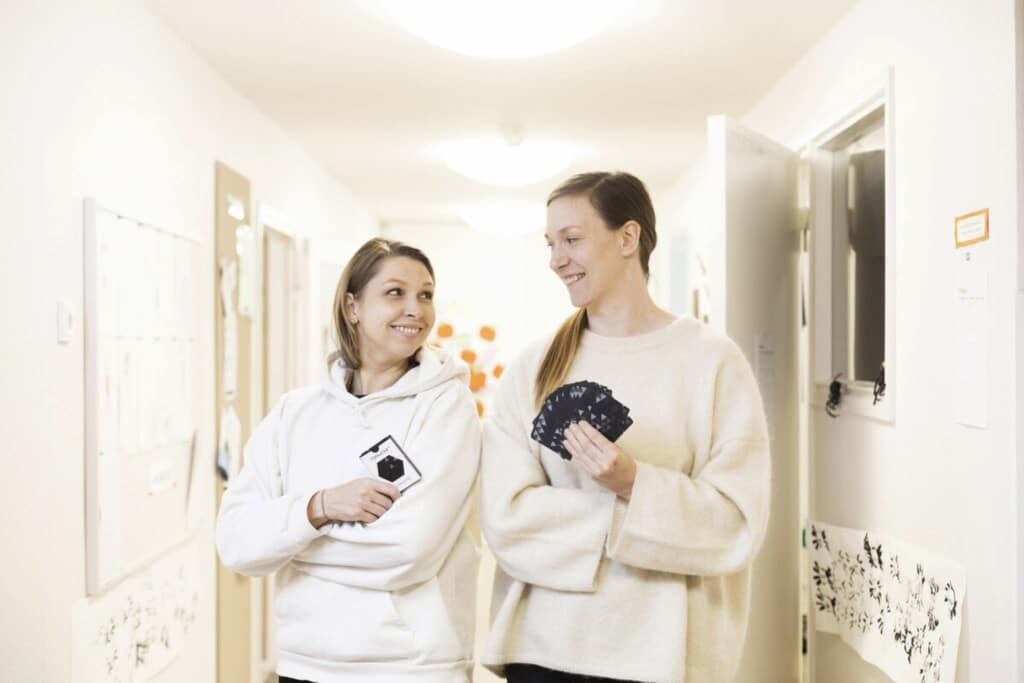
Good workplace community skills promote smooth work and employee wellbeing. They can also be a recruitment asset. The staff of Maunula daycare centre practise workplace community skills by playing a game.
How a work community is developed in everyday work, how to spot the need and which areas to look at is collected on one page: Workplace development: how to do it in everyday work, not on a development day.
Doctoral researcher Kata-Riikka Kumpulainen (left) and daycare centre director Sonja Kivilehto played a round of the workplace community game together. Photo: Laura Oja
Workplace community skills are needed in every work community, but they are needed especially in a daycare centre. This is how Sonja Kivilehto, director of the Maunula daycare centre, sees it.
"We work all day in interaction with children and adults, and situations change constantly. It is really important that our interaction and team skills are in good shape, so that we can handle different situations smoothly."
The course of a day in early childhood education cannot be predicted in advance. The team has to find and invent the best possible ways to handle each day and situation.
"When work flows well together, the team does not rush or panic even in a tight spot, because things get sorted out by working them through together."
Kivilehto has noticed that at their best, colleagues have communicated in a surprising situation with small gestures, without saying a word.
Time for shared conversation
Workplace community skills have been close to Kivilehto's heart throughout her career, in fact ever since her student days. In her current role as a supervisor, she keeps up a shared conversation about team skills. That is why she was eager to get involved when the opportunity arose to improve team and communication skills even further with a game designed for that purpose.
During the autumn, the daycare centre's teams have brought the game into their weekly meeting once a month. On those occasions, the team gatherings run about half an hour longer than usual. Kivilehto points out that it is the supervisor's job to make sure there is enough meeting time.
"You often hear people say there is no time left for shared conversation. But a game session at the start of the team meeting guides people to talk and brings all members along."
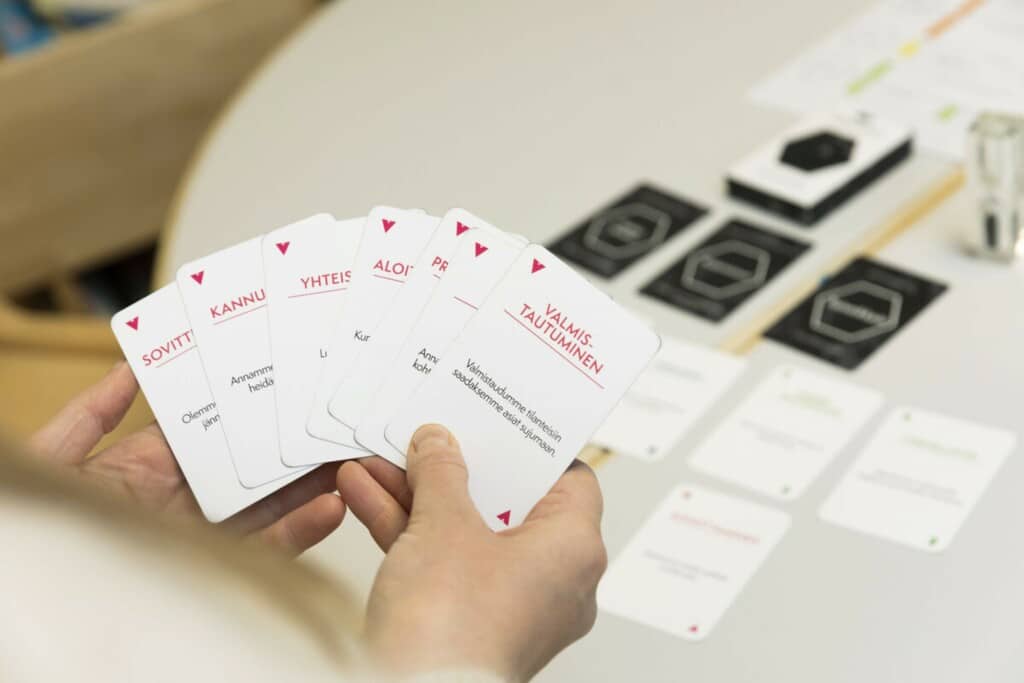
The workplace community game can be played with physical playing cards or as a digital version. Photo: Laura Oja
Every voice heard
In Maunula, the team members play a game called Topaasia, which can be played digitally or with physical playing cards. Most of the staff chose the playing cards, while some found the digital version handier.
A few game sessions are now behind them. So far they have noticed, for example, that many people have been able to bring out their own viewpoints better than before. Kivilehto is especially pleased that those who are shyer about sharing their thoughts have become more active.
The staff feel that equality and parity have increased when everyone gets to say their opinions out loud. Good, concrete matters about how the daycare centre's everyday life works have come up, and they have been able to address them from many angles. The team members have grown closer.
Even the choice of a particular card prompts a conversation about why exactly this card. It is good to pause on things that seem small, too.
Especially during the first few sessions, getting into the game takes its time. A shared point for reflection is how to arrange the time the game requires.
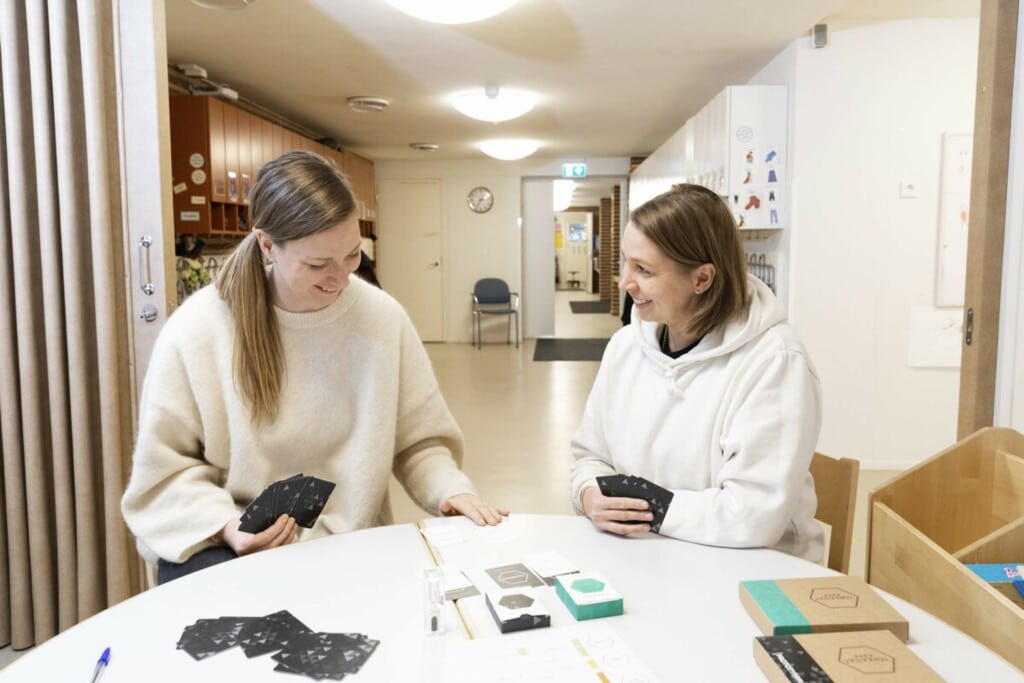
Kata-Riikka Kumpulainen (right) is writing a doctoral thesis on developing the teamwork and wellbeing of early childhood education professionals and supervisors. Photo: Laura Oja
Staff wellbeing delivers the best possible early childhood education
Kata-Riikka Kumpulainen is writing a doctoral thesis on developing the teamwork and wellbeing of early childhood education professionals and supervisors. The Topaasia game method and the systems intelligence game serve as tools in Kumpulainen's research. She examines whether reflective dialogue strengthens people's ability to perceive their own and each other's actions in the work community.
"The value system of early childhood education is tipping in the wrong direction," Kumpulainen reflects.
"The child's interest is emphasised at the expense of staff wellbeing, even though it is precisely staff wellbeing that guarantees the best possible early childhood education."
Daycare centres' everyday life suffers from constant hurry. If the staff could plan their own work and the team's shared work, the hurry would ease and wellbeing at work would grow. The treadmill should be brought to a stop.
"Half an hour of playing once a month tunes the team straight into the team meeting and makes it more effective."
The game helps people talk about work in a different way
So far Kumpulainen has heard praise from Topaasia players, from beyond Maunula as well, for the way the game helps people talk about work differently. In addition, it makes it easier to perceive how the whole work community operates.
Playing together has been experienced as a significant support for everyday wellbeing.
Kumpulainen points out that no one can solve big structural problems on their own. In everyday life, however, learning to set boundaries for one's own work is a big help.
"A virtuous cycle emerges when we understand how significant the seemingly small things are."
Workplace community skills as a recruitment asset
In Kivilehto's view, a team's good workplace community skills are a recruitment asset.
When applying for jobs, people often want to see what the team and the atmosphere at work are like. Kivilehto makes a habit of walking applicants through the teams so that they can see the atmosphere in the daycare centre and how good a work community they have.
"When people are asked what matters most for coping at work, almost everyone puts a well-functioning team at the top."
Text: Kirsi Riipinen
Photos: Laura Oja
The article was originally published on the hel.fi website on 9 January 2023. Source:
https://www.hel.fi/fi/uutiset/paivakodin-tyoyhteisotaidot-kehittyvat-pelia-pelaamalla
The Topaasia workplace community game
- The game has more than 40 different themes.
- The themes chosen for the Maunula daycare centre's game were psychological safety and systems intelligence.
- Psychological safety means a fearless atmosphere in which it is safe to take social risks, for example to present one's own ideas.
- Systems intelligence, developed by philosopher, professor emeritus Esa Saarinen and professor emeritus Raimo Hämäläinen, combines human sensitivity with world-changing engineering thinking.