
Winning Team is a conversation game for sports teams, clubs and coaches who want to develop their team's ways of working through constructive conversation, slamming playing cards on the table. The game was created in content collaboration with Kati Kuoksa, an expert in interactive communication and a passionate ball games player.
Learn more about the Winning Team game or buy the game from the shop: physical, digital, or a package including a keynote by Kati Kuoksa.
The Winning Team game was born from a combination of business development and sport
Kati and Topaasia have previously collaborated on the Participatory Strategy game, designed for business development. Following the positive experiences, Kati suggested that a similar way of discussing and working through issues might also work in team sports. Kati tells us about the game's background:
"I have a 35-year background in football myself, and my family includes many volleyball players. Once I was listening to a lecture by volleyball coach Olli Kuoksa and noticed that in business and in leading a sports team, many things are shared when you want to build a winning team. That gave rise to the idea of creating the game for sports teams too, from the perspective of leading a sports team."
When building the Winning Team deck, Kati drew on her business leadership expertise, her experience of team sports, artificial intelligence and Olli's coaching materials.
What kinds of topics does the Winning Team game cover?
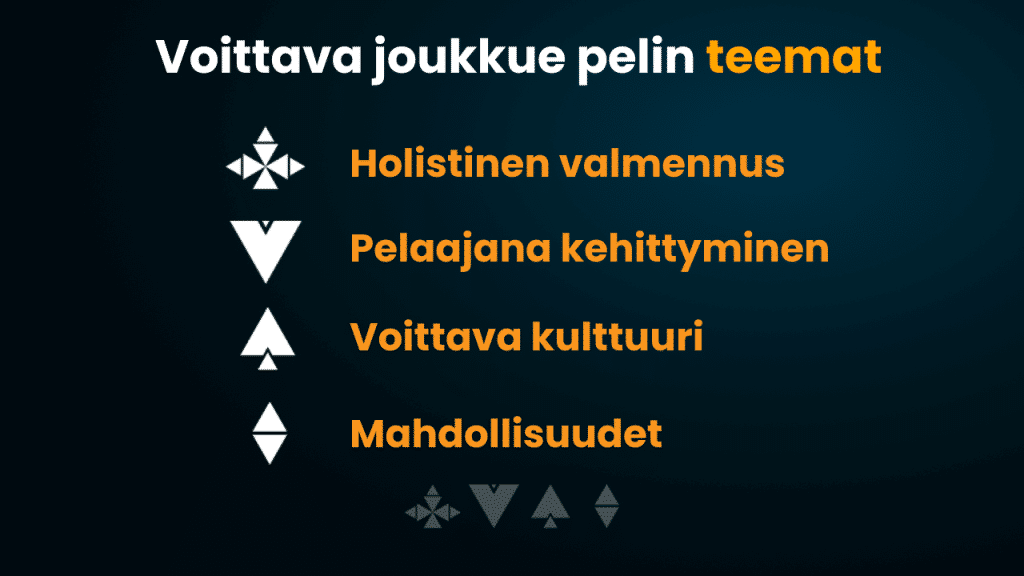
The Winning Team game covers the themes of excellent sports team activity. The game's themes are holistic coaching, developing as a player, winning culture and opportunities.
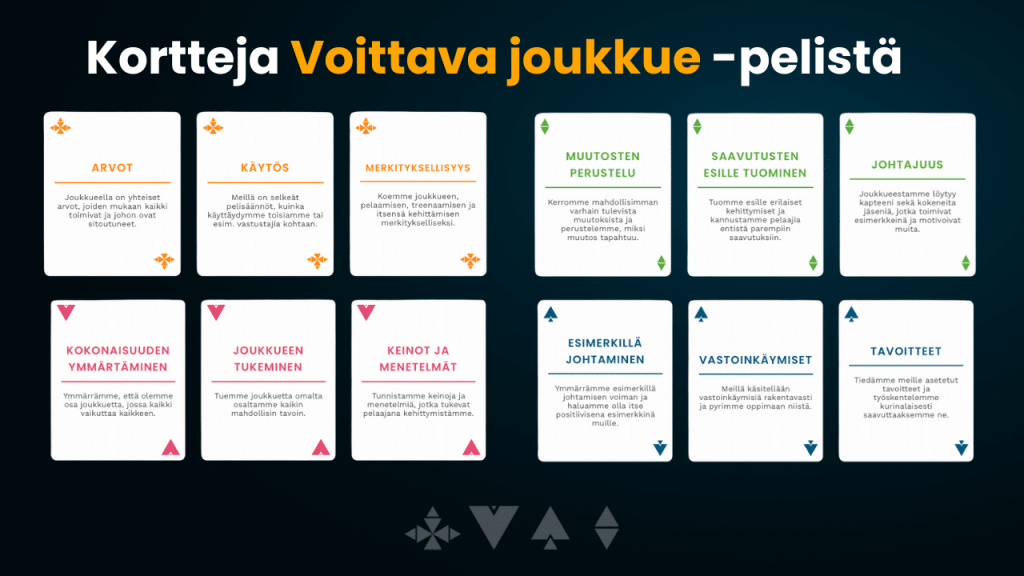
Kati explains that a winning team needs certain core things to be in order, relating for example to coaching, the interaction between the team's players, or a team player's understanding of leading their own motivation. Understanding is also needed of the player's own role in the team's bonding.
"Certain shared core topics speak to an athlete regardless of whether we are talking about a gymnast or a ball games player: Do we have the physical factors in order? The psychological factors? Do we have a culture of conversation? Do we have psychological safety? Do we appreciate each other? Do we appreciate the opponent? What are our team's values? What are our team's ground rules? They are unique to each team, but every team needs these things", Kati says.
The Winning Team game is meant for all sports teams
The Winning Team game is meant for sports teams regardless of sport or league level. Kati believes the game works at junior and recreational level as well as in professional teams:
"The game can be used anywhere there is an ambition to be a winning team, and where the coaching staff have a genuine desire to develop the activity and to develop together with their team", Kati says.
Example situations for using the Winning Team game:
- The team is new and getting to know each other is still in progress: the coach does not know the team, the team does not know the coach, or the players do not know each other.
"If the players raise, say, the team's internal communication as the Topaasia, that is, the most important thing of all, we start thinking together about where we have challenges and where we are currently succeeding well. We think together about what actions would let us improve this communication together, and what it means in our team. What kinds of things do we want to commit to? Who is responsible and on what schedule? The game generates conversation about what kind of feedback each person wants to receive and how, or what kind of feedback we ourselves give. These are really important things to discuss within the team. With Topaasia, the game gets down to the level of concrete action", Kati explains by way of example.
- As a systematic development tool throughout the season
- Forming the team's shared understanding: what does a winning team mean in our case?
- Supporting team bonding
"What is our goal? What makes us, as a team, capable of achieving that goal? What do we need as a team? What do we need as individuals?", Kati offers as examples, and continues that the playing cards also stir thoughts of self-knowledge in athletes:
"To understand others in the team or the coaching staff, you must have an understanding of yourself. What things motivate you? How can you be given feedback on the pitch or off it? What brings out the best version of you in a game or in training? What kind of support do you need in order to succeed?
When you understand yourself, it is easier to understand your teammates. What is their motivation? What kind of feedback can you give them so that everyone feels good in the team? How can you encourage your teammates to better performances? Shared understanding becomes the glue of the team, which also makes possible setbacks easier to face", Kati sums up.
What benefits does the Winning Team game aim for?
1. A winning team has a shared understanding
By playing the Winning Team game, the aim is for all members of the team, the coaching staff, the players and other stakeholders, to have a shared understanding of what we want to be and by what means we will achieve this goal."We want to be a winning team in our own sport, in our own league. We have shared goals. We have shared ground rules. We all commit to them. When we talk, we learn to understand each other. ", Kati summarises, and adds from the coaching staff's perspective:
"It is easier to coach when every player has been able to put into words what motivates them, what kind of feedback each one wants and how the coach can support the player's development".
2. A winning team understands difficulties and resilience
Kati explains that working through even difficult topics with the game builds the team's resilience:"What if we have lost five matches in a row? Then team spirit easily disappears and people start looking for someone to blame. But this is actually the core of everything! How do we build a foundation for our team that lets us withstand that streak of five losses? That is when it would be good to have tools for how we process losses".
"It would be good if everyone recognised their own ways of getting frustrated. The main point is that we do not curl up into ourselves and turn angry. Instead, we should have psychological safety, interaction and team glue that keeps us together even in bad moments. That is when it is really weighed how much of a winning team we are. When everything goes super well and we win every match, then we are all winning teams. But when we face challenges, we should mentally be those winning teams even then". Kati sums up.
Experiences of playing the Winning Team game
Experience: Men's volleyball championship league team Hurrikaani Loimaa
"After the game the feeling was good. We got a great amount of conversation going between the team members. We thought about things in a completely different way from what we are used to on the court. Sometimes in training things easily become black and white, and now it feels like we thought about things from a completely different angle than usual. Playing was found easy to use.Read more about Hurrikaani Loimaa's experiences and watch the videoPlaying in small groups lowered the threshold for sharing opinions honestly, as we got support from a teammate. Often things are just stated without producing anything concrete in everyday life. In the game we reached the conclusion of picking three everyday things that we start doing today with a low threshold. Things that everyone can support in our everyday life."
-Player
Experience: Youth gymnastics team
The players were 17-18 year old team gymnasts, and we used this game session as part of the end-of-season debrief discussion. The cards led to very good conversations, and even the athletes who in everyday life can be a little at odds with each other were clearly on the same side in these conversations and supported each other's comments; I was quite astonished by this.
At the end of the game I asked whether they found this tool useful and what thoughts using the game in the discussion raised. They felt that with the game it was somewhat easier than usual to talk and tune into the topic. In their view, the cards also brought to the shared table things that would otherwise not have come to mind.
I myself felt that for a coach this was an extremely good tool. I have led team discussions a lot over the past 17 years, and in my opinion this was the most successful discussion moment of all.
-Coach
Go ahead and try it - testing is free!
Kati's greetings to sports teams across the country: "I would hope we get a diverse range of teams playing the game. I believe the game suits different sports, different age groups and different league levels well. If we talk about fandom beyond volleyball, it would be really nice if the Oulun Kärpät ice hockey team played this ". Kati sends her greetings to Oulu and sums up:
"I hope the game inspires many kinds of teams from many different sports. Whether it is ball games, gymnastics or synchronised swimming. Women's teams, men's teams, senior or junior teams. May you all be winning teams, mentally and physically!"
Try the Winning Team game free of charge · Read more about the game · Buy the game from the shop