
Kati Kuoksa is a communications professional who studied at a university of applied sciences for a master's degree in business development, with participatory strategy work as her thesis topic. Based on this research, Kati and Topaasia have together created the new Participatory Strategy Work game, which prompts an organisation, through discussion, to realise what measures should be taken regarding the participatory nature of strategy work and which matters deserve particular attention.
Where did the research on participatory strategy work begin?
"I had noticed that business trends talk a lot about participation and about people being involved in developing organisations. For a year and a half I researched, firstly, how the strategy process could be made more participatory and, secondly, sought to demonstrate the benefits for the business and the personnel", Kati sheds light on the beginning of her research.
For her thesis, Kati interviewed eight organisations that have successfully involved their personnel in strategy work, as well as eight strategy professionals who train people in matters related to the strategy process, have written books on strategy, or otherwise work with the subject. In addition, she held an open workshop on the theme of participatory strategy for members of the Strategiasta viestimässä network on LinkedIn.
"I wanted to hear genuine experiences from organisations, about how they have succeeded in it and what they have done. There was a lot of shared good there, excellent examples, but also challenges. It was also good to get the perspective of strategy experts, on how they see participation and where the business should be developed in that respect", Kati says.

Kati Kuoksa
What is participatory strategy work like?
According to Kati, traditional strategy-making is when the management team, top management or a very limited number of the company's personnel have been involved in making the strategy. The weakness of this approach is that the content of the strategy can be bubble-bound and one-sidedly thought out. Often the investments made in strategy are directed at the content of the strategy, but resources are rarely reserved for execution, or thought given to how it should happen. In addition, management may have a differing view from the personnel about what customers want, what the personnel can do, or what all the personnel could do to advance the strategy.
Another traditional problem of strategy work, according to Kati, is that after publication the strategy stays in the management's desk drawer or lies dormant on the intranet, and then three years later people wonder whether our strategy was realised or not, instead of matters related to the strategy being led purposefully and kept alive the whole time.
Kati defines participatory strategy work as meaning that the company puts the potential of the entire personnel and organisation to use.
Involving the personnel has several benefits in connection with strategy work:
- Awareness of the strategy and the big picture increases. The personnel understands their own role as an enabler of the strategy's realisation. The strategy itself becomes better.
- The vision and goal, in other words the direction of the strategy, where we are heading, stays in the minds of the entire personnel.
- The earlier in the process the personnel is involved, the greater the manifold benefits gained.
- People's motivation, commitment and wellbeing at work increase when they get to influence decisions and are brought in to develop the operations and the strategy itself.
- The amount of interaction and plurality of voices in the organisation grows, which increases resilience to change and creates meaningfulness, among other things.
- From a business perspective, people's initiative and involvement in developing the operations shows up as increased competence among the personnel, better results and business development.
We may well ask why we would have only a small percentage of people's competence, intelligence and initiative in use, when we could harness all of it for developing and improving the business for the common good?
-Kati Kuoksa
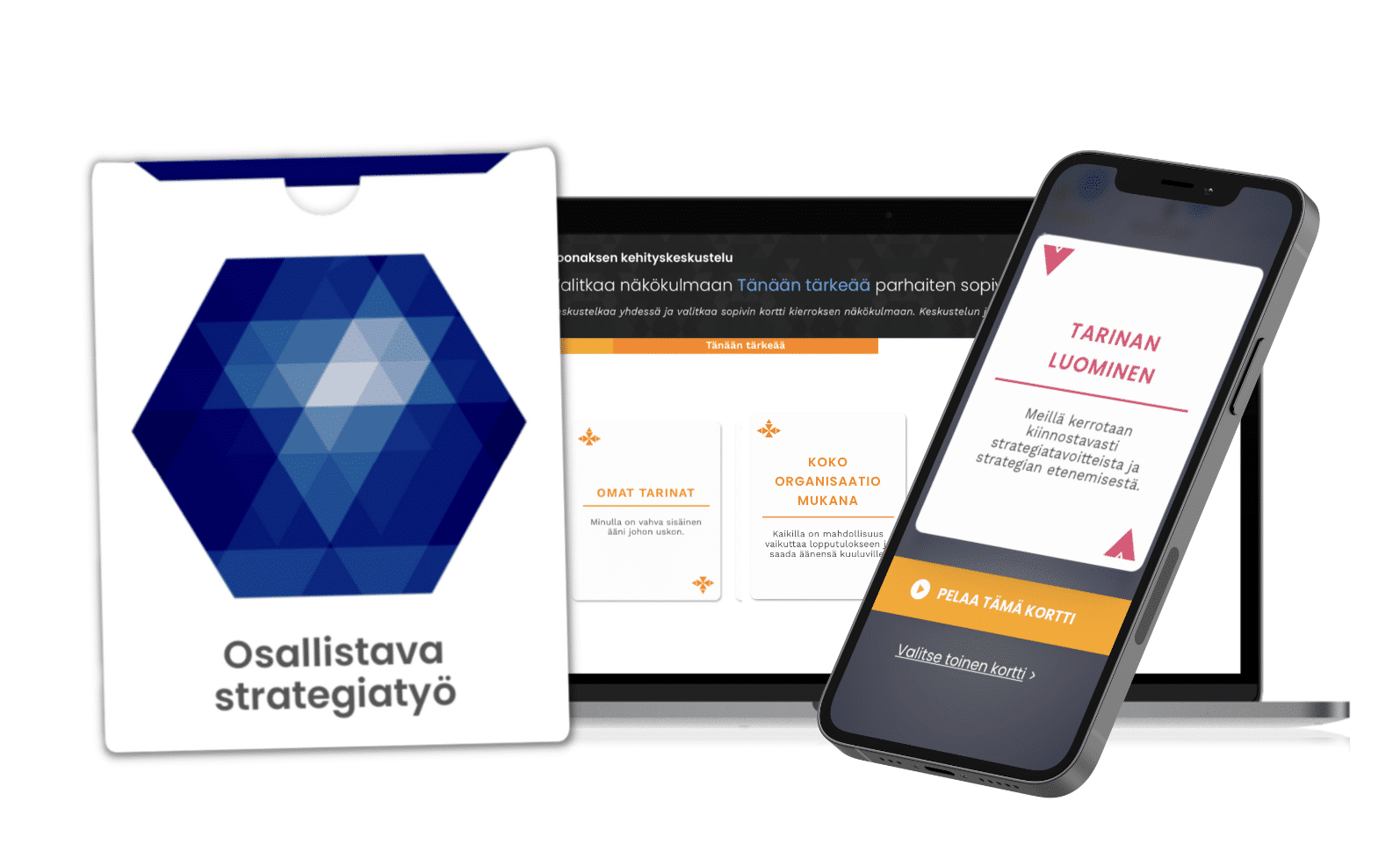
Participatory Strategy Work - a game for working with strategy
The collaboration between Kati and Topaasia began when Kati, while researching the participatory strategy process, came across the collaboration between Granlund and Topaasia.
"One of the sub-topics of my research was gamification, in other words how the strategy process could be made more participatory, more meaningful and more modern in place of the traditional slide drills. I contacted Topaasia and the collaboration started from there", Kati says, and describes the idea behind the deck:
"Maury (2015) found in his research that in an organisation, 13 percent of top management, eight percent of middle management and only two percent of employees can recall the content expressed in the strategy. In many organisations the personnel has not yet been brought into strategy work, and I wondered whether a Participatory Strategy Work deck like this could help the business. It would prompt management, middle management and supervisors to reflect on what participatory strategy work would be and how it could be carried out in their organisation. With this game deck you can test which things are recognised as already being in order, or which matter should get attention, like hey, we haven't even thought about this yet and this is what we should now start working on with the personnel."
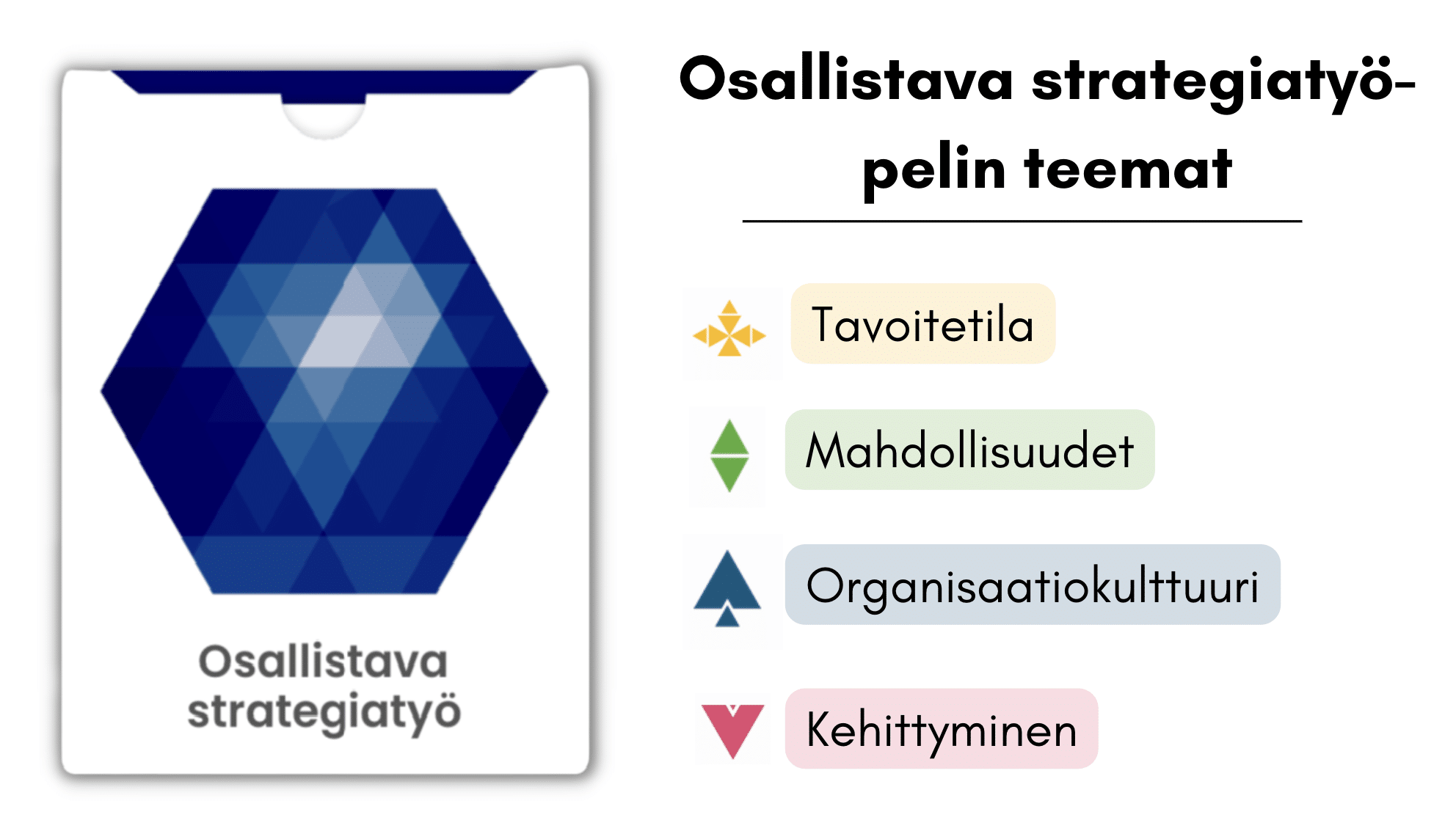
The four themes of the Participatory Strategy Work game
The Participatory Strategy Work deck consists of four themes: Target State, Opportunities, Development and Organisational Culture. Kati sums up the deck as a whole as follows:
"In participatory strategy work the target state is important because the strategy must have a clear goal. The cards related to it awaken those questions of how the goal can be achieved. Then there is Opportunities, where we reflect on all the areas where we can succeed and do the various things through which we achieve the desired outcome. Third is Development, in other words everything that develops when we involve the personnel in strategy work. Last is organisational culture, in other words for the strategy to succeed, the organisational culture must support it".
Our goal, after all, is that through participation the strategy lives in the everyday and is realised, the work culture supports the strategy, and the personnel is motivated and committed.
-Kati Kuoksa
Target State
The target state means that the strategy must have some goal:
"Companies often have a vision, a mission and a purpose and all sorts of things that express what the company wants to be. The Target State section of the deck prompts reflection on how to get people thinking about how and by what means the goals will be achieved, and what is needed to reach the goals. The prerequisites for this are often increasing the discussion culture, resources and awareness", Kati says.
Opportunities
Opportunities are the things that enable the target states to be realised. Kati explains what opportunities often mean:
"Opportunities include, among other things, a listening management that dares and wants to hear the personnel, and wants to know what customers are talking about and what they need. We need clear wording for the strategy so that people understand what it is about and what their own contribution could mean in relation to the strategy process. The strategy must be made visible." Kati explains that, for example, the organisation's values are an opportunity: the more people act in accordance with the values, the more likely the work culture is of the desired kind and supportive of the strategy.
Development
If the strategy is, as it were, slapped in front of the personnel, saying this is now our strategy, it can be hard for them to get a grip on what the big picture is, where we are going, or what the strategy aims for. Instead, a jointly built strategy can be like a story that tells what kind of organisation we are, what kinds of things we are pursuing, what is important to us and what our values are.
Development is also needed in genuinely wanting to develop and to grow, together. When the personnel is brought into the strategy process, it increases, among other things, initiatives that develop the business. Inclusion also develops the competence and understanding of the individual and of the management. As interaction develops, ever more people's opinions can be taken into account. The personnel can be harnessed to develop, for example, values, to examine the effect of megatrends on the business, or to gather feedback from customers in order to develop the operations.
Organisational Culture
For strategy work to succeed, the everyday ways of working and the structures, in other words the organisational culture, must support it. Kati explains the significance of organisational culture through the Shared Ground Rules card:
"When we think about working together from the point of view of creating a good and humane work culture, it matters that we have agreed, for example, to greet each other in the mornings. This is not self-evident, because there are many workplaces where people do not greet each other. Or that we consciously decide to make the good work done by others visible. A ground rule does not always have to mean something restrictive; it can also be a ground rule related to wellbeing at work or working together. It is important to think consciously about what kind of culture we want to create, because some kind of culture forms everywhere, whether it is led or not."
In Kati's research, the term "jargon" came up strongly in relation to the personnel's attitude towards strategy:
"People's hackles go up when overblown strategy words start being used. For some, the word strategy alone triggers the thought that this matter does not belong to me, but to management. Not to mention purposes, visions, missions and other words that easily cause a jargon allergy. In a work community it is worth speaking in the language and terms that are used in that work culture anyway. When the story is worded in your own words, through your own people, it is easier to understand and absorb", Kati says.
What is the most important card in the deck?
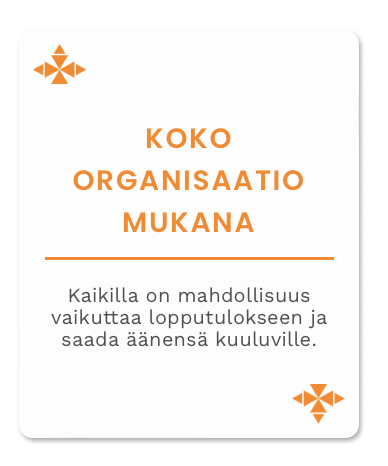
In Kati's view, the card "The whole organisation involved" crystallises the ideology of the Participatory Strategy game deck and of participatory strategy work:
"Management's intent must be that we have the whole organisation involved and that everyone has the opportunity to influence the outcome of the strategy process and make their voice heard during the strategy process. That is the starting point of everything, and if the idea is that wisdom resides only in the management team, then we are heading down the wrong track with this whole thing. Every member of the organisation can have wonderful ideas for developing the business, and it would be a shame to leave them untapped!"
What greetings would you like to give to the players of the deck?
"I congratulate you on choosing this deck to play, because then you have already understood the big thing, that strategy work should be participatory, and you want tips on everything that should then be taken into account. Then when you start playing the deck, you can pick up various new ideas, you can identify which things are already going well for you and where there is room for improvement. By playing the Participatory Strategy Work game deck, you have the opportunity to develop and to start making your organisation and your business ever better, together", Kati concludes.
Thank you Kati!
Two ways to try the Participatory Strategy Work game:
1. Try the Participatory Strategy Work game for free with the digital Topaasia 30-day trial period
2. Buy the physical Participatory Strategy Work game from the online shop