Who are you?
I am Sebastian Kotonen and I work as Quality Manager at Step Education. Previously I worked as Education Manager and was part of the working group where we created our institution's pedagogical strategy. That is how I got to know Topaasia.
In what situation did Topaasia emerge as an option?
We were creating a pedagogical strategy called Pedainno for the years 2020 - 2024, which provides guidelines for pedagogical activity across the whole institution, and it was made in collaboration with the entire organisation and the students. When it was completed, we started to consider by what means the strategy could be rooted in practice and which tool would be of most help? One member of the working group already knew Topaasia, having taken part in a game session in another organisation, and she suggested that Topaasia could be a good facilitation tool for our staff and students too.
What need does Topaasia answer?
We ended up with Topaasia because it offered a new angle, yet with a method that was familiar in itself. The tool was new to us. Many people associate Topaasia with Kahoot, which has been experienced as easy and inspiring. We felt that it is easy and inspiring, and easy to take into use, as indeed it was. Topaasia is simple and does not require deeper methodological expertise; with it you can easily start facilitating and the conversation process progresses well.
What kinds of user experiences have there been, and how did you start working on the whole?
We had a working group of 5-6 people who got to know Topaasia. Then it was demoed to the institution's management, and once we had signed the contract, we started presenting it to the staff teams and every team leader.
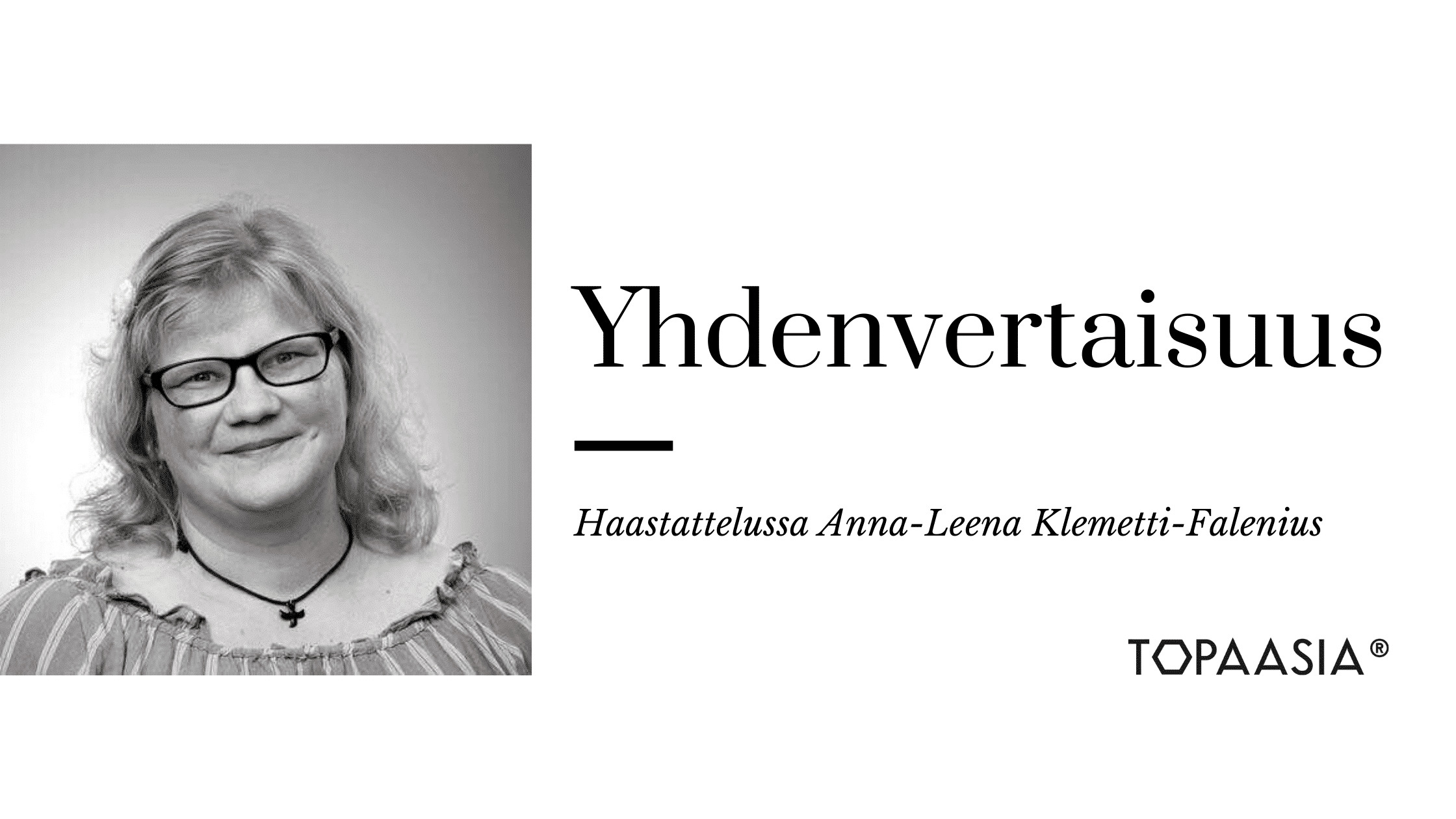
Alongside the strategy implementation, we have also run individual games based on staff wishes. Some got really excited, and for example Anna-Leena went on to create the Equality deck with you. As with everything, some adopted the tool a little more cautiously, but the general view is that Topaasia has helped us open up the conversation and take it forward systematically.How has the playing process progressed?
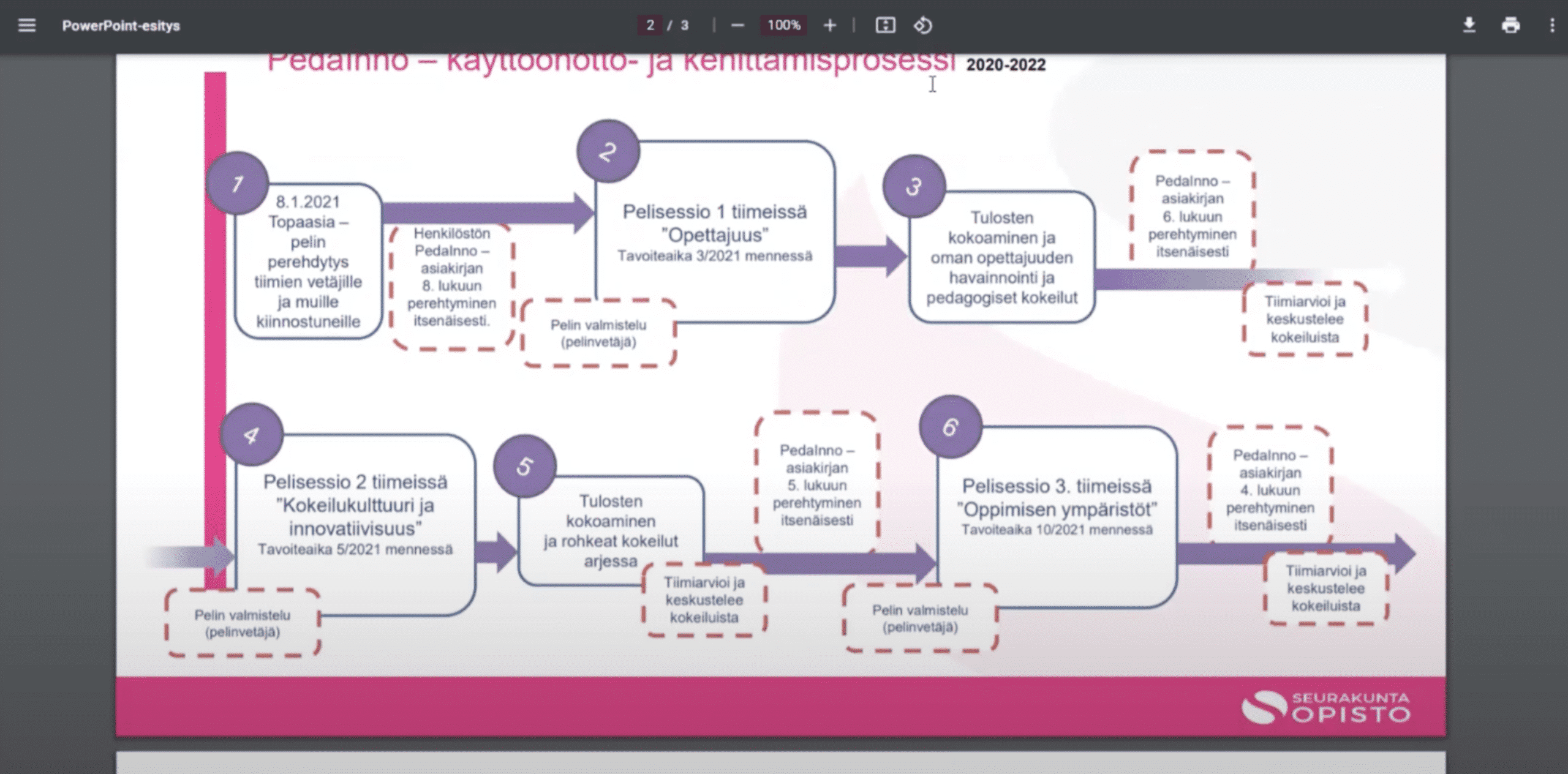
We have flexible target times, and we proceed according to their schedule. We have divided the games into four game sessions according to the PedaInno themes. We started with an introduction, then assigned independent familiarisation, which was followed by a game session on the topic of "Teacherhood". After that, the results of the game sessions were compiled and pedagogical experiments were carried out in relation to the goals of PedaInno.
The journey continues and a new chapter of PedaInno is coming. In it, experiences were discussed and then a new game session was played. It is a two-year process of this kind, where we discuss, experiment and learn.
We made this as a guideline for the teams. We have many teams in several locations, and for them there is a path and an approximate schedule. This is a continuously advancing process, and pedagogical reflection never really ends, but we wanted to outline in this way a time frame and a development path along which to proceed with the teams.
What do you think is the greatest value Topaasia brings to the table?
This has been a tool around which it has been easy to structure the whole.
As an alternative we could have said "Read chapter 6 of PedaInno and discuss it", but I believe Topaasia has brought an extra dimension to the conversation that would not have come from a mere PowerPoint with its discussion instructions and questions. Topaasia has led us to perspectives that would not necessarily have emerged otherwise.
What challenges and aha moments have there been so far?
Whenever you are dealing with a technical tool, there are always some things involved, especially remotely like this: connections can stutter, someone may forget they are on mute, someone may drop off the line. It does require a little getting used to before things start to run smoothly. A good thing about Topaasia is that you can always get back into the game, and the game continues from the same point if you drop off the line.
So for the first few game sessions it is worth setting aside a little time so that everyone can log into the game in peace.
The other thing is the role of the game leader, that is, the facilitator, who must remember to explain the perspective from which the cards and their themes are being examined. Clear wording such as "our topic now is Teacherhood and we are looking for a factor that promotes it in relation to our PedaInno teacherhood goals". Sometimes the facilitator's wording was not the best possible, but we still always got to a good conversation, even if someone had chosen a card from the so-called "wrong perspective". It always leads to some good point or discussion anyway, because in the big picture we are still on the same topic. By now I have surely developed myself as a game leader and can explain the topic better to the players.
Would you recommend it?
Yes, I recommend it, and especially if you want a lightweight system.
I feel that Topaasia is lightweight, and taking it into use has not been a heavy effort. On the contrary, we got it into use and to good effect quite easily.
I cannot say what it could not be used for. It bends to quite a lot. Whether the topic is reflecting on something new, development ideas, facilitating conversations, or if you want a new way of working for network collaboration or a working group, Topaasia works as an icebreaker for the conversation.
I dare say that with Topaasia's help our goal has been achieved.
Thank you Sebastian and Step Education!
Read more: Step Education Sebastian Kotonen - LinkedIn
Download the new free Strategy Engagement Guide