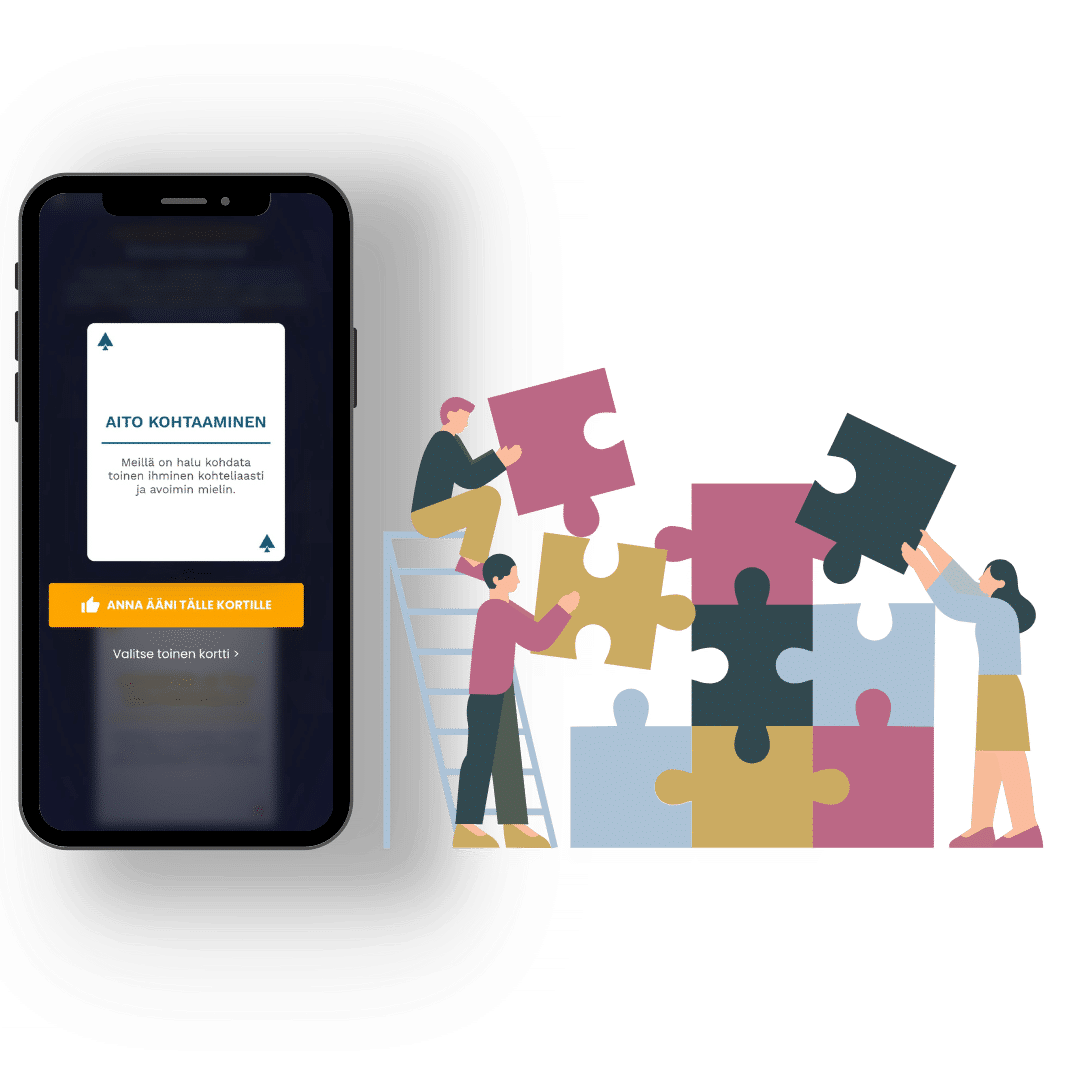
Diversity is the newest addition to the Topaasia game family. The game helps work communities discuss diversity themes at a concrete level. The game was made in content collaboration with Technology Industries of Finland and the University of Eastern Finland. The interviews for this text featured Jenni Pitkänen, Leading Specialist in working life development at Technology Industries of Finland, and from the University of Eastern Finland Ulla Hurskainen, Director of Human Resources and Wellbeing, Senni Pykäläinen, Planning Officer at the Centre for Continuous Learning, and Anne Kauppinen, HR Specialist.
The diverse nature of diversity
Diversity is a multifaceted theme that stirs up many kinds of feelings. Anne Kauppinen stresses that diversity is a term that is hard to define specifically:
"We talk about all kinds of diversity. We talk about human diversity, that is, what backgrounds people come from. We talk about functional limitations or the absence of them, religious or spiritual backgrounds, gender diversity, the diversity of sexual identities, ideological diversity. This field is not easy to delimit; where it ends and where it begins."
Anne also emphasises that diversity means everyone having the space to be who they are, so that people would not need to spend energy hiding certain characteristics of theirs or fear bringing them up. Ulla Hurskainen continues on diversity and inclusion:
"In our community we have different people who come from different backgrounds, think in different ways and do different work. Really, we are talking about how we can promote everyone's participation and their giving of their full contribution for the good of the organisation and the community."
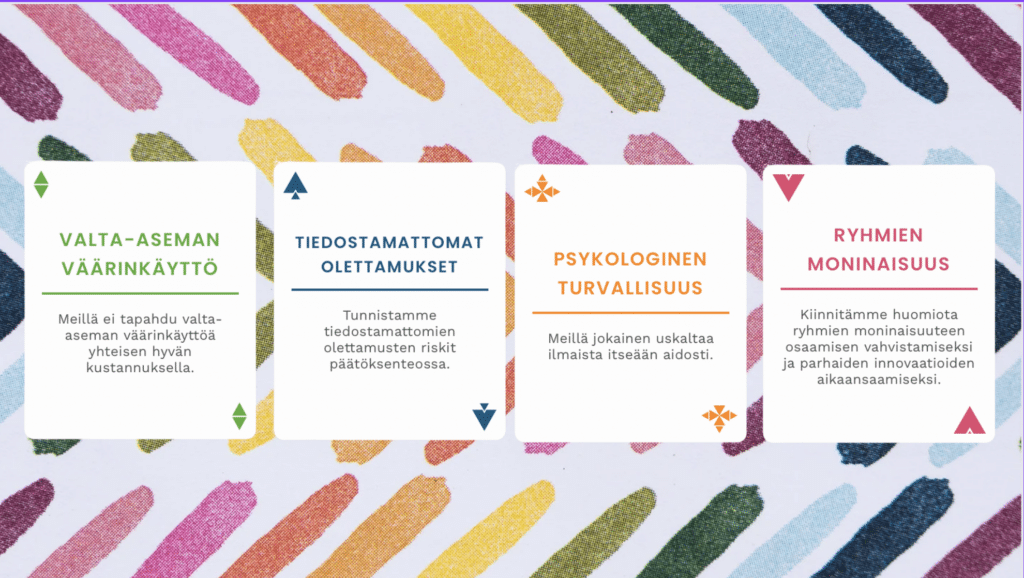
Example cards from the Diversity game. The game has a total of 52 different cards
Diversity in working life
In recent years, diversity has been particularly prominent in working life, in conversations about organisations and work communities. A work community that takes diversity and inclusion into account seeks to increase people's wellbeing through better and more open interaction. Diversity creates richness both for the organisation and for people. It has also been found that nurturing diversity improves a work community's capacity for innovation.
It is important for organisations to understand diversity especially from the perspective of labour availability. "In the technology sector it has been recognised that we need 130,000 new professionals over the next ten years. Of this, about half will come from growth and half from retirement. Having enough skilled people and workers is what keeps the structures of Finland's welfare society possible in the future too", Jenni Pitkänen says. Related to this, Ulla raises the theme from the perspective of new employees: "Inclusion makes it easier, for example, for an international professional to join the organisation."
Diversity promotes innovation capability
"It is good to remember that the more diverse the community, the more opportunities there are to find different creative solutions and innovations. The more diverse we are in the work community, the more diversely we are also able to take the whole into account, both within the work community and in the services developed for customers", Ulla describes.
Taking diversity into account helps companies develop better services and products, even if the work community itself is not particularly diverse.
"Understanding diversity and difference helps take them into account from the perspective of the end users of the solutions. From a smaller organisation's perspective, it is important to understand all that difference can be, so that it can still be taken into account better in its own customers, services and products", Senni Pykäläinen sums up.
Wellbeing at the centre
The interviewees stress that diversity in the work community is not only about productivity, innovation, nationality or language differences, but about the deep difference that is in all of us.
"Diversity is absolutely all kinds of difference. A desire to understand each other better, with all our nuances and backgrounds, so that we can genuinely be who we are. That is what it is about too", Ulla says.
Taking diversity into account promotes the wellbeing at work and job satisfaction of individual employees, which Ulla also connects to psychological safety:
"In a diverse but thriving work community, everyone can be themselves, and everyone has the opportunity to take part in the work community's activities through their own contribution, whatever their role. "
Understanding diversity is therefore important at all levels of the work community. And this is precisely why a new conversation game has been made on the topic, so that everyone in the work community can understand and address diversity in all its forms.
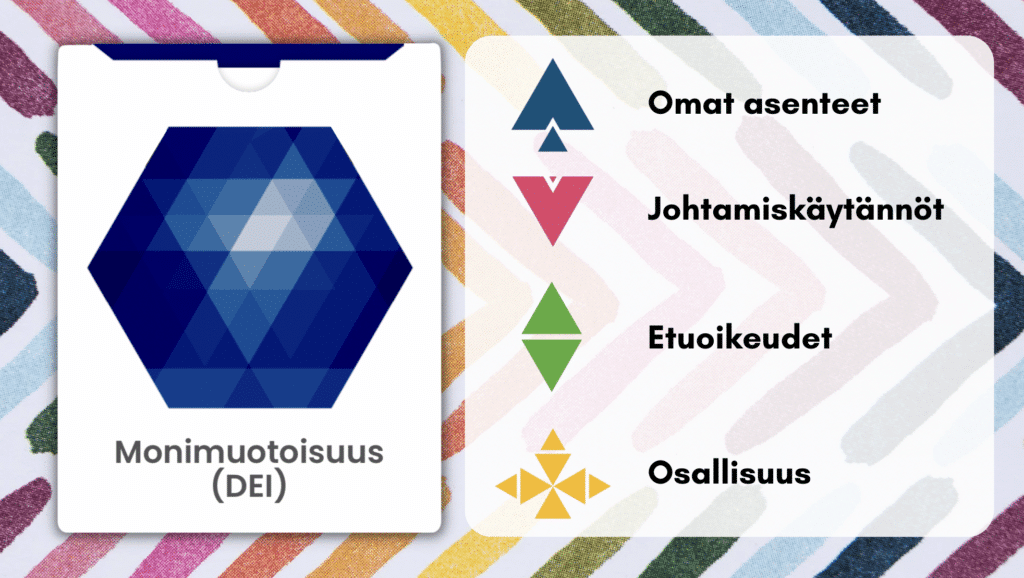
The Diversity game has four suits, that is, themes, under which the cards are divided
The Diversity game helps engage people and discuss diversity constructively
The Diversity game helps address diversity and its different dimensions, through conversation, at an everyday level in work communities.
"This way, this important topic is brought into the conversation and everyone is engaged through the game. The challenge often is that a work community's ways of moving a conversation forward are not very engaging. This is an engaging way to handle the matter in a community, whether it is a large or a small group", Ulla says.
The Diversity game consists of four different themes
The Diversity game is a set of 52 cards. Each card contains one statement related to the topic. Like a traditional deck of cards, the deck is built on four suits, or as they are called in Topaasia, four themes. In the Diversity game these themes are inclusion, privileges, leadership practices, and one's own attitudes.
The Inclusion theme
"Inclusion means that every member of the community can feel they are taken into account, can feel they have opportunities to influence, and can safely be themselves", Senni says.
The Leadership practices theme
"Leadership practices is a theme that takes into account different backgrounds and ways of working. For example, metrics and data can be used to guide activity. And meeting practices, for example, ensure that even those who are not normally the ones speaking can bring their own opinion forward", Senni describes the theme.
The One's own attitudes theme
"One's own attitudes is important as a theme so that people can relate to diversity in a way that lets them take in more information. So that we are not startled by our own mistakes, and we are also able to boldly take things forward", Senni notes, to which Ulla adds that the biggest challenges in addressing diversity often lie at the attitudinal, individual level:
"Attitudes and unconscious attitudes are probably the biggest challenges at the individual level. It can even be frightening to recognise them. But if we genuinely aim for learning and change, then the individual level must also be faced, even though this game is about shared learning and recognising things together. In the end, each of us can only change ourselves, not others or the community. That change always starts from the individual and individuals' behaviour"
Jenni shares her experiences of the conversation coming from the field of Technology Industries of Finland's member companies, in which companies' interest in human, unconscious attitudes stands out:
"We have 1,800 member companies, and over this winter we have organised many different occasions and events around the theme of diversity, at which I have talked a lot with company representatives. Both unconscious biases and one's own attitudes are themes that get people talking and come up in conversations a great deal. They are human things, after all. What matters there is precisely having a certain openness and a desire to learn despite one's biases. Developing diversity is a continuous process. It is never finished. You learn a little all the time, just like being human in general. We are constantly practising and learning, about ourselves, about others and about our own work community."
The Privileges theme
"Privileges as a theme means that in order to understand diversity and different starting points, it is important for us to recognise our own privileges. Then we can use our own privileges for the benefit of others." Senni begins, and notes that diversity is a difficult topic, and it involves the knowledge increases sorrow phenomenon:
"At first you think everything is fine, and the more you learn about the matter, the more you feel the weight of the world on your shoulders, because you understand everything that is involved. In my view, one's own attitudes and understanding privileges are the first things to start from."
You can try the Diversity game for free, along with 40+ other games, during the 30-day trial period
What should you keep in mind when trying the Diversity game?
When a team or work community starts discussing diversity for the first few times, it is good to be aware that the topic can be very personal for some people. For this reason, it is good to agree on ground rules for the conversation in advance: the situation is made confidential, and it is good to go over the basic principles of dialogue with the participants: listen, respect, wait and speak directly. You can read more about dialogue and supporting it in the work community in the Dialogue Guide
"When addressing diversity, truly sensitive and personal topics can come up", Senni begins, to which Ulla continues: "Painful things may surface personally, but also as a community. Then it is important that the game facilitator holds a ground rules conversation with everyone at the start, that is, how we are going to be here and what the goal is."
"It is also important, when starting to play a game with a theme like this, to create a shared atmosphere of trust. Precisely that sense of psychological safety. After that, this is an excellent tool for holding the conversation and raising things that can otherwise be difficult to bring up. With it, people can also safely bring up their own experiences and thoughts. In the game, both as individuals and as a group, unconscious biases can be recognised", Jenni describes.
In addition to an atmosphere of psychological safety, Anne emphasises courage and openness in the conversation:
"There is no single right solution to these things. There are only different views. Whether it comes from one side or the middle or wherever, it is worth approaching with an open mind. There are many kinds of thoughts. We aim to respect. Everything may be said. But we say it appreciatively and respectfully; that, I think, is important to remember. This is not a game of right answers", Anne describes.
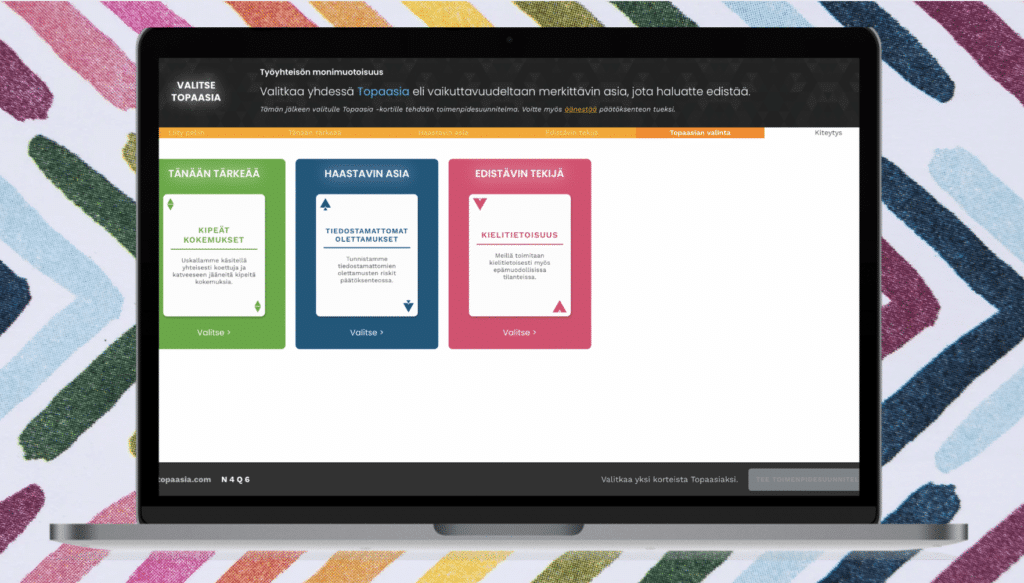
At the end of the game session, based on the conversations, the Topaasia, that is, the Top matter, is chosen, and a concrete development plan is made for it
From conversations to concrete development actions with Topaasia dialogues
The game helps identify the conversation's top matter, the topaasia, that is, the matter that emerges as the most important target for development. Based on this matter, a concrete action plan is drawn up, including the people responsible and a schedule for carrying out the action plan. Jenni emphasises the importance of concreteness when choosing the topaasia:
"I would like to encourage moving from conversations to concrete action. I know that in many organisations this may be a completely new thing, and taking hold of this theme can feel like a huge lump. Just be bold, one step and one thing at a time. Even small things and measures already achieve a lot of good."
Finally, Anne says she hopes the deck will awaken people and advance the conversation despite potentially difficult realisations:
"People often have the idea that surely I am already international, I know these things, I act correctly and I promote equality. But then when we start talking about these things, an awakening happens. Guilt easily follows: wait a moment, am I not the person I imagined myself to be. But you simply have to move forward from that and bring things up boldly. This is a long process with a lot of learning. But it does not get going without self-reflection, shared conversation and waking up to the matter. The more we talk, the more light bulbs hopefully go on, and we find a shared way of moving forward. And we learn to take different things and people into account."
Thank you Jenni, Ulla, Senni and Anne!
Thanks also to Technology Industries of Finland and the University of Eastern Finland.
https://teknologiateollisuus.fi
https://uef.fi
Read about Elomatic's experiences of playing the Diversity game
Read more about using the Diversity (DEIB) game
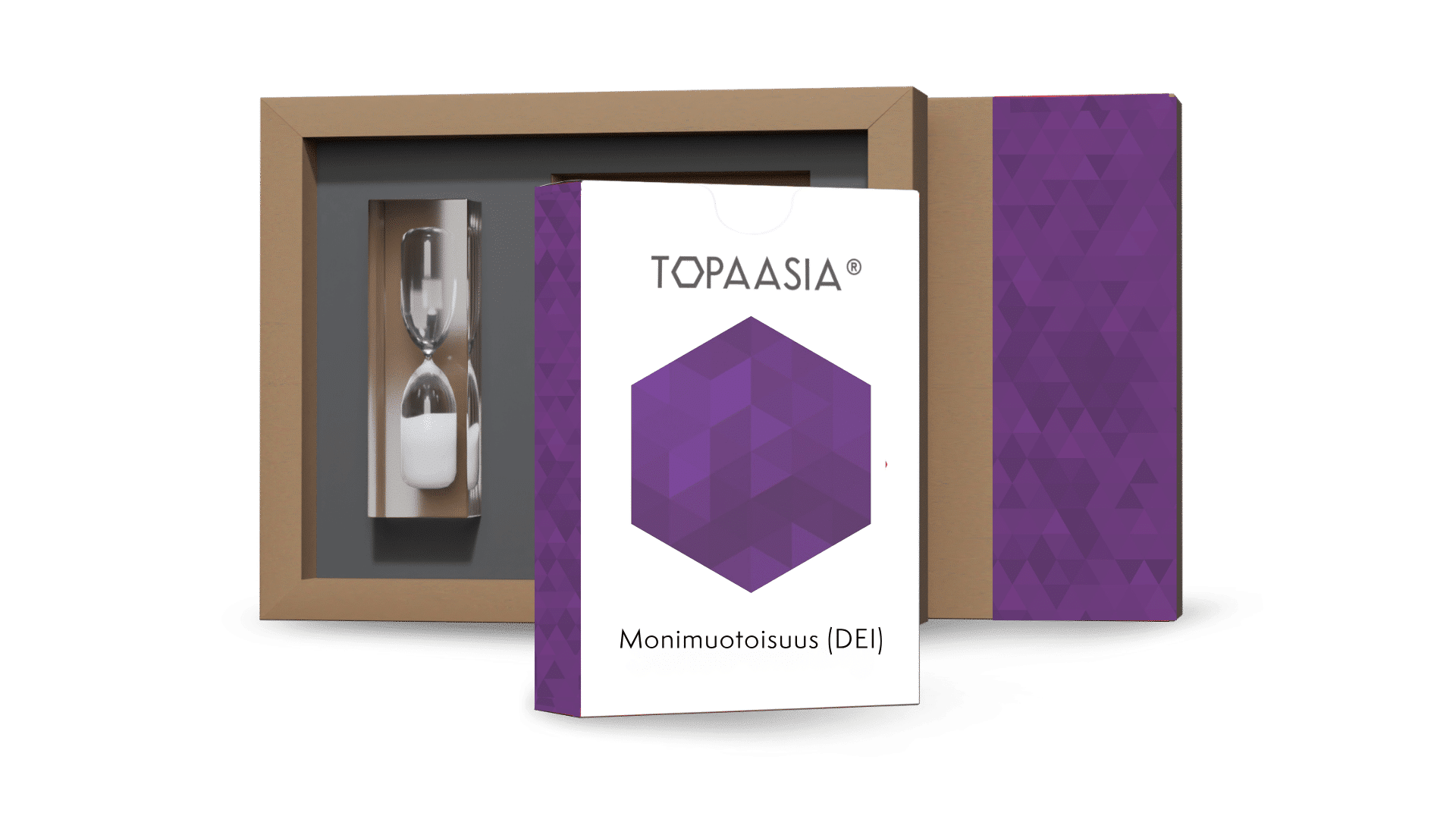
Would you like to play the Diversity game with tangible physical cards?
Buy from the online shop