
What is coaching leadership?
Coaching leadership is a leadership style that focuses on maximising the potential of individuals and teams by supporting, coaching and developing their skills and abilities. A coaching leader aims to create an environment where employees can grow and develop independently while achieving shared goals.
Central to the development of coaching leadership has been the shift from authoritarian management styles towards models that show greater respect for people, engage them and support self-direction. This development reflects a broader societal change in which the uniqueness of the individual, personal growth and the meaningfulness of work are increasingly valued.
How does coaching leadership differ from other leadership styles?
Coaching leadership differs from traditional management in that it focuses more on the growth and development of the individual, encourages self-direction and goal orientation, and uses open dialogue to support employees' learning and development. Traditional management focuses more on the organisation's goals and achieving results with a directive and controlling approach.
Servant leadership and coaching leadership are both leadership styles that focus on developing individuals and teams, but their approaches and emphases differ. While both approaches focus on supporting and developing employees, servant leadership emphasises the leader's role as a servant and supporter, whereas coaching leadership focuses more on individuals' professional development and improving performance through coaching.
The table below helps to illustrate how the different leadership styles differ in terms of core principles, focus areas, roles, modes of interaction and feedback themes.
| Characteristic | Servant Leadership | Coaching Leadership | Traditional Management |
| Core principle | The leader's primary task is to serve others. | Focus on maximising the potential of individuals and teams through coaching. | Achieve the organisation's goals efficiently. |
| Focus | Create an environment where employees can succeed and develop. | Setting goals, personal development and improving performance. | Achieving the organisation's results and goals. |
| Leader's role | Acts as a supporter and resource, removes obstacles from employees' path. | Acts as a mentor and coach, supports and challenges employees. | Director and commander, sets goals and instructions. |
| Interaction | Emphasises open communication and listening, seeks to understand subordinates' needs. | Includes active listening, asking questions and constructive feedback, encourages self-direction. | Top-down communication, passing on instructions. |
| Feedback theme | Focused on understanding and the needs of subordinates. | Focused on development opportunities and achieving goals. | Focused on performance problems or mistakes. |
Each leadership style can be effective in a certain context and with certain types of employees, but they require leaders to apply different skills and approaches.
7 mistakes leaders make when attempting a coaching leadership style
Although a coaching leadership style can be effective in developing employees and thus achieving the organisation's goals, leaders can face many challenges and make mistakes when applying this style. Here are common mistakes leaders make when trying to lead with a coaching style:
- Inadequate listening: Central to coaching leadership is actively listening to employees and understanding their perspectives and needs. However, leaders can sometimes focus more on their own assumptions and advice than on real listening, which can lead to misunderstandings and demotivated employees.
- Insufficient questioning: A coaching leader helps employees find their own solutions by asking open questions. However, leaders often make the mistake of offering answers too quickly instead of helping employees think independently.
- Inconsistent feedback: Giving constructive feedback is a cornerstone of coaching leadership, but if the feedback is inconsistent or too general, it does not help the employee develop. Leaders should give regular, concrete and constructive feedback.
- Unclear goals: In coaching leadership it is important to set clear and achievable goals. If the leader does not make the goals clear or does not share them effectively with the team, it can lead to a lack of direction and inefficiency.
- Neglecting personal development: Although a coaching leader should focus on employees' professional development, they can sometimes forget to support employees' personal growth and learning, which is also important for motivation and commitment.
- Excessive impatience: Coaching leadership requires time and patience, as developing employees and fostering independent thinking does not happen overnight. Leaders may nevertheless expect quick results and lose their patience during the process.
- Lack of trust: A coaching leader must trust their team's ability to learn and grow. If the leader does not give employees room to make their own decisions or take risks, it can hinder their development.

What are the main benefits and goals of coaching leadership?
Leading with a coaching approach offers many benefits for both individuals and organisations. Here are the main benefits that can be achieved when leadership is based on a coaching approach:
- Increased employee engagement: Coaching leadership helps employees feel valued and heard, which increases their commitment to their work and the organisation.
- Improved performance: Employees who receive regular, constructive feedback and encouragement for their development perform better. Coaching leadership helps identify and utilise individuals' strengths, which leads to improved performance.
- Personal and professional growth: A coaching leadership style focuses on the development of individuals, which encourages continuous learning and professional growth. This not only helps employees achieve their personal goals but also advances the organisation's overall objectives. Assuming that individuals develop in areas that benefit the organisation in the big picture.
- Increased self-direction and ownership: Coaching leadership encourages employees to take responsibility for their own learning and development. This increases self-direction and innovation, as employees feel empowered to make decisions and try new approaches.
- Creating a positive work environment: A coaching leadership approach has a significant impact on the atmosphere of the work environment. It promotes openness, trust and support, which leads to closer collaboration and a stronger team spirit.
- Effective conflict resolution: Coaching leadership helps develop employees' interaction skills, which is useful in resolving conflict situations. With a coaching approach, leaders can guide employees to find solutions collaboratively, which reduces tensions and improves group dynamics.
- Managing change and uncertainty: Change is inevitable in all organisations, and coaching leadership can help employees adapt to changes more effectively. A coaching approach encourages flexibility and adaptability, which is vital in a rapidly changing business environment.
- Improved organisational performance: When individuals and teams develop and perform better, the performance of the whole organisation improves. Coaching leadership can lead to better decision-making, more efficient processes and ultimately better results.
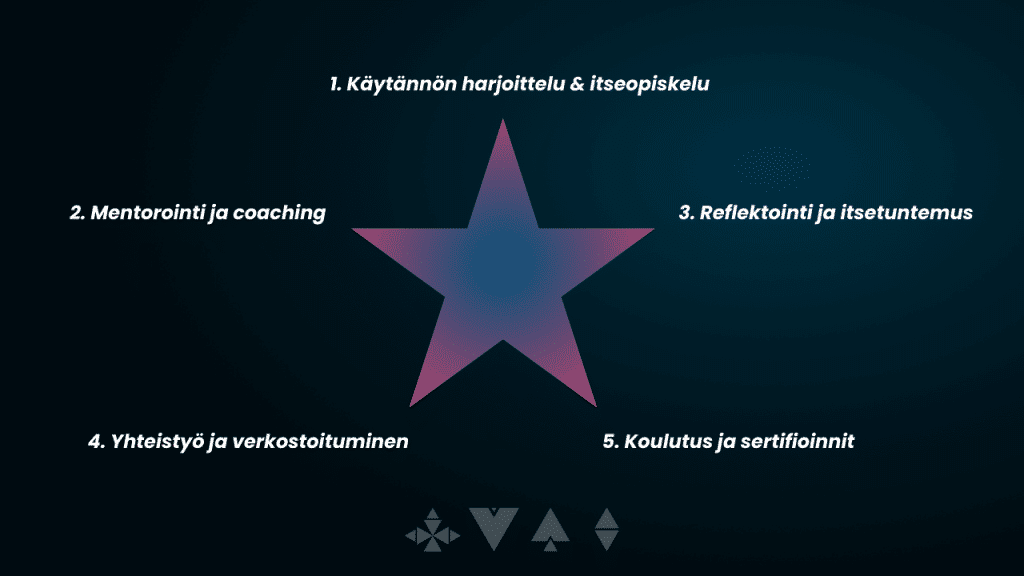
How can leaders practise coaching leadership?
1. Practical training and self-study
-
Practise active listening: Focus on truly listening to what others are saying, without planning your response at the same time. This helps you better understand employees' needs and perspectives. Listening is indeed one of the rules of dialogue.
-
Develop your questioning skills: Learn to ask open questions that encourage others to think and find their own solutions.
-
Ask for and give feedback regularly: Create a culture where giving and receiving feedback is normal. Use feedback constructively and developmentally.
Read more about how to practise and develop concretely as a coaching leader
2. Mentoring and coaching
- Get your own coach or mentor: Individual coaching or mentoring can help develop coaching skills and offer new perspectives.
- Start practical mentoring and coaching yourself: you learn by doing. That goes for coaching too.
3. Reflection and self-awareness
- Keeping a journal: Write down your experiences and insights from practising coaching leadership. Reflection helps identify areas for development and reinforce learning.
- Developing self-awareness: Learn to recognise your own strengths and development areas as a coach. This can include personality tests, gathering 360-degree feedback or self-assessment.
4. Collaboration and networking
- Join professional communities: Take part in networking events and join professional communities where you can learn from other leaders and share experiences.
- Participate in peer groups: Peer groups offer an opportunity to discuss challenges and share best practices in the area of coaching leadership.
- Get trained: Many organisations and private trainers offer coaching leadership training programmes that can provide in-depth knowledge and practical tools.
- Get certified by a coaching organisation: The International Coaching Federation (ICF) and other similar organisations offer certification programmes that can add credibility and knowledge.
More information and sources on coaching leadership
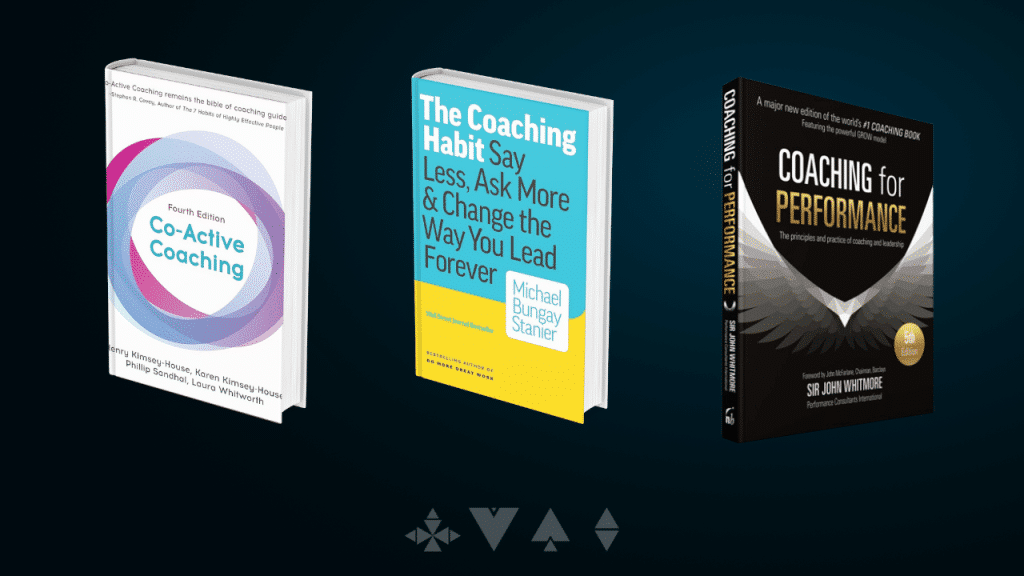
There are many valuable sources on coaching leadership that offer deep insights, practical tools and research knowledge. Here is a list of a few recommended books, websites and articles that offer comprehensive information on coaching leadership:
Books
- "Coaching for Performance" by John Whitmore: This book is a classic in the field of coaching leadership, introducing the GROW model (Goals, Reality, Options, Will) and offering guidance on how a coaching approach can be integrated into leadership and organisational development.
- "The Coaching Habit: Say Less, Ask More & Change the Way You Lead Forever" by Michael Bungay Stanier: This book offers simple but effective tools for leaders who want to adopt a coaching approach in their day-to-day leadership.
- "Co-Active Coaching: Changing Business, Transforming Lives" by Henry Kimsey-House, Karen Kimsey-House, Phillip Sandahl, and Laura Whitworth: The work offers a comprehensive overview of the co-active coaching model, which emphasises an active and reciprocal relationship between coach and coachee.
- Harvard Business Review (HBR): The HBR website offers a wide range of articles and blog posts on coaching leadership, providing research, case examples and expert views. In particular, Google's Project Oxygen on the HBR site is an interesting research report, in which Google carried out an extensive study to find out what the characteristics of the most effective managers are. The study highlights the importance of a coaching approach in leadership.
- International Coaching Federation (ICF): ICF is the leading organisation in its field, and its website contains resources, research and articles on coaching best practices and the benefits of coaching leadership.
Read more:
Executive Coaching - a game for coaching leaders How to develop as a coaching leader: three key skills