
In this blog you will learn:
-What is the retrospective familiar from the software development industry? -How does a retrospective differ from a pointless one-hour meeting? -Why should you too hold retrospectives with your team, whatever your industry? -7 benefits of retrospectives -2 ways to run a retrospective
The IT industry has long recognised the importance of shared team discussion. At the latest when agile software development became well known, the Scrum framework introduced the concept of the retrospective to the IT world. The retrospective, or retro for short, is a way of developing how the team works that is embedded into everyday life. It has its own slot in the calendar and is a kind of shared moment of learning and orientation.
Retrospective comes from the Latin words "retro" and "spektae", which together mean looking backwards. A retrospective is a shared team habit that ensures the team has conversations about how things have gone, so that actions can be identified for doing better in the future.
Imagine you are in an escape room with your friends. Rushing after different clues, with everyone pursuing their own ideas for a long time, is not the best way to make progress. Every now and then you have to stop and discuss which clues have been collected and what you know, so you can decide how to continue. These conversations can be figuratively compared to small retrospectives.
We collected a 60-minute retrospective agenda, the most common mistakes and a comparison of tools on one page: Retrospective meeting: a 60-minute agenda, common mistakes and tools.
Why retros?
A retro is an excellent opportunity to step away from your daily work and look at your own and the team's activity more objectively, a little more from the outside. This helps identify patterns of behaviour and generate alternatives to them. Repeated regularly, retros enable continuous improvement.
Continuous improvement means not ruminating on your own habits and thoughts forever, but trying to be lively people in lively teams, who talk in order to think together and to change their practical actions for the better. But thinking and conversations need a time, a place and permission, in other words a suitable moment. That moment is the retrospective.
The point of this long description is to make clear that there is no reason why retros should not be held regularly in other industries too, wherever people work in teams.

How does a retrospective differ from pointless one-hour meetings?
In retros the point is to discuss the past so you can identify what is worth changing now, so that the future may be better.
If in a meeting you do not:
-Discuss meaningful matters together -Reflect on what has gone well and what has gone badly in the recent past -Decide on practical experiments or actions to make the future better
then the meeting has at least not been a retrospective, and more likely falls into the "pointless meeting" bucket.
Depending on the number of participants, a retrospective can take 45-90 minutes. Usually the retrospective is run by someone outside the team, but that is not essential. It is worth holding a retrospective about once a month, or when some large piece of work has been completed and you are moving on to the next one.
The benefits, or 7 reasons to hold retrospectives
- Team members get to speak and are heard. Retrospectives are a place of full participation, where everyone's views are heard.
- Clearing the air. In retrospectives you can vent your frustrations, which is not usually appropriate in many forums.
- People learn about their work, their ways of working, and how to work better together. This enables continuous improvement.
- Retros are empowering, because people get to evaluate the way they do their work, understand where they are already good and where they are not, and change the things they want to change and can influence.
- Shared understanding. Teams get to talk and build a shared understanding of what has happened and what will be done, which does not happen by itself in everyday life.
- A moment to pause. A shared moment of pausing builds team spirit and gives thoughts room to breathe and create something new.
- Resolving conflicts caused by different ways of working. Some people are keener than others to try new things. A retro is a good moment to agree on such things together, so that the more conservative people also stay up to speed on what is being tried and why.
How is a retrospective run in practice? (2 ways)
There are very many ways to run a retrospective. We present commonly known methods, as well as our own Topaasia game method.

1. Discussion sessions run with sticky notes and flip charts.
Sticky-note retros are usually run so that people themselves write down on notes the things that come to mind and answers to various questions posed by the retro facilitator, such as "what has gone well?" or "What has gone badly?". Then the players put their notes on the wall and discuss them. They may also move and combine notes into piles as the discussion goes on, and in that way build a shared understanding of the overall situation. Finally, priorities are set and practical actions decided.There are many variations of such retrospectives, such as "reduce/remove/start/stop" or "worries/hopes". You can read more detailed examples here:
http://www.funretrospectives.com http://agileuprising.com/2017/01/01/10-retrospectives/
A remote way to run a retro imitating sticky notes is, for example, with free Trello boards.
2. A Topaasia® game session
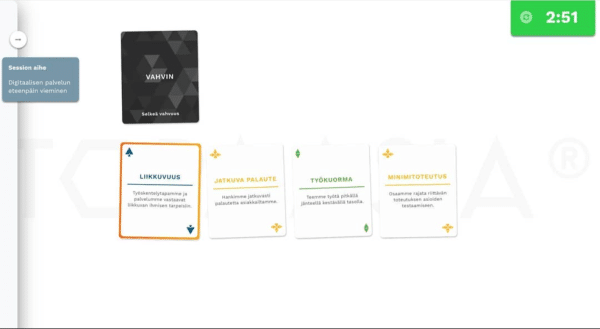
A Topaasia session is a gamified way to run a retrospective around a card deck. At the start of the game session, the team decides the topic of the session and the different perspectives from which they want to examine it (e.g. the most inspiring thing, the most frustrating thing, the most likely risk, strength/weakness, etc.).In the game, players choose from the topic cards in their hand the card that in their view best matches the round's perspective card, and the group discusses the cards played.
Read more about playing Topaasia®.
Topaasia is an excellent way to run remote retros with the Digital Topaasia service.
Physical versions of the Topaasia serious games for holding gamified conversations can be ordered from our online shop.
You can try the digital Topaasia service, built for remote conversations, for free here.
If the phone feels familiar, you can also call our cheerful game man Jussi Galla on 040 0246626 or send electronic letter mail to galla@topaasia.com