
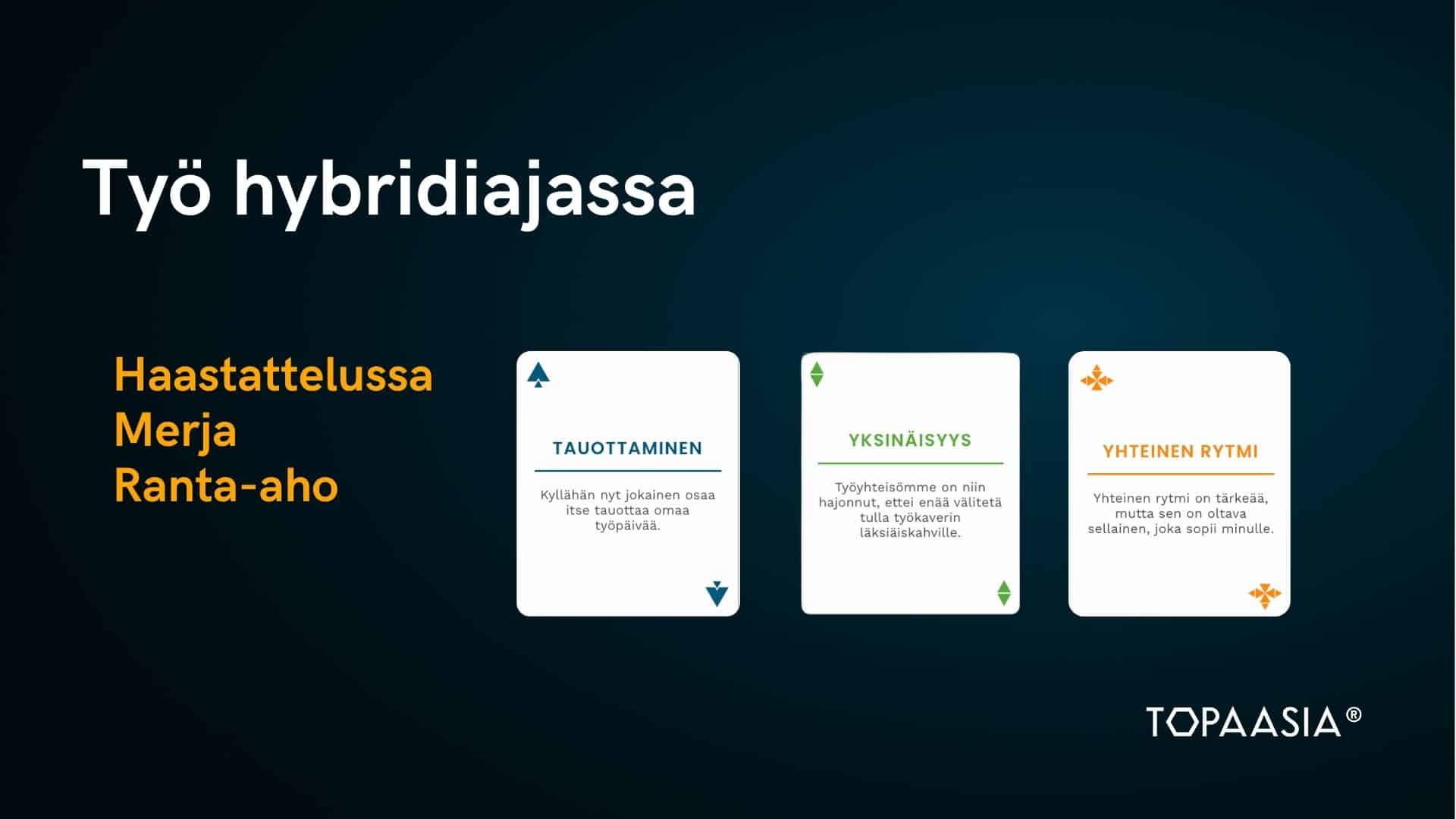
Merja Ranta-aho is a developer of people, operations and organisations who gets excited about how people can achieve great things together. For her, leadership means leading change and learning, and continuous improvement.
The Topaasia deck content Work in the Hybrid Era was created in content collaboration with Merja. We interviewed Merja about the phenomenon.
Merja Ranta-aho, what interests you about working in the hybrid era?
In general, I am interested in how people succeed best together. Achieving significant things usually requires many kinds of people, and that is why it is vital that people know how to work together and succeed together. Anything that supports this interests me.
In 2020, 49% of employees were knowledge workers
In Finland, the share of employees doing knowledge work in 2020 was 49%, which corresponds to over 1.2 million people (source). Working in the hybrid era concerns everyone who does knowledge work. It also concerns everyone who collaborates with knowledge workers. We have, for example, organisations with production facilities where people must be on site. Even they have, somewhere along the line, people whose own work largely consists of knowledge work and collaboration with the rest of the organisation. In that sense the interface matters too.
What is involved in working in the hybrid era?
Recent years have brought a permanent change to working life, as we have seen and experienced new possibilities for working. These existed before as well, but on the one hand technology developed to a good enough level, and on the other hand we were forced to find the courage to try a new way of working during the pandemic. And it turned out to have many great sides.
We are now searching for new norms for ways of working together.
Companies have to find a new balance regardless of their own way of working, because in collaboration with other organisations they constantly encounter different working modes, tools, cultures and practices.
In fact, we are now searching for new norms for ways of working together: what is the default, what is polite, what can be expected of others, what cannot be expected.
The widespread presence of hybrid work raises new questions of collaboration that need answers. In different jobs, in different organisations and for different people, the same solution is not the most productive, nor does it support the work in the best way. Compromises must be sought so that the different needs of different people in a team fit together in a way that lets the team work effectively. In an organisation, in turn, the ways of different teams need to fit together, so the organisation has some shared understanding that this is how we do things here.
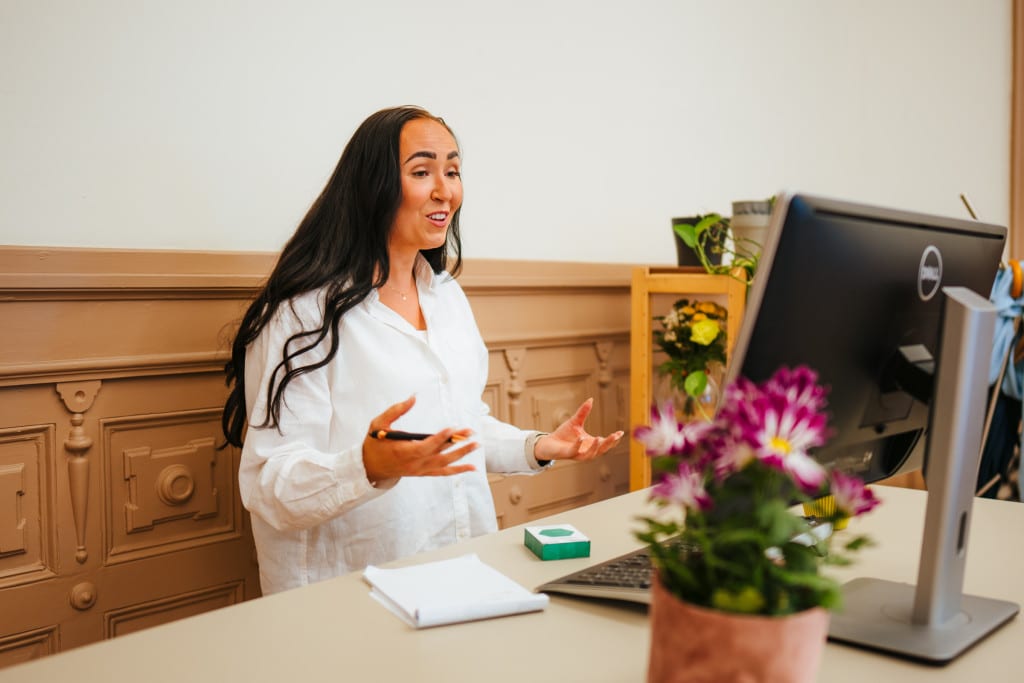
What kinds of phenomena did you put into words in the statements of the "Work in the Hybrid Era" game?
I have heard people ponder and say every one of the statements in the game. Someone somewhere has thought about each of these statements, either thinking that way themselves, or being annoyed, or marvelling that someone else has said so.
Some of the statements are such that at first hearing they feel exactly right, but when you think more carefully, you feel that actually they make no sense at all. Many of these statements involve a tension between two things that are true at the same time.
The statements carry many beliefs that stem from ways of working from the time before widespread hybrid work. Sometimes old assumptions work in the new environment, but sometimes they do not. What is essential is to discuss whether things are still this way. Some things may feel a little foreign in the hybrid world, and then you can sometimes wonder whether they were a bad thing even before hybrid work, even though they were accepted back then. So now there is an opportunity to seek new norms for collaboration.
Take for example the statement "Shared goals: Even if other teams do not succeed in their goals, we make sure we do our part."
It is important that every team takes care of its own goals. At the same time, as the organisation's situations change, it may be important to be flexible about team goals so that a shared, more important goal can be brought home.
Changing a goal midway does not feel nice: have we done pointless work? Have we produced waste? If rewards are tied to this, the situation is even more challenging. On the one hand it is a fine thing that a team focuses on its own goals, but there are also situations where it would be more important to think about the whole. But this has to be talked through.
What is the purpose of the "Work in the Hybrid Era" game?
Hybrid work, now established in working life, brings out new kinds of needs to agree on ways of working together. This game raises those sides of the matter that are rarely talked about and that may partly feel like somewhat difficult topics of conversation. The goal is to improve shared understanding of how to work in the best way in your own organisation.
Thank you Merja!
Merja Ranta-aho is a psychologist and a Licentiate of Technology by training. She worked at Elisa from 2001 to 2024, from 2013 as Chief Human Resources Officer, and had the opportunity to help build the renewal of the company and the whole industry, and an organisation striving for excellence. Before that she worked as a researcher and teacher at Helsinki University of Technology on the user-centred development of telecommunications services. She has also been able to practise the skills of leadership, training, influencing and coaching in volunteer work in the Scout movement for over five decades.