
In this article we interviewed Mari Laari and Anni Pura. They work as organisational psychologists at Heltti, an expert organisation in organisational development, leadership, occupational health and sustainable wellbeing. In their work they help their customers develop work ability management. Together with Mari, Anni and Hanna Rainio we have created the Topaasia Work Ability Management deck, and in this interview Mari and Anni share their thoughts around work ability management.
What do you do and what inspires you in your work?
Mari: I work as an organisational psychologist and I also have a long background as an occupational health psychologist. I do various organisational development projects, work supervision and coaching in our customer organisations. I get a kick out of seeing customers have insights. Perhaps not necessarily from getting one of my own ideas through, but from the fact that in that shared conversation insights emerge that I could not even have offered myself. They are born through the conversation. Those are perhaps the best moments.
Anni: I work as a customer-responsible organisational psychologist and a specialist in work ability management, helping our customers develop work ability management. My work involves analysing data and forecasting trends in order to manage various personnel risks. I discuss these observations with customers, and the observations help develop ways of working that affect the whole customer organisation. It is wonderful to see how knowledge-based management can prevent bigger challenges, such as disability pensions. This kind of influencing through knowledge is what I enjoy.


What is work ability management and why is it important?
Anni: Work ability management is all the leadership that happens in people's everyday lives. Whenever decisions are made that concern people, that is work ability management. Work ability management as a whole can be difficult to put into words or into process form, because it contains a lot of interaction and the ways of working of the organisational culture.
Mari: Work ability management is important, of course, for the individual employees whose work ability is being looked after. When we are able to work, we are also usually satisfied, happy and functional. Our quality of life is better, work flows and things are in order. Even if there are problems, we have the resources to overcome them.
Work ability management is also important at the team level, because an individual person's work ability affects the functioning of the whole team. By promoting work ability we promote how teams function. It is a positive cycle. For supervisors, work ability management is important because when supervisors know how to do work ability management, they have a functional team and things run smoothly. Supervisors have a distinct opportunity to influence how their own team works and the wellbeing of individual team members. At the organisational level, work ability management is important because when people are able to work, the full capacity is of course in use. People are the most important resource in any organisation.
Anni: Let me add something from the organisational perspective; I sometimes come across the idea that work ability management is something soft, a bit of fluffy nonsense and an HR thing. But it is hard business. First of all, from the organisation's perspective, big risks are being managed. Sickness absences and disability pensions are really expensive if they come to pass.
What an organisation invests in work ability management increases the organisation's competitiveness, personnel productivity and performance. In other words, you get motivated employees who are able to work. By work ability I mean above all motivated, skilled employees who cope well in their work. People whose work flows. That is when the organisation is also at its most productive and efficient as an organisation.
What does leadership mean in the context of work ability management?
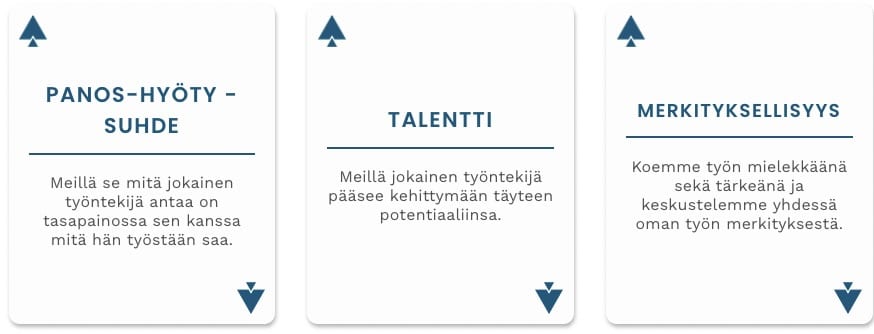
Anni: In a strategic sense, work ability management starts at the management team level as decisions. What kind of strategy there is, how personnel are engaged in implementing the strategy and by what means. It is purely a question of leadership: what is being pursued and how. Are we aiming to maximise employee productivity through the number of billable working hours, or to develop competence and provide the freedom to choose to take part in activities that are personally meaningful and where one's own motivation is at its best.
At the supervisor level, work ability management means leading the work of employees and teams. HR can also support achieving the goal for its part, and on the other hand employees themselves must take care of their own work ability. Employees' self-leadership skills are important so that they do the agreed work and their work flows. And if it does not flow, they raise the issue and address it proactively.
Is work ability management more broadly connected to how the organisation pays attention to productivity from the perspective of individual wellbeing?
Anni: As a concept, work ability may evoke the idea that it means health or illness. But it is not just about talking about health or illness. That is one part of it. Competence, motivation, working conditions, frameworks, leadership and work tools must also be in order for work ability management to succeed.
Mari: It is not only about taking care of wellbeing, but specifically about taking care that work flows well.
How does work ability management show up in the everyday life of organisations? Where do organisations succeed? Where are the challenges?
Mari: Every organisation is different, and these things are understood in different ways in each one. Organisations are at different levels of maturity in how much these matters are considered in everyday life. As an example, one could mention how much work ability management features in the talk of management or in the work of the management team, or whether it is discussed as part of the strategy. There is no formula saying that certain types of organisations do this well or that certain types do not. Or that in a certain industry this works or does not work. It is very organisation-specific how work ability management has been understood and how well it is carried out in everyday life.
Anni: As a rule of thumb, work ability management works best in an organisation where supervisory work is valued and resources are set aside for it. One where human resources are seen as a major, in fact the most important, asset in the organisation. In such an organisation, work ability management is visible at the management level and in management's talk. From the management team level down, personnel are committed to doing things for the benefit of people, and decision-making takes into account the perspective of individual employees and teams.
The challenges are greatest in organisations experiencing rapid growth. The pace of growth is so fast that personnel resourcing, for example, cannot keep up, which means supervisory resources are constantly under strain. Such organisations often do not succeed in work ability management.
In top organisations, work ability management is strongly data-driven. It can be anticipated and used over the long term to support decision-making. For work ability management, it is important that processes exist. In a small organisation, tacit knowledge is enough, but in a larger organisation it no longer suffices. Processes help with anticipation, and this is needed for work ability management to succeed.
How is work ability management connected to company culture?
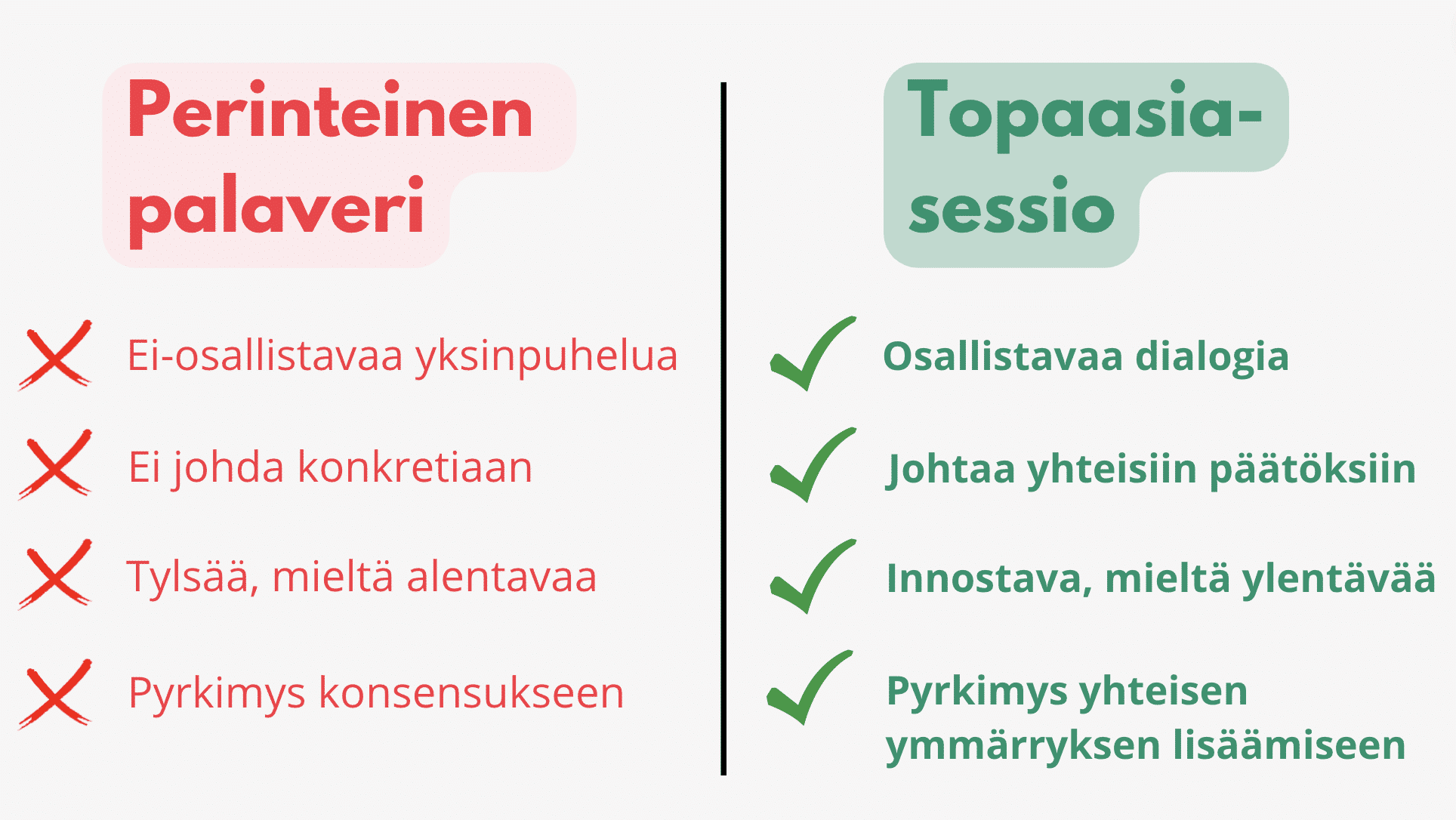
Mari: Work ability management is part of the culture. Work ability management is not a separate thing in the style of "here is our work ability management process". It is part of what we are as an organisation, how we think about people and how we lead every day.
Anni: As a practical example, organisational culture and values are very central in defining what kind of early caring process and model we create, and how it is worded.
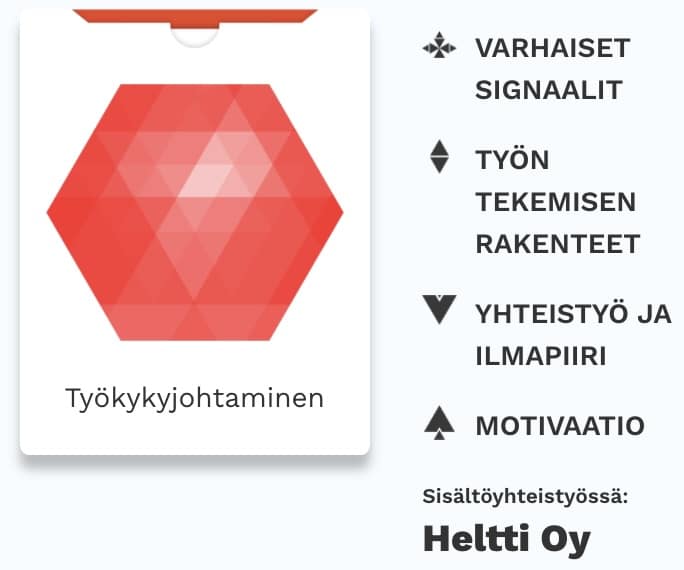
The Work Ability Management deck was built under four umbrella themes (Motivation, Early signals, Structures of doing work, Collaboration and atmosphere). Why these four umbrella themes?
Mari: These themes are closely linked to work ability management and to how it can be promoted in workplaces. For example, we know that motivation is a very significant factor in an individual's work ability, and it also has a broad effect on the work ability of others. We want to highlight early signals because people often think that work ability management means monitoring sickness absences, and when the alarm thresholds are breached, then conversations are held. We want to bring the attention to a genuinely earlier stage. To being able to understand, before sick leave is needed, that someone here is starting to have challenges with their work ability. The structures of doing work, in turn, relate to leadership and the smoothness of collaboration. This is about the flow of work and the structures that support it. Structures have not been created to restrict, but to safeguard situations where there are challenges and support is needed. Then structures, processes and leadership practices guide what kind of measures and forms of support are needed, and on the other hand support equality and fairness when everyone is treated the same way. Collaboration and atmosphere have a great effect on how people experience the workplace and how it supports their wellbeing and work ability. People often mention, among other things, their colleagues or the company culture as the greatest resource at the workplace.
These are the umbrella themes under which the conversation can start to be built.
Anni: These themes represent the different perspectives of different organisational levels. We take into account the individual's perspective, the supervisor's perspective, the work community's perspective and the organisation's perspective.
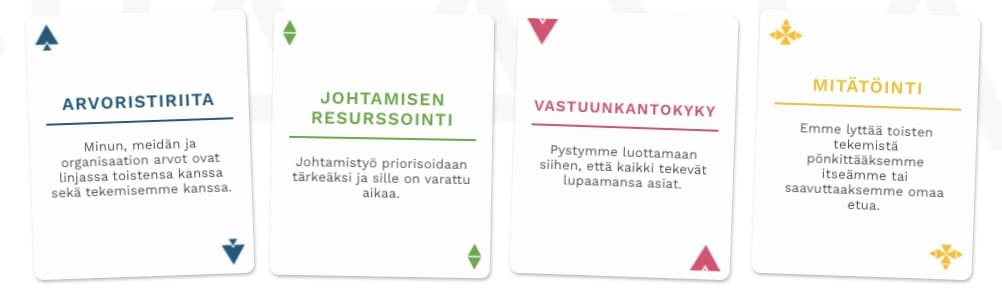
The Work Ability Management deck consists of 52 statements, 13 statements per umbrella theme. What were the statements trying to put into words?
Anni: The game is our wording of what work ability management consists of. Of course, work ability management is something more and bigger than what can be put into words with 52 cards. The purpose of the deck is to act as a spark for where to start developing, where to move forward from.
What kinds of situations is the Work Ability Management deck made for?
Mari: What makes this an interesting and good deck is that it can really be played by any group. Of course, as a starting point these matters are developed at the organisation's management and supervisor levels. For example, supervisor groups, management teams or HR could use this deck to get interesting sparks for how work ability management could now be developed in their particular context. But I would also see the game as interesting for playing right at the team level and seeing what kind of input comes from there towards management or HR.
Where can you hear more?