
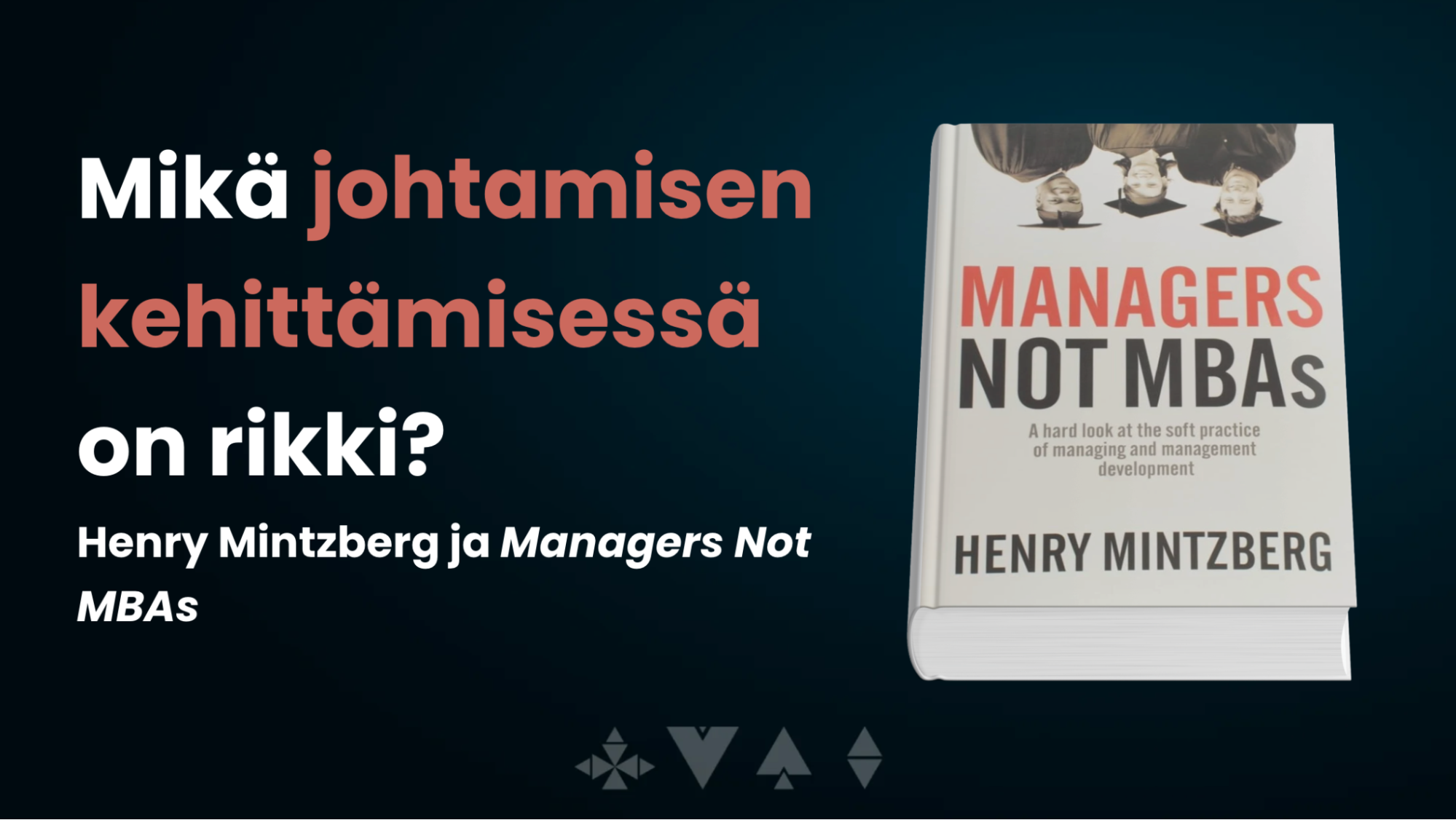
Henry Mintzberg, familiar from the book Strategy Safari, published a book in 2004 with a provocative title: Managers Not MBAs. The book's hypothesis is this: the Western way of training and developing leaders is broken in a way that shows up in organisations every day.
More than twenty years later, the book's argument has not aged. It has simply moved from business schools into organisations: into training days, strategy seminars and leadership development programmes that repeat the same basic mistake: teaching leadership analysis from the outside while forgetting the real-life experience and context where learning could actually happen.
Leadership training is broken, claim 1: Leadership is significantly more practice and context than analysis
According to Mintzberg, management is a blend of three things: craft (experience and context), art (vision and intuition) and science (analysis).
Formal leadership training focuses almost exclusively on the third, analysis. It teaches analysis, frameworks and models, the things that are easy to teach and easy to assess. Craft and art do not bend to a curriculum.
The problem is not analysis itself, but that analysis without context is left hanging in the air. It produces leaders who can construct a well-argued decision without knowing the reality the decision concerns.
Leadership training is broken, claim 2: Without experience and context there is nothing for learning to attach to
According to Mintzberg, you cannot teach management to someone who has not managed. Experience cannot be merely an application phase that comes after the training. Experience should be the growth medium from which learning arises in the first place.
The same applies in organisations. When a team is given a training day on interaction, psychological safety or strategy execution, the content comes from the outside. It is often good content. But it does not attach to anything, because the team's own experience, the concrete situations, never makes it onto the table.
That is why a training day feels good and is forgotten in three weeks. The show was good, and nobody had to deal with their own real issues.
Leadership training is broken, claim 3: Context does not transfer in training
Mintzberg sharply criticises case teaching: twenty pages of paper, an hour of time, and the learner makes a decision about a situation they do not know. That does not teach management. It teaches quick judgement from thin data and builds the belief that a competent leader can lead anything, anywhere.
The organisational version of this idea is "best practice". What worked in another company, another culture, another team and after a different history is brought as-is into your own environment and expected to work. A common variation is a leader reading a book about Netflix culture or the Scrum framework and bringing it as-is to their own team the following Monday.
Context, meaning your own environment, your own system, your own "real life", is however where leadership actually happens.
Mintzberg's alternative: Colleagues and peer learning in leadership development
Mintzberg's alternative to analysis-heavy internal and external leadership training is a programme where managers are trained among managers, learning from peers, with the participants' own experience as the main focus.
At the core of the programme is peer learning (which he calls peer consulting). When a manager brings their own problem to a peer group, the group is not an outside expert. It is a group of people who recognise the situation from their own experience and can ask the questions an outside coach or consultant would not know to ask.
What follows from peer learning in practice?
From Mintzberg's ideas it follows that there are two options in organisational development:
The first: bring in content from the outside and hope it sticks. This is still the mainstream: coaching sessions, models, strategy presentations, workbooks and keynotes.
The second: build a structure into the organisation where people process their own experience together. Then the outside contribution is not content but form. The questions, the order, the way of making sure everyone speaks, and the documentation.
The latter is harder to sell, because it does not look as finished. It does not produce slides or a certificate. But it is the only way learning attaches to the reality it is supposed to change. This is Topaasia's starting point for organisational development. We call it participatory organisational development.

Participatory organisational development
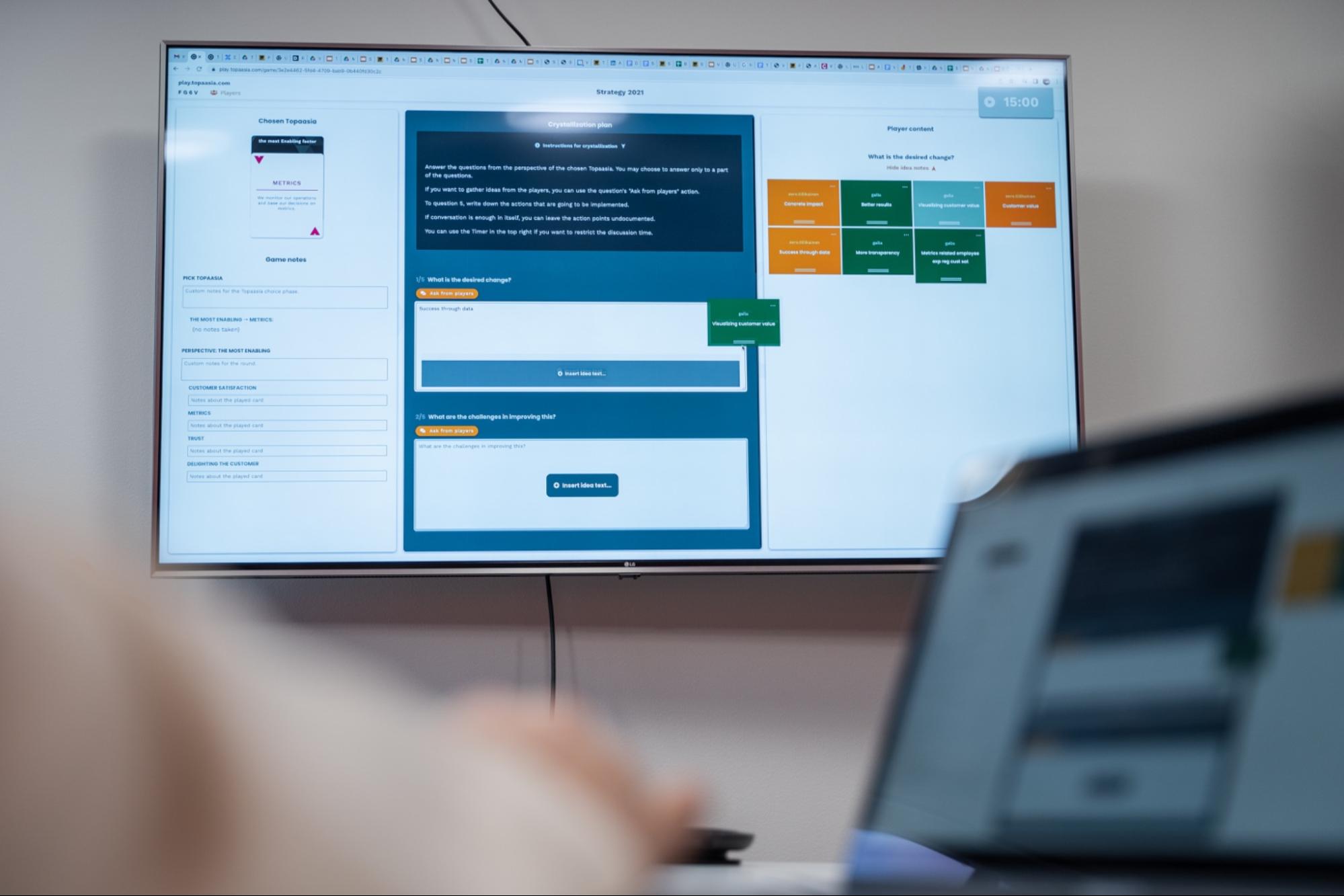
Topaasia is a card-based dialogue method, and it does not bring the team content from the outside. The cards do not tell you how you should lead, do strategy or hold a development discussion.
They do one thing: they open up the team's own situation or the topic at hand for discussion so that the conversation does not depend on who dares to speak first or loudest.
In practice this means two things that respond directly to Mintzberg's critique:
The learning material is the team's own experience. The conversation starts from what the team's everyday work looks like and how, for example, leadership development (or, say, strategy execution) could work best in this particular team.
Peers do the work, not an expert. The method is built so that a team manages without an outside facilitator. The structure carries the conversation.
Mintzberg wrote about leadership education. But the same logic applies to every situation where an organisation tries to change the way people work together: if your own context is not on the table, nothing changes.
Interested? See how Topaasia works →