
What if the boss did not (always) bring their own ready-made agenda to development sessions?
What would everyday work look like if everyone felt they were taken seriously? If everyone dared to raise the issues they feel are important? Every single day, on every working day, in every work community there are moments when someone would like to start a conversation about something they feel is important. For themselves or for the whole work community. Even at this very moment, right now. Why does the conversation so often run more heatedly in the corridors after the meeting?Of course, the small and large matters of everyday life await solutions, here and now. Yet even shared team development days are almost always pre-built in terms of content. Out of the goodness of their hearts, in the name of efficiency, the bosses have thought through and decided in advance the themes and issues to which the work community's attention will be directed.
When is it time to pause and look more openly at the world surrounding the work community?
An operating environment that may have changed quickly and even drastically. And whose change has probably been experienced by the people on the front line, the people who serve the customer directly in their everyday work all the time. How do we bring their experiences and thoughts to the surface and into shared discussion? How do we get people to raise especially the difficult issues? Issues that may be frightening to bring up? Issues that, while mulling them over, someone might wonder whether they will end up in the front row at the next redundancy negotiations, as a difficult type?Can something important rise from behind the curtain of silence under the guise of play? And if so, on what terms?
Joonas Jälkö, a doctoral candidate at Aalto University, sees randomness and a kind of veil of denial as helping to raise difficult issues. He belongs to the Probabilistic Machine Learning research group, where he studies privacy-preserving machine learning; how we can learn from data without revealing individual respondents. He feels that using randomised algorithms can, for example, reduce the effect of the social pressure experienced by respondents to a standardised survey. For example, if a respondent faces the question Do you use drugs?, the respondent may, out of perceived pressure for social acceptability, answer no even if the answer would be yes. A simple randomised algorithm, for example a coin toss, where tails means answering truthfully and heads means the respondent tosses the coin again. Now, when tails comes up, the algorithm directs them to answer yes even though the true answer is no. Thus the respondent can, if needed, state that they do not really use drugs, but the algorithm forced them to answer this way. In this way randomness protects the individual respondent, and yet in a large research sample general patterns can be learned from the data even though the data contains noise added by the response algorithm."Randomness is an element in TOPAASIA's approach. Why is it not a catastrophe? Why is it not a bad thing that the 'right issues' don't come up? - Jussi Galla, TopaasiaPlay, randomness and the veil of refusal are found in the TOPAASIA game. TOPAASIA is a serious game based on the use of playing cards, which helps teams have productive conversations in which all participants get to bring their views forward. Randomness is realised when, during play, participants are dealt 5 playing cards in each round, whose themes relate to developing the work community. If the cards feel unsuitable or even unpleasant, the player has the opportunity to exchange cards from the deck. The player decides which card to place on display and which issue they want to bring into the shared discussion through it. Randomness gives the player the protection it affords; they can suggest that they would not necessarily have raised the issue themselves, but since this card brought it up...
"Randomness creates a certain kind of equality in the team development work where TOPAASIA is used. No manager has decided on the cards that are dealt. Deciding in advance would be really dull; how would that differ from the normal hierarchy. Randomness also gives the players a kind of veil of refusal. You can put the cat on the table, which you would not normally do, without fearing the consequences." - Joonas Jälkö, Aalto UniversityIn this way, a playing card that comes up randomly offers a chance to grasp meaningful, even difficult issues in the work community. Joonas Jälkö raises workplace bullying, which can be an extremely sensitive topic and hard to bring up in a normal conversation governed by hierarchy. In an hour, a work community has time to play many rounds, which produces a tremendous amount of randomness.
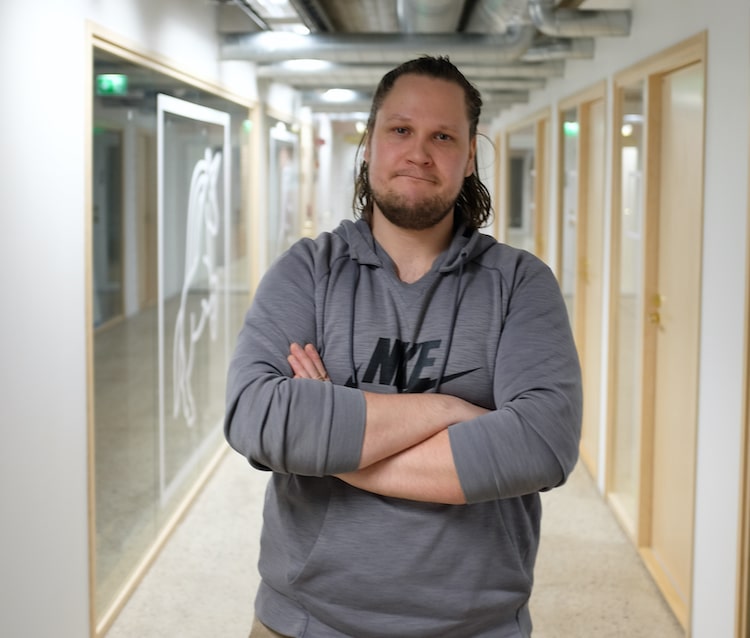
Joonas Jälkö
Why does randomness matter?
Randomness offers, in a way, the protection of anonymity for the individual person, in a single round and throughout the whole game. This potentially increases the courage to raise issues the player feels are important. Round by round the randomness increases and the conversation can head in surprising directions."The right to privacy is a human right. In general I am glad that large companies' efforts to protect data privacy are not mere empty words. At the same time, it is indisputable that data-driven solutions are damn good and effective." - Joonas Jälkö, Aalto University
Why does it matter that questions arise from behind the veil of privacy, outside the conversation defined by the organisation's hierarchy? Three reasons:
1. In the TOPAASIA game, exciting opposing forces swirl around the members of the work community:On the one hand the hierarchy of the work community, on the other the equality of the players. There are over 30 themed TOPAASIA card decks, which can quickly get to the heart of the matters within the themes. Thus, to a certain extent, the structure of the chosen game guides the discussion. On the other hand, the random appearance of playing cards in the deal and the players' interpretations of the cards' contents add diversity to the voices. The game may even bring up issues outside the themes of the chosen deck that players have felt to be important at that moment.
2. The fears and taboos experienced by players in the community on the one hand, and on the other the randomness and the veil of refusal, which offers at least partial privacy protection for the themes raised.
3. The control the organisation craves in directing the attention of the community's members, and on the other hand trust in the diverse voice produced by the discussion.
In summary, it would seem that TOPAASIA helps the work community navigate the terrain between hierarchy and equality. Even the simultaneous maintenance of strong paradoxes: control and trust in developing the community's activities. With its help, even the difficult topics of corridor talk can be brought into the development work defined by the hierarchy.
Author: Jarmo Matala-aho