
Sari Suominen is an entrepreneur and knowledge-based management professional from Powen Oy. Powen wants companies to make wiser decisions by helping them turn data into analytics for everyday leadership. Together with Sari and partners we have created the Knowledge-based Management Topaasia deck. The game is used to create a constructive conversation about the organisation's knowledge-based management and to make decisions to improve it.
Next we will go through what knowledge-based management actually means, what benefits it brings, and what the most common pitfalls are when trying to put knowledge-based management into practice.


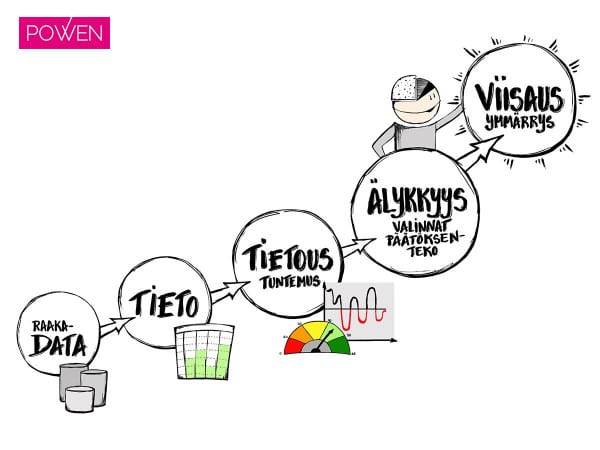
Knowledge-based management is the active and controlled use of information to take the company forward in the desired direction.
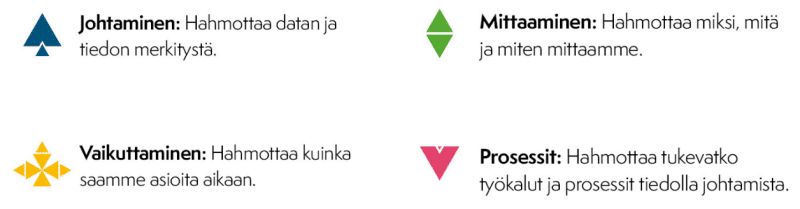
As its name suggests, knowledge-based management helps you lead based on facts. In knowledge-based management, people often talk about data, analytics and processes, but the "management" part of the whole is easily forgotten. What is done with all the organisation's information, and how is it communicated? Well-executed knowledge-based management helps form a shared and objective understanding of how the company is doing.Knowledge-based management consists of leadership, influencing, measurement and processes. These are also the suits of the Topaasia Knowledge-based Management deck:
The benefits of knowledge-based management
- Making progress concrete. Humans are goal-oriented beings by nature. Many people want to strive forward in their work. Some to a different degree than others, but usually everyone wants to advance and to feel they are advancing. Good knowledge-based management makes progress towards goals extremely concrete, measurable and visible. It helps the individual, the team and the organisation alike see where things stand in relation to the jointly agreed goals. .
- Resolving ambiguity and differences of opinion. Some people are more pessimistic by nature and others more optimistic. This can create conflict about how the company is doing overall. But if the goals are first defined together and progress is then measured against those goals, no one should be unclear about where things stand. At its simplest, this can appear as a visual gauge showing green or red. Green shows that progress is good in relation to the goals, and red is a moment for reflection: How could we improve?
The biggest stumbling blocks in knowledge-based management
- Too many metrics. Less is more. A few well-chosen and well-justified metrics are enough. They actually get followed and taken seriously. .
- Information is not transparent. If, for one reason or another, an organisation does not want to share information with those who need it, there is no point in trying to practise knowledge-based management. ..
- Goals are not broken down into measurable actions. If the sales target is, say, €100,000 of sales per month, this tells the salesperson nothing about actions yet. The goal must be worked out in detail. If the target is €100,000 and the company has 10 salespeople, the target can be €10,000 per salesperson. The figure is further broken down into everyday actions: How many calls or meetings does this €10,000 require on average? This gives the actions measurable quantities.
Thank you Sari!
Learn more about knowledge-based management and Powen at www.powen.fi You can also message Sari on LinkedIn.
You can buy the Topaasia Knowledge-based Management deck from our online shop You can also ask for more information, or shout "I'll buy it", by phone to game man Jussi Galla on 040-0246626