
Mikko Bäckström is an expert in brand building and marketing. During his career he has worked as an expert, a supervisor and a leader, and has been involved in developing company culture and leadership. Mikko has studied servant leadership since the 1990s and is currently writing a book on the subject.
Together with Topaasia, Mikko has created the Servant Leadership game, which helps organisations and supervisors identify and develop the focus areas of servant leadership.
You can hear more from Mikko about servant leadership and get to know the Servant Leadership game by joining the Humane Leadership webinar series on 9 November
The transformation of working life and leadership
Working life has changed radically over the past 50 years, but according to Mikko the basic tenets of leadership have remained unchanged.
“More and more of us do expert and knowledge work that is independent and self-directed by nature. At the same time, people work in independent and self-directed teams where the level of autonomy is high. In this kind of operating environment, individuals and teams carry broad responsibility for their own work, their decision-making and leading themselves. Yet organisational charts are still pyramid-shaped, both strategic and operational decision-making power is still concentrated in the hands of leaders, and the interaction patterns of companies resemble a military chain of command and control,” Mikko says of the evolution of working life.
For leadership, the change in work inevitably means a shift from being right and holding authority towards serving people. Mikko describes the situation: “A leader no longer is, and no longer even can be, the all-knowing number-one expert in every area they lead. Even though competence, experience and expertise are distributed across the different structures of a company, organisations are still led in a very hierarchical way. In an environment of distributed expertise, traditional top-down command leadership no longer works. People working as experts often have both the capability and the will to make a difference, and we humans consider meaningfulness and impact to be important values. And so, sooner or later, we either start to resist or throw in the towel if our competence is not heard and we do not get a sense of meaning from our work.”
As a solution to the changes in working life, Mikko describes a transformation of leadership that completely redefines the leader's identity, the roles of leadership and the emphasis of its tasks. Enter servant leadership.
What is servant leadership?
Servant leadership is not a leadership model or a leadership strategy but a philosophy, guided by a way of seeing and interpreting the surrounding world, and by a way of seeing organisations not as machine-like process continuums but as organic, human and constantly evolving organisms. It is about refitting leadership to more human-centred thinking, to an organisational model of more distributed decision-making and to a more humane work culture.
“Servant leadership can take us closer to a leadership model that allows organisations to make the kind of change that modern work requires and that modern business models equally drive,” Mikko says.
What does servant leadership consist of?
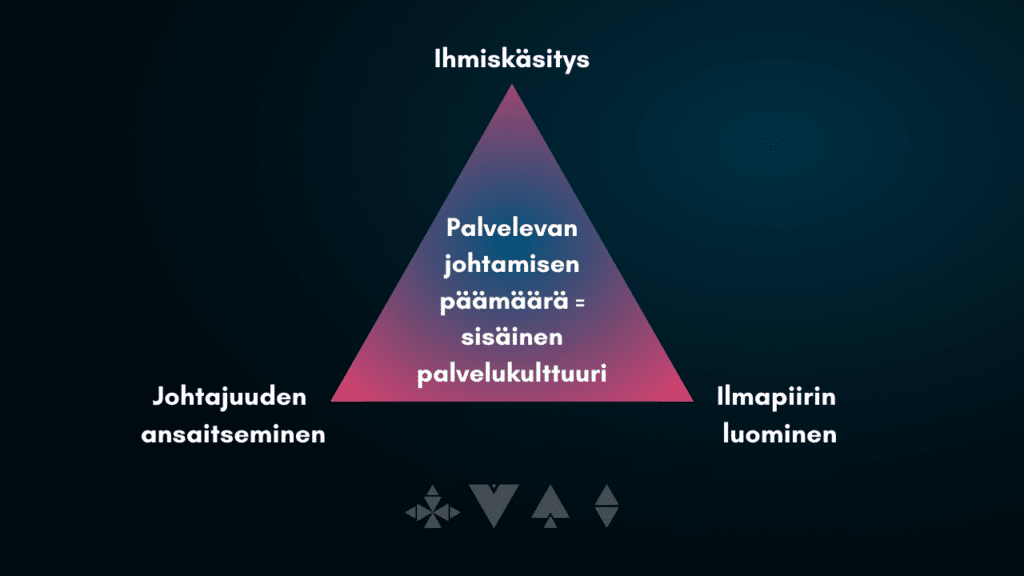
According to Mikko, servant leadership rests on three core ideas: the conception of the human being, earning leadership and authority, and creating the atmosphere.
The conception of the human being
In Mikko's view, a central idea in servant leadership is the conception of the human being, that is, how a person experiences another person regardless of whether the context is work, leisure or something else. It is based on the idea of indivisible and intrinsic human worth, which cannot be taken away from a person under the guise of hierarchies or pecking orders. It is essential to understand that the value an organisation creates can become greater than the sum of its parts only when each of its members feels valuable in themselves and sees their work role as important and valuable for the organisation's success.
Earning leadership
In the philosophy of servant leadership, the leader earns their own leadership. Even though trust should be intrinsic, the leader must have the power and responsibility to make decisions on behalf of those they lead. It is essential to understand that leadership does not arise from an appointment or a promotion but from a mandate given by those being led. That requires deep trust in the leader. Just as people long for respect, appreciation and empathy for themselves, and strive to practise what they preach, this is required to the greatest degree especially of the leader.
”It is likely that the leader has longer experience and substantial competence in the area they lead. In addition, they must have the understanding and the trust to help, support, provide resources, remove obstacles, and, most importantly of all, create psychological safety in the group they lead. Besides serving the company's goals, it is far-sighted for the leader to focus on serving especially the needs of the people who together produce that result. This is where the term 'servant leader' comes from," Mikko says.
Creating the atmosphere
Third, one of the most central tasks of a servant leader is to create optimal conditions for their team to succeed. It is about creating an atmosphere in which the individual members of the group can apply their own strengths in a way that serves their own work and the team's work. A servant leader must therefore have sufficient resources to focus on this: securing enough time, obtaining money, arranging the necessary tools and creating a psychologically safe atmosphere in the group they lead.
Building psychological safety is something we can all take part in: by being ourselves, by accepting each other as we are and by encouraging one another to test the limits of our comfort zones. In this way we take part, often without even knowing it, in leading ourselves and each other.
The purpose of servant leadership
The most important goal of servant leadership is that an internal culture of service emerges in the organisation, in which everyone is able to help, support, remove obstacles and create an encouraging atmosphere. Mikko says that when these goals are realised, shared leadership and community-directedness can be achieved, in which everyone practises the basic principles of leadership towards one another. In the ideal situation, this appears as an organisation where people pull together, take responsibility and lead shared matters regardless of positions and titles.
According to Mikko, in an organisation that practises servant leadership, leadership is more broadly the result of shared decision-making than in a traditional one: “Decisions may be validated in the company's formal bodies, such as the management team or the board, but in the ideal situation the role of leadership is to create strategy and make sure the organisation is heading in the right direction, while the teams take care of planning and carrying out the necessary actions. The leader, in turn, supports, resources, removes obstacles and helps individuals and the team move forward,” Mikko describes
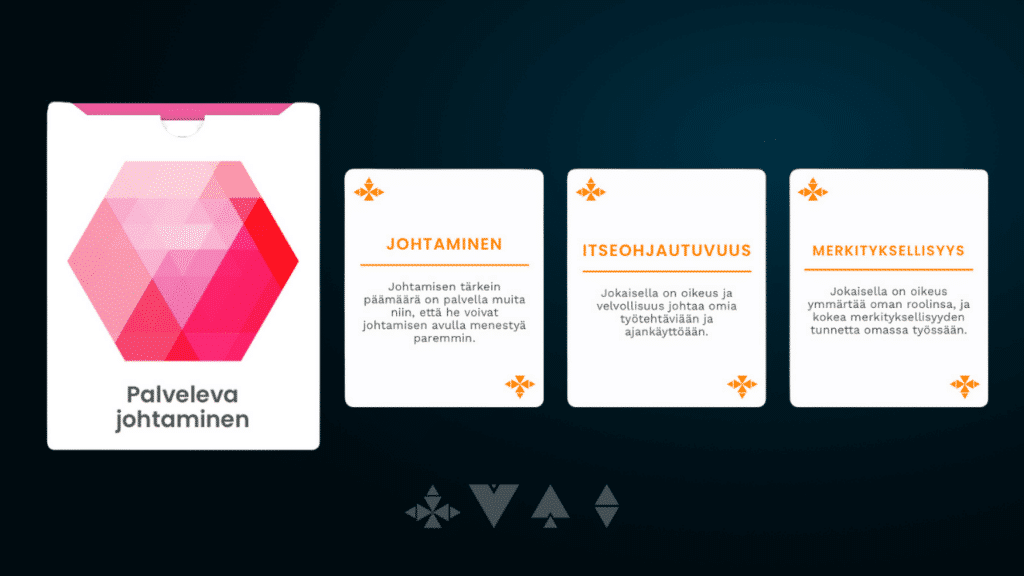
Topaasia - Servant Leadership, a serious game for developing leadership and leaders
Topaasia and Mikko have together created the game content Servant Leadership for Topaasia's service offering.
The Servant Leadership game is available to all Topaasia customers and anyone can test it through a free trial period.
“I wanted to make this deck so that every organisation would have the chance to get to know the principles of servant leadership through play. And to test, in a facilitated way, whether the servant leadership philosophy would be the right way for them to lead. It is not the case that it works for everyone, one size fits all, but some principles of servant leadership can most certainly be adapted to every single organisation,“ Mikko says.
Topaasia's Servant Leadership game consists of four themes, which are the conception of the human being and values, principles and tools, internal and external communication. Under each theme there are topic cards related to that theme.
“The topics of the Servant Leadership game are important because they allow an organisation, through practical examples, to define which matters leadership or supervisors should take into account and emphasise in order to practise a motivating, inspiring and human-centred leadership culture.” Mikko stresses.
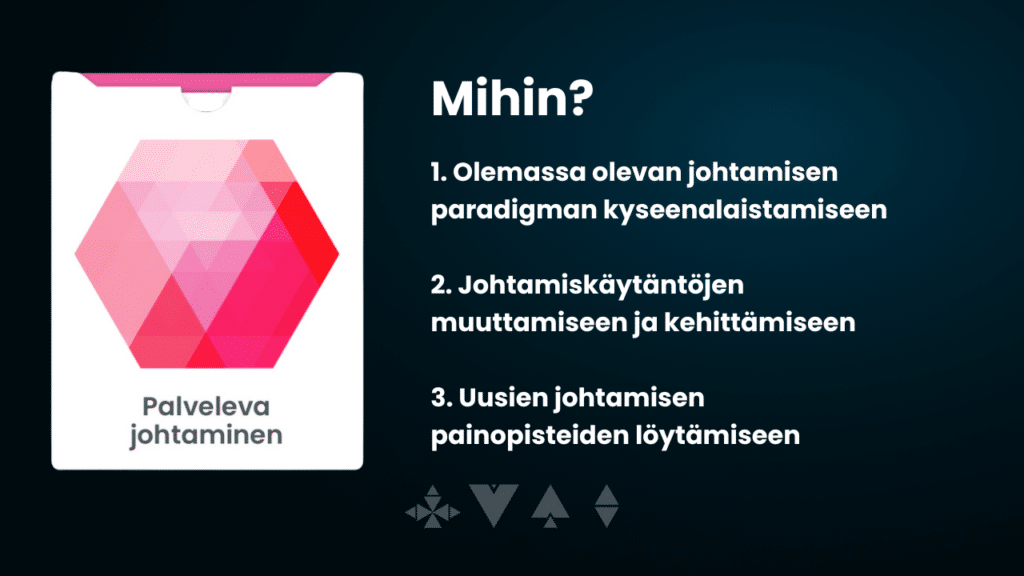
What is the Servant Leadership game suited for?
Mikko says that the Servant Leadership game is intended especially for the following situations:
-Questioning the existing leadership paradigm
-Changing and developing leadership practices
-Any situation where you want to find new focus areas for leadership.
“The context you move in when using this game is modern servant leadership and its principles. It is a philosophy that creates a foundation for decision-making. The philosophy contains quite a lot of moral, ethical and values-based reflection,” Mikko clarifies, and goes on to explain why it is worth setting aside time for philosophical reflection on leadership:
“Once you understand the philosophy of servant leadership, it automatically starts to guide the organisation's decision-making so that alongside the hard substance, the human aspect is also taken into account. That is important because even though decisions can be made in cabinets, management teams and boardrooms, for change to take root, people need to join in carrying out the decisions with their own motivation and humanity, and to believe that it can achieve a common good.”
This deck introduces people, in a facilitated way, to the perspectives of servant leadership. It helps you choose which matters to focus on if you want to develop in servant leadership, both as an individual and as an organisation.
-Mikko Bäckström
Who is the Servant Leadership game intended for?
The Servant Leadership game is intended for everyone working in leadership and supervisory roles in an organisation, as well as for people whose work involves developing leadership, company culture or the employee experience.
“Both people at the expert level and people working in leadership and supervisory roles can benefit from playing this deck,” Mikko says.
The deck can be used when starting to communicate a change in the organisation's leadership. If you want servant leadership to succeed in an organisation, it is worth communicating widely across the organisation what it means, what it is based on and what kind of change it can bring about.
“Carrying out the change does not happen solely from the management team, the CEO or the board; the whole organisation must take part in the change. The deck is really intended for everyone working in the organisation, but the first step is often that supervisors and the people who make formal decisions get to know the subject and understand what it is about.” Mikko describes.
Learn more about servant leadership
1) Google the term servant leadership
2) Servant leadership was conceived by Robert Greenleaf in 1970. By googling Greenleaf you will find plenty of material on servant leadership.
3) There is also literature on the subject. Mikko says that a book on the topic written by a colleague will soon be published in Finland as well. Mikko will later publish his own book on servant leadership too.