
Marita Heinä and Anna Kaisa Ojala work as HR planners for the City of Turku. They are part of the city's HR services and coordinate matters relating to wellbeing at work, competence development and work ability management. Together with Topaasia, Marita and Anna Kaisa have created the From Survey to Personnel Discussion game deck, based on the Kunta10 survey, for public use in Topaasia's digital service. The game is designed for regular work community dialogue aimed at realistic development of everyday work. In this blog, Marita and Anna Kaisa open up their thinking about developing the work community and the background of the game deck.
A game based on the Kunta10 survey for pulse discussions that develop the work community
Anna Kaisa says she has been thinking for years about the meaningfulness of measurement and about how to help personnel see how measurement guides everyday work and activity.
“We live in an age of metrics. Work communities give feedback that the benefit of measurement is not always visible in everyday work,” Anna Kaisa says, and describes the need that started the development of a game based on the Kunta10 survey:
“The From Survey to Personnel Discussion deck grew out of the need to speed up the Kunta10 discussion held in work communities, and to offer a low-threshold way of regularly raising wellbeing-at-work matters through pulse discussions. Kunta10 is a long-term national follow-up study coordinated by the Finnish Institute of Occupational Health, which tracks the development of wellbeing at work in municipal organisations. It began at the end of the 1990s and, as things stand, will continue at least until 2030. The long-established framework is very familiar to part of the personnel. It provides a really good frame around which to hold a conversation about wellbeing at work.”
Marita describes how surveys do not easily lead to the level of concrete actions, and how playing helps with concrete everyday development:
“With the discussion deck we get genuinely concrete actions on the matters that come up for development in surveys or in everyday work in general. Through the game, the participants agree concretely on what will be done, in a way that also gives the participants and respondents responsibility for putting things into practice.”
With Topaasia, the development targets naturally become concrete enough, small actions that the group can really commit to.-Anna Kaisa Ojala
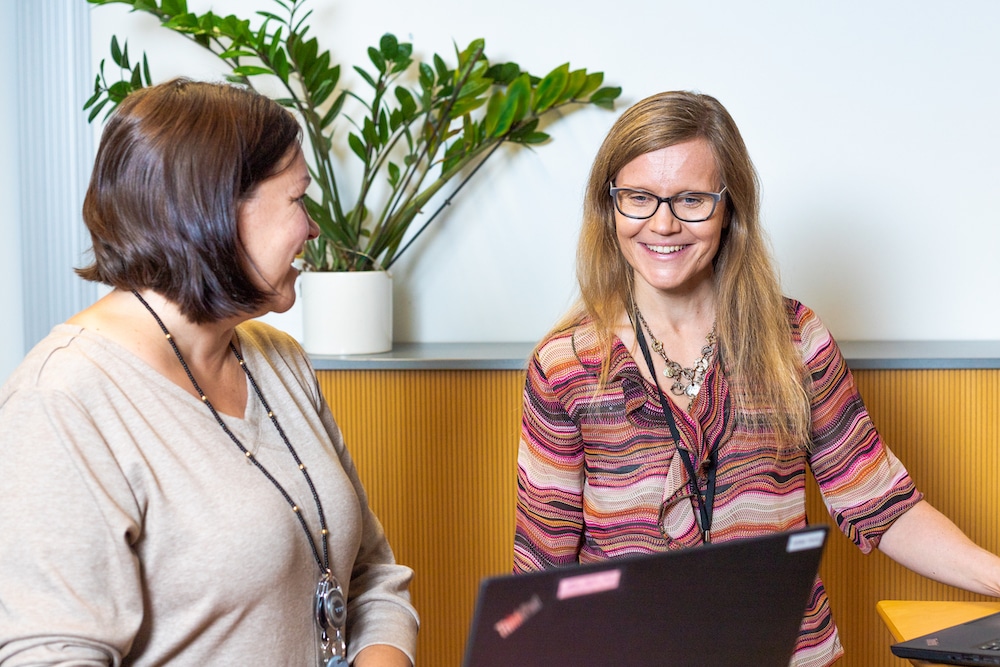
Marita Heinä and Anna Kaisa Ojala
The From Survey to Personnel Discussion game deck is designed for regular work community dialogue
The From Survey to Personnel Discussion game deck partly draws on the structure of the Kunta10 survey, and the deck has four themes: collaboration, leadership, competence and learning, and addressing inappropriate behaviour. The deck is designed for regular work community dialogue aimed at realistic, personnel-driven development of everyday work.
“Nowadays there is a lot of talk about pulse metrics and pulse surveys. Why wouldn't we have pulse discussions? Does there always have to be a pulse metric? This tool enables a regular pulse discussion that engages everyone, and it also includes those colleagues who have recently joined the team and were not part of the Kunta10 round. This kind of pulse discussion is truly needed. Meetings are still surprisingly often about giving and receiving information, and the genuinely dialogic meetings are left in the minority,” Anna Kaisa reflects.
Marita describes how quick pulse discussions support personnel surveys:
“Surveys are done once a year or every other year. The idea here is to take up a regular tool that can also be used briefly. Half an hour of some meeting a few times a year could be enough. The topics for the game would be taken from the Kunta10 survey or from interim surveys, and then we look at how we, here in our unit, could make this concrete.”
Anna Kaisa stresses, however, that pulse-style personnel discussions are not meant to replace strategic measurement, but to help bring it into the everyday life of the work community.
“We do not think this could replace strategic measurement. That is not the idea; the idea is precisely to bring it alive in everyday work. As one more angle I would add that this supports strengths-based conversation. From strategic discussions it is terribly easy to pick out the items in red that must be reacted to one way or another. These pulse discussions also help to regularly nurture strengths-based development and thinking."
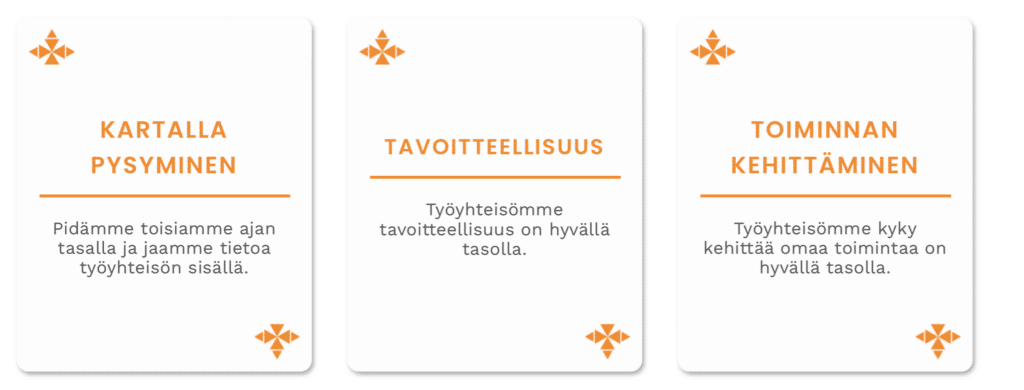
Example cards from the game “From Survey to Personnel Discussion”
The soft stuff is the hard stuff
Why is it worth increasing and promoting personnel discussion with the help of a game? Anna Kaisa and Marita have a clear view on this: at its core, a dialogic operating culture has a strong effect on personnel wellbeing.
“The mission of my own work is to reduce the risk of work disability, and I think we in Turku are getting to a good stage. We are starting to see that strengthening a dialogic operating culture is reducing the risk of work disability. It has somehow been considered too soft a matter, but now people are really beginning to understand what an enormous impact it has on wellbeing,” Anna Kaisa says, and Marita continues:
“Beyond the wellbeing angle, the discussions help bring up competence development matters: what kind of competence development is needed, what kind of development of their own work individuals themselves need to do, and what we should do together to make things work?”
How to hold a dialogue with the From Survey to Personnel Discussion deck
- Start a Topaasia trial period
- Get to know the game on your own or with a Topaasia expert
- Play a game session with your teams using the deck “From Survey to Personnel Discussion"
Thank you Anna Kaisa, Marita and the City of Turku!