
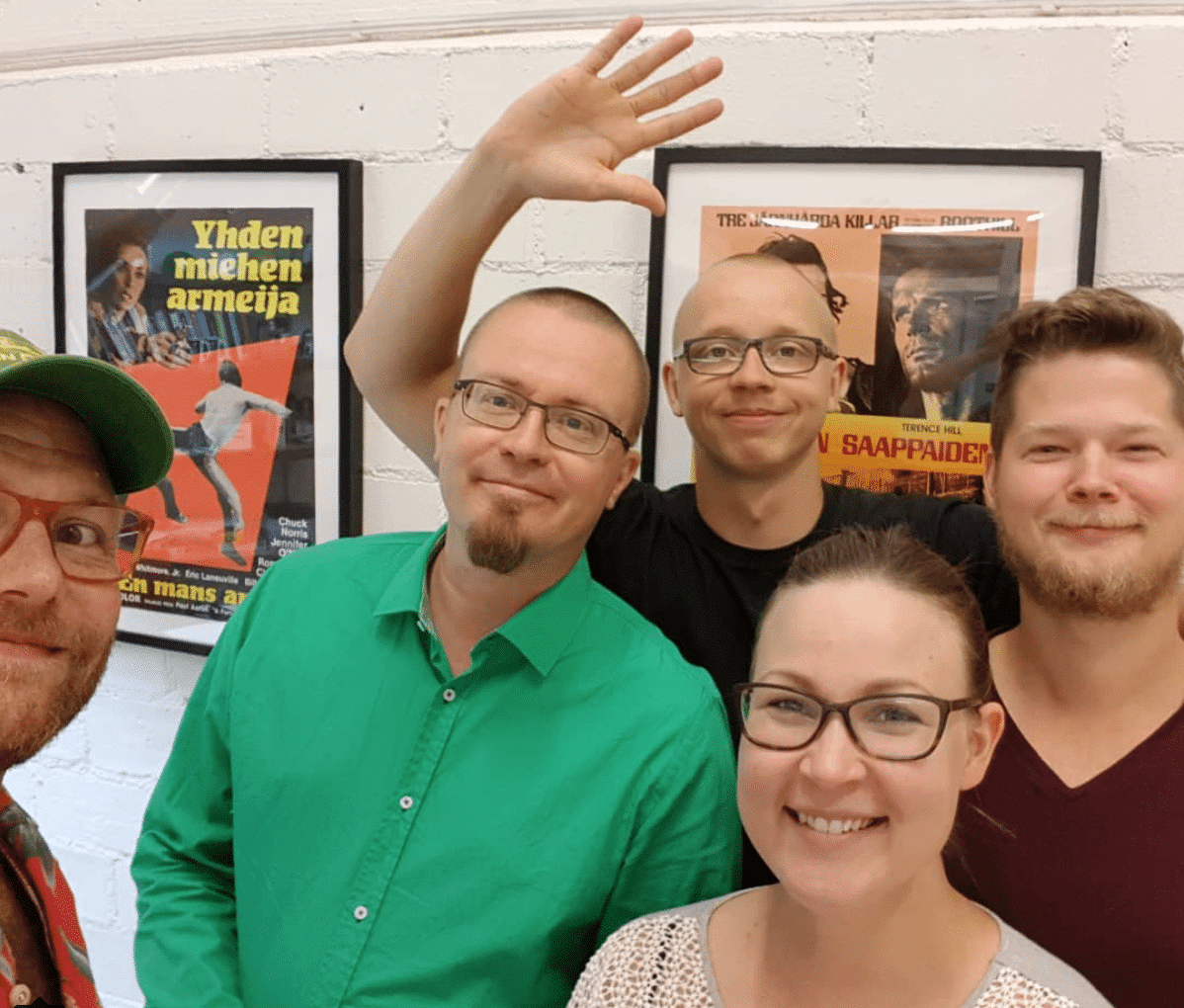
To kick off the autumn we took part in the first podcast interview of our lives, hosted by Seymour Consulting Oy. The topic of the episode is a fitting one for us: "Serious games as tools for facilitating dialogue". Joining us as a podcast guest was J. Tuomas Harviainen, professor of information studies and interactive media at Tampere University.
Listen to the podcast episode or read the summary written by Seymour's Pekka below:
YOU CAN LISTEN TO THE PODCAST HERE
What do we mean by serious games?
According to professor Harviainen, a serious game generally means any game that is played for a reason other than pure entertainment. Serious games are also often designed for other than entertainment use. Serious games can include various simulation games, in which you might run a virtual municipal economy or learn to fly an aircraft. They can be purely digital strategy games or, like our example Topaasia, physical card or board games. The roots of serious games lie in early board games that were used to practise strategy and to depict the movements of military units on the battlefield. Because the games gave their users a competitive advantage and produced good results, officers who had left active service gradually began bringing games into business practices as well. Today, serious games are indeed used most in military command, business management, crisis resolution and school environments, where games and simulations make it possible, among other things, to try out alternative solution models in a safe environment.
Why and how are serious games used to ease dialogue?
According to Jussi Galla, at their best serious games offer their users a social structure that creates the space, the time and the permission to engage in dialogue. The purpose of serious games that ease dialogue is thus to create an environment in which dialogue is possible in the first place and in which it can be conducted in a way that differs from the usual. According to professor Harviainen, in games of this type the rules enable equality of ideas and ensure that the voice of everyone taking part in the game gets heard. The views of an individual team member, a customer or even the CEO about, say, the business environment are for a moment on the same line and open for everyone to examine. According to Harviainen, serious games bring existing practices and hidden knowledge to light in an entirely new way, while at the same time enabling new knowledge to emerge.
At the same time as games break routines, they inspire people to have conversations about matters that may sometimes even be difficult. With serious games such as Topaasia, you can also create continuity in a world that is otherwise changing at a fast pace. By making games part of routines, you can also collect trackable data on decision-making. Depending on the game used, this can be achieved with a very small investment of time and money.
We at Seymour were interested in bringing serious games into the design and implementation of new and better working-life practices. Some time ago we got to know Topaasia and its developers Jussi Galla and Ville Häll. After getting acquainted, we decided to make it part of the development processes we design for our customers. Topaasia is a card game intended to ease the dialogue and decision-making of a team of 3 to 10 people. We saw that games like this help especially teams struggling with continuous improvement to stay reflective about their own ways of working. According to Jussi Galla, the idea behind Topaasia is indeed a game that would help a team, instead of holding long meetings, to have a more effective internal dialogue about what practical things the team should do next to make its work better. The first card decks were developed for software developers, especially to facilitate retrospectives. Now there are decks for the needs of the work community, customer experience and software development alike.
Besides helping people engage in dialogue at the very moment they are played, games can also help break free from old ways of dialogue that may have been found poor. At its best, Topaasia or a similar game changes and supports the players' way of perceiving the reality of the business landscape, so that instead of linear solutions the players are able to see their actions as part of a complex whole. Games can also be used to create a new kind of culture of action, make it easier to get to grips with things and develop non-verbal communication. When playing games like Topaasia, however, it is important to make sure that the things decided during the game can also be carried out.
The future of serious games
According to professor Harviainen, various business simulations and learning games will continue as the big trends in the field. On a particular rise, however, are various HR tools that enable, for example, a better communication culture, innovation and working together. Even though serious games bring a lot of good with them, Harviainen reminds us that through their rules they also constrain action and communication. Games are terribly good at teaching system dynamics and the fact that things have more than just one direct consequence. When playing serious games, however, it is also worth staying alert. By creating precise rules for how problems are approached, they may also easily make us see things in a more limited way. A further challenge for the future of games is that product developers fall into "gamifying" things that already exist, without bringing anything genuinely new or of real benefit to the situation.
Generally speaking, the number of games that facilitate the decision-making and dialogue of groups of people in particular will grow in the future. As the complexity of business environments increases, so does the need for continuous development and learning. Continuous development and learning, in turn, are impossible to achieve without functional and effective dialogue between different actors and solutions that support it. From games designed for small teams, we will probably gradually move towards game solutions that facilitate the dialogue and decision-making of ever larger groups of people.
Thanks to the Seymour crew and Tuomas!
You can find Seymour Consulting here: website, linkedin, instagram, twitter
You can find J. Tuomas Harviainen here: website, linkedin
You can buy Topaasia® games directly from our online shop or, if you want to know more, get in touch or call Jussi Galla directly on 040 - 024 6626