
People usually start looking for a tool for development discussions and one-on-one meetings when the current way has begun to annoy them. Word forms are scattered across managers' laptops, nobody knows whose discussions have been held, and last year's notes turn up only when they are no longer needed.
There are plenty of tools on offer, and they promise roughly the same thing. Under the surface, however, they solve different problems. Some take care of the process, meaning that the discussions are held and recorded. Some help with the conversation itself, meaning the hour that the manager and the team member spend together. Few do both well.
This page compares three main options: a form, the HR system's development discussion module and the Topaasia One-on-One serious game.
What should a one-on-one meeting tool do?
Before comparing, it is worth deciding what the tool is needed for. There are four points in a development discussion where a tool can help.
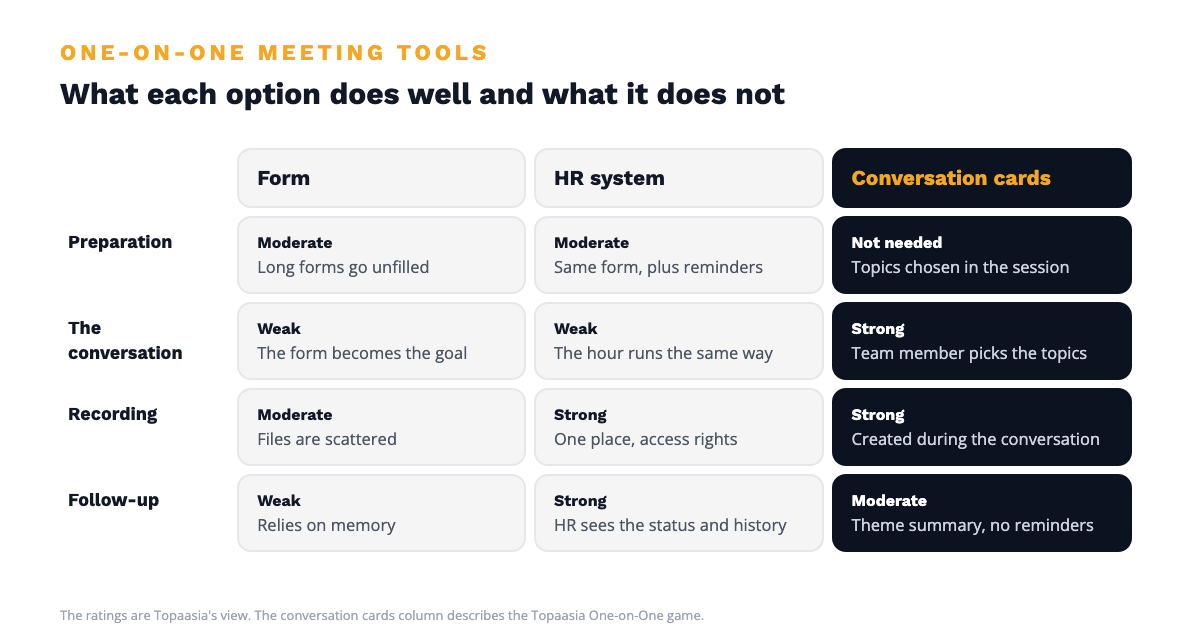
- Preparation. The tool helps the employee and the manager think in advance about what is important to talk about.
- The conversation itself. The tool gives the hour a structure, keeps the topic on the person and makes sure the employee does the talking.
- Recording. Agreed actions, responsibilities and the check-in point are saved so that both see the same text.
- Follow-up and the big picture. The discussions are revisited, and HR sees that they have been held and what themes come up in them.
Most tools are built for points 1 and 3, because those are the easiest and most visible problems. The employee's experience of the conversation, however, is decided at point 2. If the hour is spent going through a form, it does not get better because the form has been moved into a browser.
What a good development discussion looks like regardless of the tool has its own guide: development discussion: what it is, why it matters and how to do it well.
Option 1: a form
A form is the most common development discussion tool. It is a Word or PDF template, a Forms survey or an Excel sheet that the employee fills in beforehand and the manager reads before the conversation. In the conversation the form is gone through together, and at the end the agreed actions are written into it.
Where a form is good. A form is free and familiar to everyone, and taking it into use requires no purchase or training. It makes sure the same topics are covered with everyone, which matters if the discussions are required to be consistent. A good form also supports preparation, as long as it is short.
Where a form is weak. The problem with a form is that it easily becomes the goal of the hour. The employee reacts to ready-made statements instead of telling what is important to them right now. At Entteri, some team members left the form completely unfilled and some filled it in sparsely, because putting their own thoughts into finished sentences felt difficult. In addition, the files stay scattered, so follow-up and the big picture depend on the manager's memory. Depending on the manager, going through a form can also be awkward and uncomfortable.
People are, generally speaking, tired of the form.
Who a form suits. A form suits a small organisation where there are few discussions and the managers are experienced conversationalists. Then the form is a checklist, and the actual work is done by talking. Three different templates are presented in the article three development discussion templates for managers.
Option 2: the HR system's development discussion module
Most HR systems have a module of their own for development discussions and performance reviews, and there is also software on the market made purely for performance management. When people search for one-on-one meeting software or a performance review app, this is usually the option they mean. The principle is the same as with a form, but the form lives in the system, and a process has been built around it.
Where an HR system is good. The system handles the process better than any other option. It sends reminders about the discussions, shows HR whose discussions have been held, and keeps the records in one place behind access rights. Goals, competences and training needs can be connected to other people data, and last year's agreements can be found with one click. In a large organisation these are real benefits that a form or cards alone do not offer.
Where an HR system is weak. The conversation itself does not change. The employee still fills in a form and the manager reads it, so the hour runs the same way as before. The system solves the administration problem, but if the discussions felt like a mandatory chore in Word, they feel like that in the system too. In addition, the purchase is an implementation project, and the price is usually based on the number of employees, which makes the system expensive if it is bought only for development discussions. It is a choice made on the terms of administration, not of the conversation and development.
Who an HR system suits. The system suits an organisation that has hundreds of managers and where the content and quality of the development discussion do not matter, as long as it can be shown to have taken place.
Option 3: conversation cards
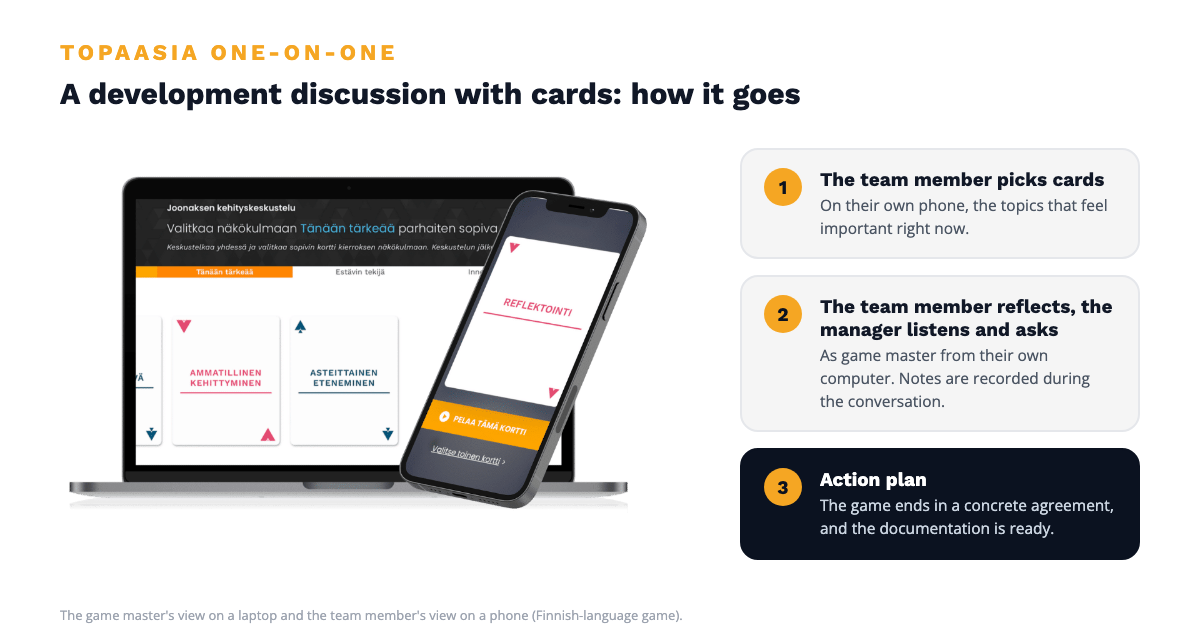
The third option starts from the other end. Conversation cards are made for the hour that the manager and the team member spend together. Each card is one topic, for example meaningful work, feedback or personal wellbeing. The team member picks the cards that feel important right now and explains why. The manager listens and asks follow-up questions.
Topaasia One-on-One is the digital version of this. The manager acts as the game master from their own computer, the team member picks the cards on their own phone or computer, and the game steers the conversation towards choosing the one most important thing and a concrete action. The record is created during the game, so notes are not written up in the evening. The game works the same way face to face and remotely. The session then helps the team member genuinely reflect and raise the topics that matter to them, and helps managers act on the principles of coaching leadership.
Where cards are good. Cards change who does the talking. When the team member chooses the topics, the topics are their own, and it is easier for the manager to stay a listener. Elisa Laatikainen from Entteri describes the difference like this:
"The Topaasia session felt more like a coaching conversation. The team member chose the cards themselves and talked about them. The team lead's role was to listen, ask, spark thoughts and help sharpen what matters."
No advance form is needed, which saves time for both. According to the calculation of the managers at Entteri, the form took the employee from half an hour to an hour and the manager the same amount for reading, before the actual conversation had even started. With cards this phase drops out. Cards also work with quiet team members, because choosing a card is easier than filling in an empty text field.
Where cards are weak. Topaasia is not an HR system. It does not send reminders about discussions, does not manage goals or competence profiles, and does not connect to pay or other people data. If the organisation needs a numerical performance rating or exactly the same questions for everyone, cards are the wrong tool. Cards also require the manager to be willing to hand the choice of topics to the team member, and that can feel uncomfortable for some at first.
Who cards suit. Cards suit a manager and an organisation that is dissatisfied with the quality of the discussions, not with their administration. The typical situation is that the discussions are held, but they feel like going through a form and nothing follows from them. Cards can also be used to show that the discussions have been held. Gamified development discussions are described in more detail on the development discussions page.
Can the tools be combined?
The options do not exclude each other, and in a large organisation a combination is often the best solution. The HR system takes care of the process: reminders, the archive and follow-up. The cards take care of the conversation. In practice the manager holds the conversation with cards and attaches the summary produced by the game to the system, so HR sees the same information as before.
The documentation is enough for more demanding use as well. At the software company Quanscient, SOC 2 and the upcoming ISO 27001 require that development discussions are documented. According to CEO Juha Riippi, the documentation produced by the game meets the requirements as it is, without a separate form process. The experience is described in Quanscient's customer story.
What does a one-on-one meeting tool cost?
Prices are hard to compare directly, because the options are priced in different ways. Three things are still worth calculating.
A form is free, but using it is not. If the employee spends 45 minutes filling in the form, the manager the same amount reading it and another half hour writing up the notes, each discussion takes two hours of working time on top of the conversation itself. In a team of fifteen that is 30 hours per round.
HR systems are usually priced per employee per month. The total price depends on the size of the organisation and on which other modules are taken into use. On top of that comes the implementation project. If the system is being bought anyway, the development discussion module is an inexpensive addition to it.
Topaasia's development discussion licence costs 900 euros a year at its lowest. The price includes one game master, an unlimited number of discussions and onboarding. When there are several game masters, the price per game master goes down. All prices can be found on the pricing page.
Five questions that make the choice clearer
- Is the problem in the administration or in the conversation? If discussions are not held or records get lost, you need process. If the discussions are held but lead nowhere, you need help with the conversations themselves.
- How many managers will use the tool? A few managers get by with a light solution, and in an organisation with dozens of managers HR needs a view of the whole.
- What is required of the documentation? Find out whether a record of the agreed actions is enough, or qualitative content on the themes, or whether other data is needed, such as goal metrics or a link to rewards.
- How much time is spent on preparation now? If the forms are left unfilled, moving the form into a system does not fix the situation.
- Can the tool be tried in a real conversation before the decision? A demo tells you about features, but only one real development discussion tells you whether the conversation changes.
Frequently asked questions about one-on-one meeting tools
What is the best tool for one-on-one meetings and development discussions?
The best tool depends on which problem is being solved. An HR system is strongest at managing the connections between many processes, cards at the quality of the conversation itself, and a form when there are few discussions and the organisation does not yet want to invest in them. Many organisations use two side by side.
Can Topaasia be used together with an HR system?
Topaasia can be used alongside an HR system. The conversation is held with cards, and the summary produced by the game is saved in the system in the same place where the records have been before. The HR system takes care of the process and Topaasia of the conversation.
Does a one-on-one meeting tool work remotely?
HR systems and digital forms work remotely as they are. Topaasia One-on-One works remotely, in person and in hybrid settings. Remotely, audio and video run through Teams, Zoom or Meet.
How long does it take to adopt a new tool?
The time needed varies a lot. Implementing an HR system is typically a project of weeks or months. Adopting Topaasia takes one short onboarding session: at Quanscient it took 20 minutes, and preparing one conversation takes about five minutes.
Choose the tool on the terms of the conversation, not the archive
The value of a development discussion is created in the hour that two people spend together. The archive, reminders and reports are necessary, but they do not make the conversation good. That is why, when choosing a tool, it is worth asking first what helps the manager listen and the team member talk, and only after that where the result is stored.
The easiest way to find out whether cards suit you is to hold one real development discussion with them. The free 30-day trial does not commit you to anything, and it does not require a credit card. If you have several managers and want to see how the discussions are rolled out across the whole organisation, book a demo. More than 1,310 development discussions have been played with Topaasia, and participants have rated them 4.59 out of 5.