
This post is one of the "homework assignments" born during a juicy mentoring experiment with the founder of Tiimiakatemia, Counsellor of Education Johannes Partanen. As inspiration I used his article on the book The Innovators Way - Essential Practices for Successful Innovation (Denning, Peter J. & Dunham, Robert, MIT Press 2010, ISBN 978-0-262-01454-0)
The first practice: sensing
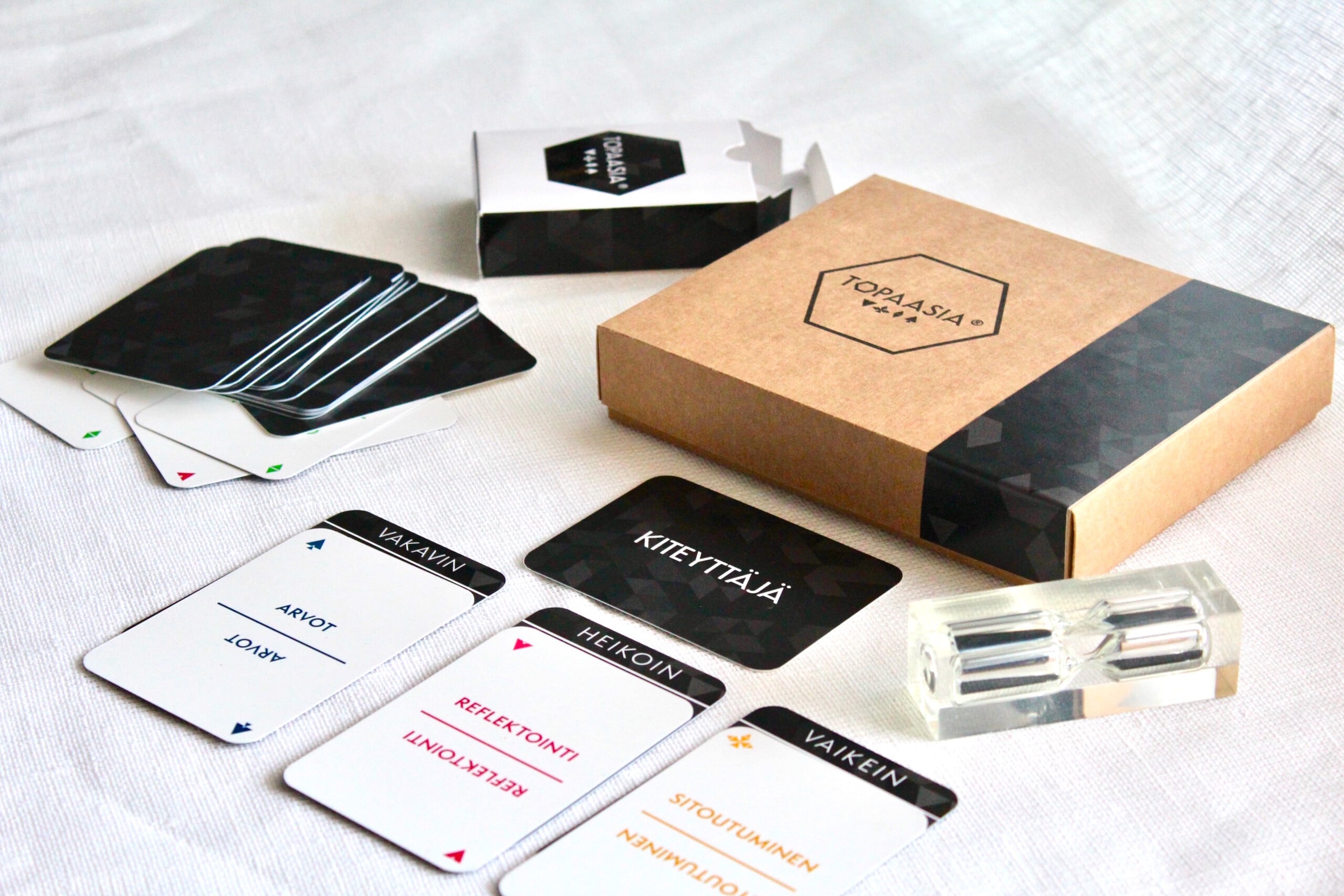
Topaasia® is built on a view of people that trusts team members' ability to solve their challenges independently. The underlying idea is not to gamify the team's work but to create the conditions for an environment where dialogue can emerge. Topaasia® is not in itself an environment for dialogue; rather, the purpose of the method is to make dialogue a more familiar way of dealing with things, which can increase the conditions for having dialogue.
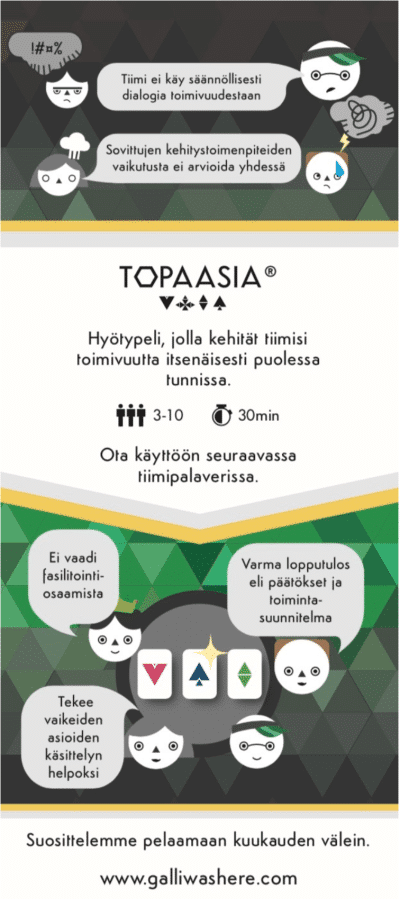
We do not sell dialogue but a tool with which teams can coach themselves and solve everyday problems, such as
- problems are not talked about directly and there is not enough direct feedback
- the shared direction is lost
- the team is stuck and needs new perspectives
- there is no time to hold team development discussions
I believe there is a growing need for tools that support teams' self-direction. It would also appear that self-direction (and the pursuit of it) is something of a trend.
The second practice: envisioning
GWH's vision has remained fundamentally the same throughout our short history: we are looking for a valid answer to the question "how would the world's largest consulting company operate without consultants?". The same can also be expressed as: "let's build the world's smallest consulting company that produces the most value".
This has proven to be a workable direction for the following reasons:
- the vision inspired and amused customers, especially in the early days
The third practice: offering
It has been important for us (while respecting the chosen direction) to detach ourselves from the product, so that we understand what the customer's problem is and what the factor is that truly produces the most value. We strive to do this work in environments where a great deal is invested in developing the team's work and where things are, as a rule, handled better. That way we can be confident that we are making a product that PROBABLY produces value also where things are not going so well.
In practice, understanding has accumulated piece by piece and the product's features have been pruned so that the most essential remains, and we have succeeded in packaging the lessons of the top performers into an easy-to-use form.
The fourth practice: adoption
Easy adoption has been a bottleneck for success, and we have paid more attention to this lately. It would seem that in order to adopt a new way of working (in this case the use of the Topaasia® serious game), the adopter must recognise an EVERYDAY problem, understand the benefits that MAKE EVERYDAY LIFE EASIER, grasp the situation of use without TOO MUCH NEWNESS being introduced, and be ENCOURAGED to try it out.
Identified situation of use:
- teams do not give and receive enough direct feedback
The fifth practice: sustaining
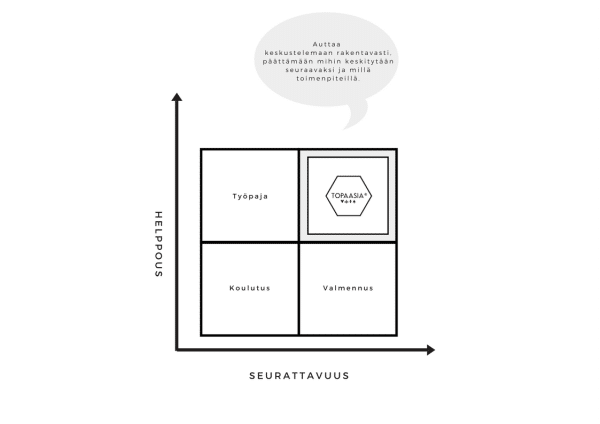
In Topaasia®'s case, sustaining means a so-called tangible aid, in other words a solution to continuity. This idea crystallised about 2 years ago when service designer and serious games researcher Otso Hannula described the problem field as follows: in a workshop / similar encounters that steer towards developing the work, a huge pull is created, after which everyday life returns, the pull disappears and there is a danger that nothing changes. A significant problem is that the bridge between workshopping and everyday life is left missing.
We must solve the customer's problem of "the outcomes of workshops are not revisited and their impact is not evaluated together", which means Topaasia® must also help team members build a story that carries between sessions. The most recent solution to this is the Topaasia® canvas.
The sixth practice: executing
Topaasia® must produce value for people working in different roles, and we must earn the trust of those working in these roles, which ensures execution. It would seem that the parties essential to Topaasia® and their interests are:
| Role | Interest |
|---|---|
| HR Director | How do I help our teams and people in their work and in experiencing meaningfulness? |
| Agile Coach | How do I help teams develop their ways of working independently? |
| Scrum master | How do I help the team focus on the essentials? |
| Project manager | How do I improve my team's work even further? |
| COO | How do I make sure the teams are heading in the desired direction? |
It is clear that we must soon also address the interest of the CEO's role, and this will possibly happen once we get research and numbers to back up Topaasia®'s impact.
The seventh practice: leading
Topaasia® must support teams in shared leadership. This works well in the game situation, where everyone participates, is on an equal footing and the outcome is reached together. Making the knowledge formed in the sessions visible is more challenging, and this is a significant area for development, as I want to see Topaasia® supporting leadership between teams as well. This will be solved once we find the factors that effortlessly support transparency.
The eighth practice: embodying
I would argue that this is still lost, and our activity has indeed consisted of a mixed soup of product development, continuous improvement and sales work. We have received a lot of help from Finnish agile coaches, but we have not known how to build a community. And I am not sure whether that is even the right way, or whether we should do something completely different. Perhaps we should rather build something that helps people share their experiences, that is, support a sense of community without the burden a community brings.
It would be great to create a framework that supports Topaasia® users in sharing pictures of the outcomes of sessions, because that alone awakens the imagination, which in turn would support learning and, in the best case, encourage dialogue.