
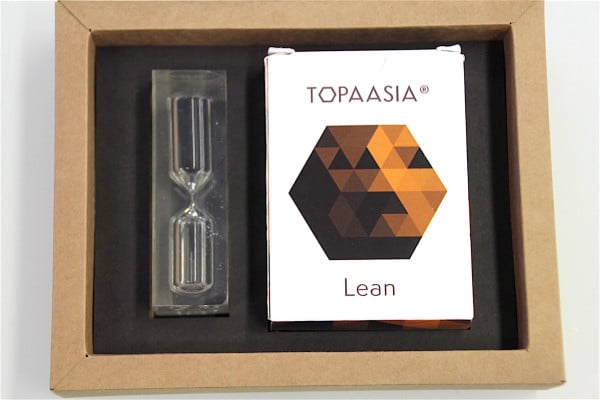
The content of the Topaasia® - Lean game was created together with lean masters Miika Kuha and Karoliina Luoto. Both work at Codento and are closely involved with lean. After the game was created, our Jussi went to interview Miika and Karoliina and asked what kind of game it turned out to be and why.

Why is lean an important thing to discuss?
It encompasses continuous improvement, understanding the customer, vision and believing in people, which are in a way the foundations of any sensible and sustainable activity. If you do not have them, you are in trouble even if you did not know the word "lean" existed at all. You need some framework in which you operate, test your assumptions and make sense of your world. Lean is a framework that has been pressure-tested fairly convincingly. It works and pulls all the necessary pieces neatly together. Over more than 50 years already.Lean contains a lot of concepts and ideas that are worth rethinking every time: do we need each of them in this particular context of ours? Lean should not be thought of as a collection of individual tools, "oh well, let's take Kanban now" or "let's implement some other thing from there". It is more that you need to understand those few key points, which have been identified in this game too, such as who is your customer? What is the vision? How do you relate to the world through continuous improvement? Only then should you think about how to improve, such as "okay, now let's manage our work queues with the kanban method" or do lean startup work.
The first suit of the Topaasia® - Lean card deck is "respect for people":
At Toyota they say Monozukuri wa hitozukuri. With this first suit of the deck we want to unpack that idea, meaning Respect for people: to grasp the understanding that developing things is about supporting people's growth. If you want people to do something together, it pays to create the conditions in which it is good for people to do so. This raises the question: how is that created? Some people may have got stuck in a stagnant state and are content with it, but quite a few people feel joy from learning new things by doing them together.
What is usually the biggest challenge in this theme (respect for people)?
It is something between one's view of humanity and appreciation. In our leadership culture, top-down thinking is really deeply ingrained. Even in workplaces where it has been decided that we will now work the lean way or put people first, practical ways of working easily slip into "I am now ordering you". Even when there is a desire to change, the leadership habits lodged in the spine still exist.
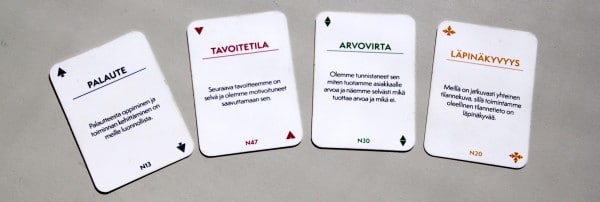
Other common problem topics, in other words cards in this game, include coping, conflicts, preparedness, letting go and successes. All of these follow once we truly have our view of humanity in place and we genuinely appreciate people. Likewise, "professional development" and "listening to a colleague" spring from appreciation, and it is natural when we have a shared understanding that we first see each other as human beings and try to get something done together. Feedback and observation must be done with open eyes. Nor is the absence of those other things such a bad problem if those foundations are in order. Not getting feedback is not such a bad thing if I have the feeling and knowledge that at heart I am nevertheless appreciated. Then individual things do not bother so much, because basic trust is already in place. Then fixing one missing thing is also much easier. Even a single conflict is not such a bad thing if people's appreciation of each other is in place. Then that single issue becomes a matter of "Hey, let's talk about this. How do we solve this?" A problem is more easily seen as an opportunity to grow. Without basic trust, other corrective moves easily feel bolted on.
There really is no lean at all without continuous improvement. If customers, problems and processes are identified only once, and nothing is done about them afterwards, the activity would not make much sense. In a pre-Darwinian world this might have worked. Then it was understood that things and the world evolve and that evolution exists. If we have a changing universe, it is rather foolish not to change yourself. It follows that change must be continuous. In business it is also silly to think "this level is enough for us now, we do not need to improve from here". As soon as you notice yourself thinking like this, it is worth remembering that it may be a sufficient level for that one day, but the very next day someone can grab a slice of your pie. A couple of weeks later a few customers disappear, and later still you realise you are no longer keeping up with the pace of development. That happens surprisingly often.
The challenge, then, is how do you keep the process of continuous improvement running? How could you get it to permeate everything you do? Many have some patent solution like the stick or the carrot: "your crew over there looks tired, I'll throw them some chocolate, then they'll get through that next workshop". But it is worth considering whether you could do something else. Could I come up with something other than throwing chocolate as motivation, and what could it be? The role of continuous improvement is not an easy one.
The biggest challenge in this suit?
One of the most essential things, that is cards, in this deck is discipline. Many things are easily solved if there is a pinch of discipline. Transparency is usually the very next problem, but it too is more easily solved if there is will and discipline. Metrics is also an essential topic. To get the metrics in the right place, you need transparency and flow efficiency, and you start to understand them better through metrics.
Failures is a companion to the previous theme. It means being ready for the idea that there is something in us to improve. We do not need to spend energy on explaining every problem away; instead we can safely start from the premise that we have things to improve and that is okay. We do not face a problem situation as if it should be immediately removed and forgotten. Root causes speaks of the readiness to get to what is really going on and, in a way, to look the truth in the eye. The core challenge in this suit is probably that Failures card: we celebrate failures and learn from them. It says that failures are not an unpleasant and frightening thing. Or they can be frightening, but we are able to live with that kind of uncertainty, because we nevertheless have the means to fix the problems.
You can do many wondrous things in the world, but if you need to make a living, there has to be someone who thinks it is a sensible thing to do and is willing to pay for it. That is how the customer comes into the game as a rather important part. You want to know what the customer thinks about what you do, so that you can genuinely please the customer. The customer is the final mirror that tells you how things are. The customer is the starting point for continuous learning. You have to keep a constant pulse on the comfort ratio. If your own comfort and pleasing yourself take priority over delighting the customer, it may be fun for a little while, but before long you may need to find a new source of revenue.
The customer is a true pair with continuous improvement. In this deck, the main features of lean are in a fine order and nicely in pairs, as respect for people and continuous improvement are very tightly connected to each other. Likewise continuous improvement and the customer. And then again the customer and the vision. It is also worth thinking from the customer's point of view: "relative to what" are you improving? If you discover that the customer has a stone in their shoe and it chafes, and you remove that stone, is that a successful solution if the customer's goal was to get a really big blister? Then it was not improvement after all, even though in my opinion it was a really good idea. It is worth asking whether the improvement and the actions are genuinely made in relation to the customer.
The biggest challenges in this suit?
The importance of the customer perhaps rises to the top, because if it is not acknowledged, everything else loses its meaning. We must understand that our organisation exists for the customer. It follows that we must understand that customer's needs. Here you need quite firm trust with the customer for this to really be possible. Reliability and developing the offering are consequences of understanding the customer.
The Impact card could also be the biggest challenge. Once the customer's deepest needs and problems have been understood, how can they then be influenced more deeply and genuinely? That of course relates to gathering understanding and many other things. Then, once the basics are in place and the customer trusts us and is happy with what we do, surprising the customer starts to emerge and you can do the icing-on-the-cake things. You cannot really do those until trust is in place and you genuinely understand what the customer needs. There is also a card here for the very advanced called Responsiveness: we are able to react to unexpected changes so that the value experienced by the customer is not disrupted. This card already assumes that the value the customer receives is understood and that we already have some way of delivering it to the customer. While playing, that card may strike a chord: "wait a minute, we do not really know that value", and then you go to the value stream card and consider whether it is in order. Have we identified how value is created for the customer and what is not worth doing? Something is being done but no one quite knows who the customer is, and this is how things are discovered and the whole thing starts to unravel.
The two previous suits describe who you develop for and how you develop. That works in the moment. This suit brings in an understanding of change happening over time. It helps you understand when it is important to remove a daily problem and when it is more important to leave the problem behind and move on to doing something new.
The biggest challenge in this suit?
From this suit, the cards Shared direction and Daily leadership rise as the most important. It is very important that we have a shared direction at all, and that we try to understand that a shared direction is not "once in a strategy process" but daily work. Meaningfulness is also quite an important card. A shared direction does not play out very well if no one finds it meaningful. Meaningfulness probably comes first and then the shared direction, because you can think of it this way: people do not want a vision they do not find meaningful. Even if you knew a lot of money would come from some direction, but you do not endorse the means by which that money is being acquired, then it cannot be a shared direction. At Toyota, too, they talk about doing societal good: "We manufacture cars because we see that cars serve people". Yet they are not fixated on manufacturing cars until the end of the world; they want to make a positive societal impact.
Thanks to Miika( Linkedin, Twitter) and Karoliina (Linkedin, Twitter)!
Do check out Codento: www.codento.fi
Order Topaasia® - Lean from our online store or by contacting Jussi Galla, galla@galliwashere.com, 040-0246626