
Kim Väisänen is a start-up investor with a successful exit behind him, a serial failer, a board amateur and a non-fiction author who has a passionate love-hate relationship with entrepreneurship. Now Kim has distilled his knowledge and experience into Topaasia's Entrepreneurship deck. In this interview, Kim shares his thoughts on entrepreneurship in general as well as on the themes of the Entrepreneurship deck.
What is entrepreneurship, Kim Väisänen?
“I would sum up entrepreneurship like this: an entrepreneur strives to reach their goals with their own abilities and with the help of the people they hire. The entrepreneur tries to fulfil themselves and their dream through entrepreneurship. But it is not a straight diagonal line; it goes up, down, up, down,” Kim says and sums up:
“In the words of J. Karjalainen's lyrics: entrepreneurship is like holy rage and great love, yes, I see it all.”
Entrepreneurship in today's society
Kim has been an entrepreneur for 28 years and, in his role as an investor, has seen many companies. Based on these experiences and on research, he has views on entrepreneurship in today's society.
“Mentally, entrepreneurship has changed enormously in people's minds. According to long-term studies of young people, at the beginning of the 2000s only one per cent of young people could consider entrepreneurship as a career option. By the start of the 2020s, this percentage has grown to over 20%. But what is required of an entrepreneur has hardly changed in 20 years.” Kim explains, and describes what entrepreneurship requires:
“An entrepreneur needs a good tolerance for risk, because entrepreneurship is rarely easy, steady and predictable. You need risk tolerance, initiative and perseverance. Quick wins are few and far between. My motto for many things is that good things happen slowly and bad things happen fast. Succeeding in entrepreneurship usually requires very long-term work. Falling from the top, on the other hand, can happen very quickly,” Kim says.

Kim Väisänen has written a non-fiction book on entrepreneurship, Väärää yrittämistä (2018)
Entrepreneurship is a game of intelligence
Entrepreneurship is at its core a game of intelligence, where you get ahead by thinking. Kim illustrates this with an example from Under the North Star:
“Under the North Star is a brilliant book, and a film version has been made of it. The old film version opens with a swamp, a hoe and Jussi. Jussi is on the swamp, he has a hoe, and he hoes away and shouts at the devil. But those who have read the book know that before Jussi starts striking the swamp with his hoe, he does a great deal of thinking: he walks around the swamp here and there, looking at how the water flows and from which direction he should start digging. He processes the matter, and once he reaches a conclusion, the hoe starts swinging.”
When starting out as an entrepreneur, it pays to do a lot of thinking, just like Jussi. Before you start swinging the hoe, walk around the swamp for a long time and consider which direction is worth hoeing in. According to Kim, that can mean intensive mapping:
“If you become an entrepreneur, think about how to succeed in the field you have chosen and who operates there. Today all the information, competitors' products, prices, customer base, can be found on the internet. You can easily do the groundwork before throwing yourself into an industry, simply by sitting at a computer persistently and doing competitor comparisons. You can also do research by phone, since in Finland people are very talkative. You can call competitors' customers and ask whether they are satisfied or have thought about switching.”
Kim Väisänen's four-field model of entrepreneurship
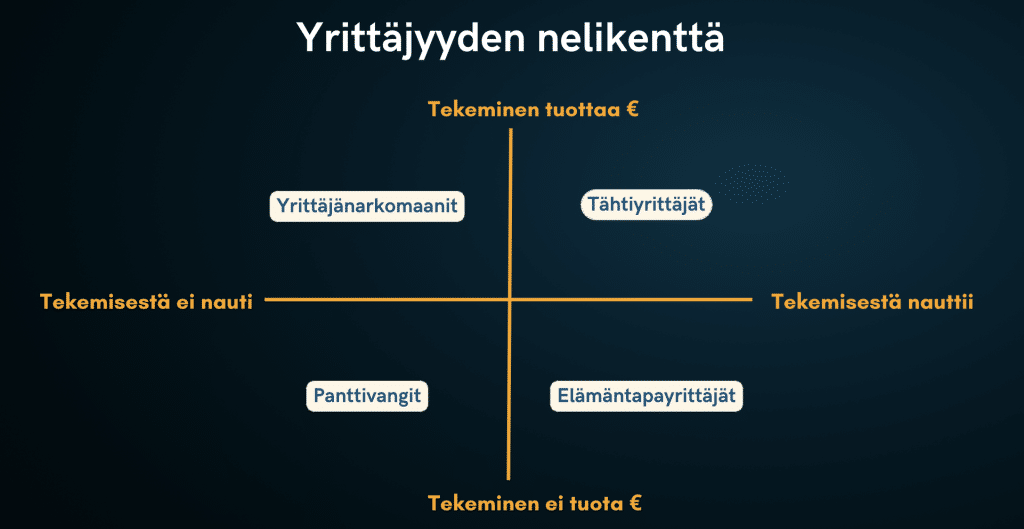
The four-field model of entrepreneurship
Kim maps out entrepreneurship and entrepreneurs with a four-field model:
Star entrepreneurs - In the top right corner is the star entrepreneur. The company is profitable, but it also offers freedom in entrepreneurship and in life. Entrepreneurship is not everything; alongside it run healthy relationships, enjoyable hobbies and taking care of oneself.
Hostages: In the bottom left corner are those for whom entrepreneurship yields nothing and who do not enjoy what they do. They are like hostages without freedom. In that case I recommend giving up. If the work yields nothing now, and you know it will not yield anything in the long run either, while at the same time it takes everything out of you physically and mentally, then it is worth jumping off.
Entrepreneurship addicts: The top left corner is for entrepreneurship addicts. The firm is doing well, but they know nothing else. Some of them do not even realise they are entrepreneurship addicts. The company is profitable, but you have no freedom over your time. It is still a perfectly fine option, if the entrepreneurs themselves like it.
Lifestyle entrepreneurs: In the top left corner are the lifestyle entrepreneurs. The work is fun and pleasant, it does not make money, but the entrepreneur is glad and happy with what they do.
The Entrepreneurship deck by Kim Väisänen
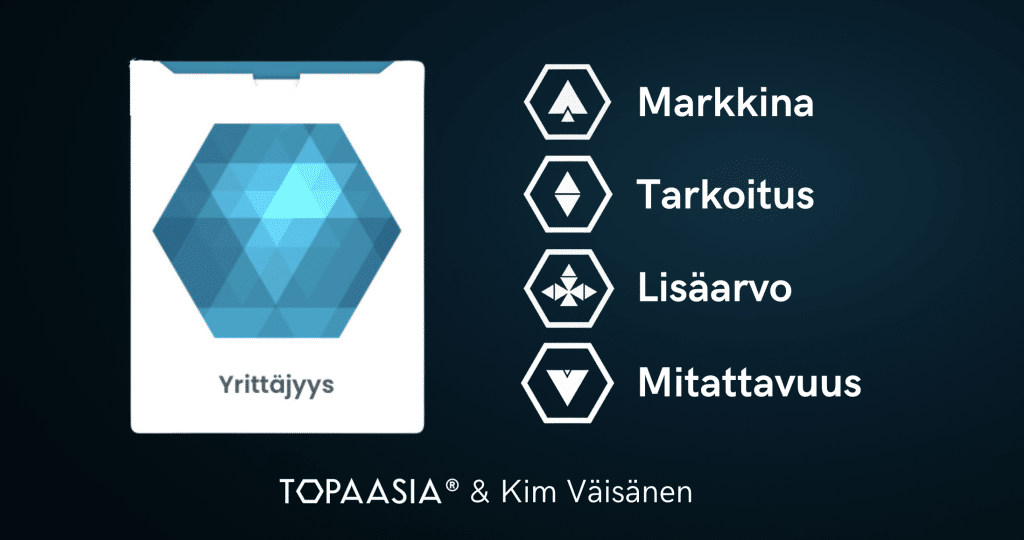
The Entrepreneurship game deck consists of four themes: market, added value, purpose and measurability. The game has a total of 52 different cards, 13 in each suit, which help you think about, work through and develop the company and the entrepreneur.
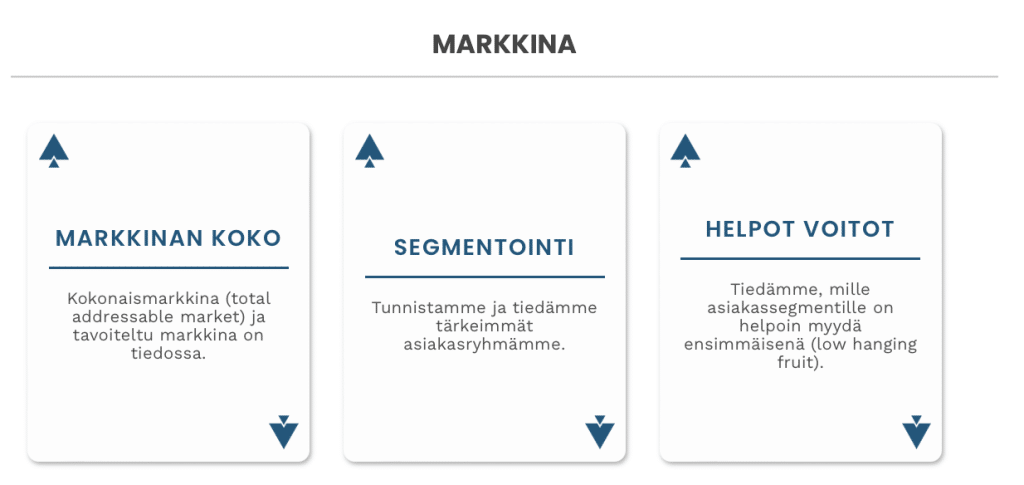
Three examples of cards from the Market theme
Market
Kim says that young entrepreneurs who enter an industry from outside it often think they will disrupt the entire field. “They imagine that the old players will raise their paws in the air and surrender when their market is taken from under their noses. They do not surrender. They will do everything they can to make your life pure hell. Go ahead and try disrupting then,” Kim says.
The advantage of a starting company is often that it can act boldly and quickly. A big market leader is frequently unable to make radical turns quickly while defending its market.
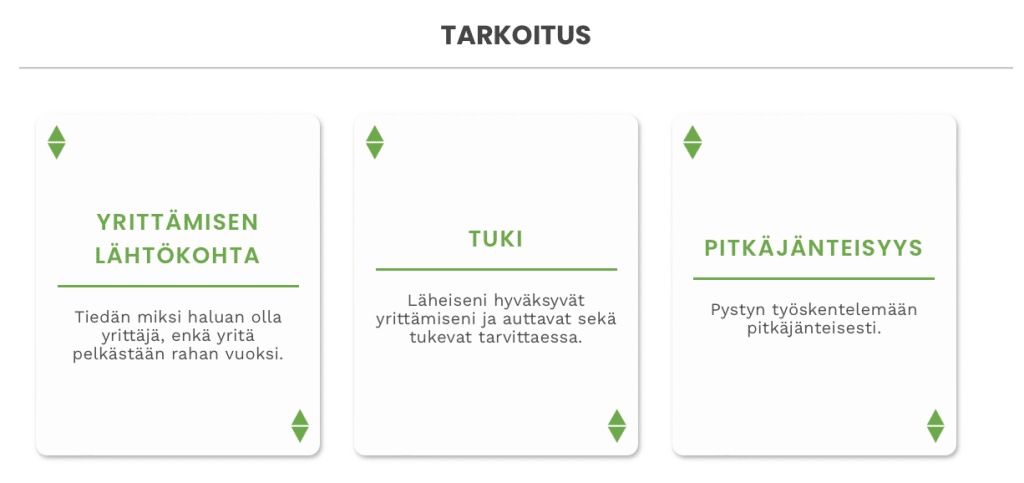
Three examples of cards from the Purpose theme
Purpose
The first thing Kim would use the deck for is examining the purpose of the enterprise: does the activity have a sustainable purpose, or did you march off to war whistling?
“As naive as it sounds, if the company and the enterprise make the world a better place, then it has a genuine and good purpose. Beyond a good cause, it is of course worth having a conversation with yourself about why you want to be an entrepreneur. Money as a reason does not carry you far.”
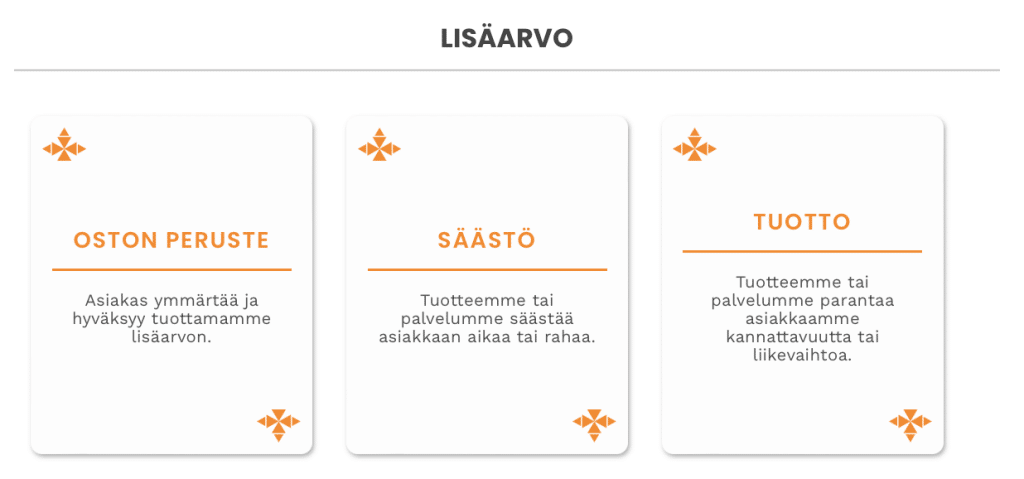
Three examples of cards from the Added Value theme
Added value
Added value means that the entrepreneur or the company must produce measurable benefit for people.
Many entrepreneurs also imagine that a good product sells itself. According to Kim, this is a misconception proven wrong by experience.
“Sometimes I too may have naively thought that a good product sells itself. Well, it does not, because good products are thirteen to the dozen. A good product needs a working machinery around it. There must be marketing, sales, customer service and everything else,” Kim says.
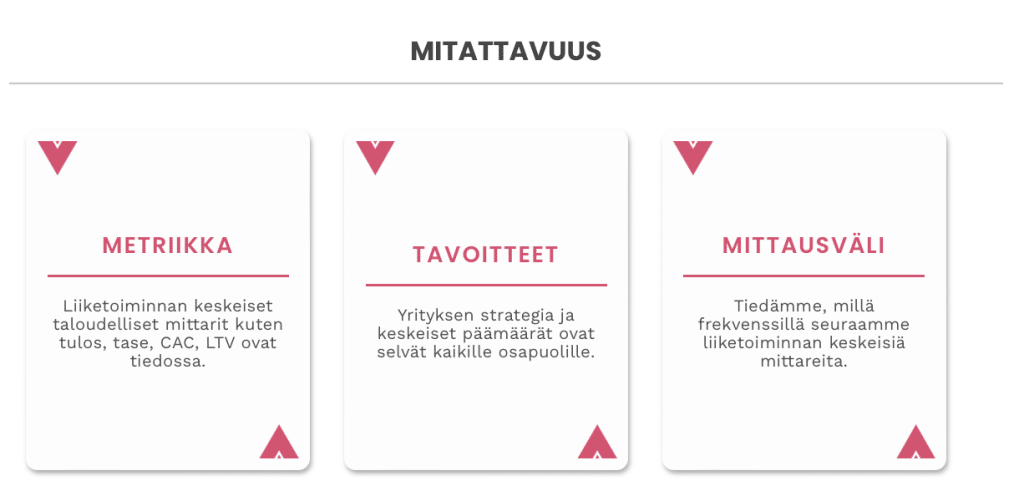
Three examples of cards from the Measurability theme
Measurability
Measurability goes hand in hand with producing added value. Measuring things keeps you on the map about where you stand, instead of going by gut feeling alone.
To finish, Kim's greetings
I have squeezed blood and tears out of my soul for this Entrepreneurship deck. This is the third deck I have been involved in making, and quite certainly the best. It has been made with real devotion and enthusiasm, enjoying the process.
"Finally I want to say: play a lot with the deck! I promise to play it in a year's time and look through whether it has stood the test of time. But I would claim that this time it will hold up better than sometimes before; right now I would not change a thing," Kim concludes.
–-------------
Good games around entrepreneurship!
-> Try Kim's Entrepreneurship deck for free <-https://www.kim.fi/
Read more interviews with Kim: Take the win without whining - Kim Väisänen