
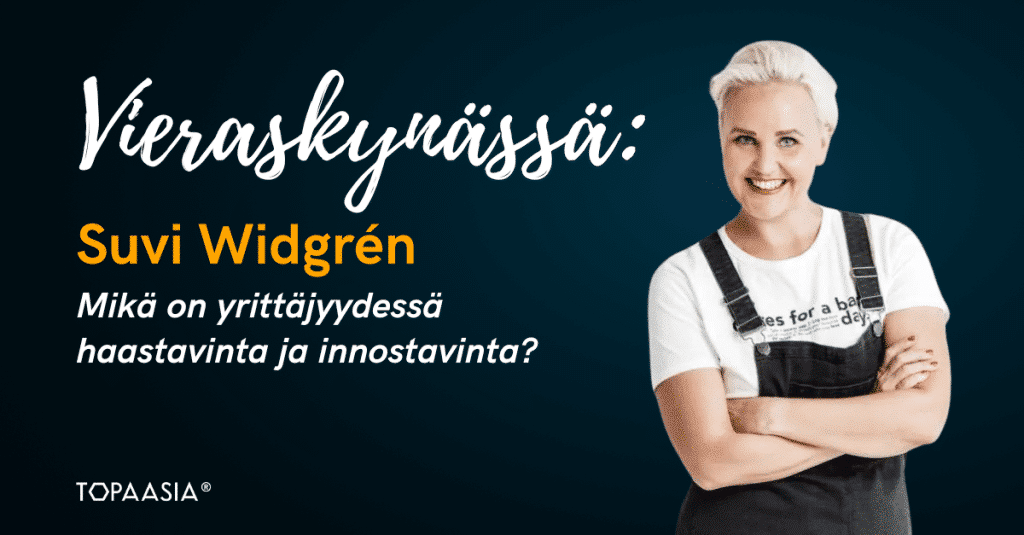
I had the honour of taking part in a webinar organised by Topaasia. The theme was entrepreneurship, and the topic was introduced brilliantly by the super entrepreneur we all know, Kim Väisänen. He, if anyone, has had a chance to see the ups and downs of entrepreneurship. Additional perspective was provided by Petri Salminen, chair of the Federation of Finnish Enterprises, and Topaasia co-founder Jussi Galla!
I myself got to know Jussi back when, after my own ten years of entrepreneurship and an exit, while on a round-the-world trip in Chile, I realised that I had a ticket to Nordic Business Forum already bought, and decided to donate it to an entrepreneur who could best justify why they in particular should get to NBF to be inspired. Jussi's justifications were heart-stirring. The core of entrepreneurship, that is passion, came through strongly.
Thinking about it now, seven years later, the ticket went to exactly the right address. Topaasia keeps growing and developing, and I have used it myself with various groups for dialogue where you want everyone's voice heard and to find a shared view of where we are and what should be done next. In recent years the significance of dialogue has indeed been highlighted amid the challenges of my own company, which seem to have no end.
In the webinar we looked for the most challenging and most inspiring things in entrepreneurship - Forecasting emerged as a major challengeEvery "hairless business consultant" tells entrepreneurs to pay attention to risks and try to prepare for them. If we look at recent years: Covid, the component shortage, the war, the fuel and energy crisis, the downturn in the construction and forest industries, inflation, interest rate rises and the now almost closed financing markets, and most recently the political strikes that shut Finland down for nearly two months (did I forget something?).
If someone's risk map had identified these things, would we have a single entrepreneur? I strongly doubt it.
My own head has stayed cool, because as a crazy entrepreneur I just keep repeating to myself "It'll be fine, any moment now, the sun will shine after the storm, all's well that ends well, threats hold opportunities, the strong endure, now we are being tested.." and all sorts of other completely irrelevant things, but as an entrepreneur, when your money is tied up in the company and you have given your whole soul to the company and its growth, what else can you do. You damn well have to try!
Several things emerged as the most inspiring, but leadership above all others
The future, goals, mission and leadership. For me, the importance of leadership has been highlighted from the very first days of entrepreneurship. I have had no substance expertise in any of the fields in which I have operated as an entrepreneur. I became a clothing retailer without having worked a single day in a clothing shop. The starting point for the restaurant business was that my skills were limited to preparing canned pea soup, and about the transport business I understood absolutely nothing, other than enough to stay far away from it, having spent my whole childhood watching the bustle of family entrepreneurship at home.
I have, however, always been interested in people and their skills. So I have managed to hire capable people around me, and together we have had successes. Leadership is why I have the energy to keep doing this. People surprise you positively, whether we have started from zero or worked through change leadership. Through the power of dialogue I have got people to understand why things must be done differently than before. Why, for example, we are aiming for growth. Leadership is the hardest discipline of being human. You have to motivate other people to do the things that are important to you.
Are there differences between B2B and B2C businesses?
The listeners gave feedback in the webinar that the B2C perspective was missing. My experience is actually stronger precisely in consumer business than on the B2B side. I hardly see any differences between them. The basics are the same in both, and both have to be in order. Here are the three most important things that do not differ whether you are on the B2B or B2C side;
1. People
Build the best possible team and give them an inspiring vision and mission. Let them shine and find their full potential.. There is more in all of us than meets the eye! Usually leaders just ruin people by putting them into some mould. By saying too precisely how things must be done, when a leader should rather be able to articulate what we want to achieve.
Every person is important, and everyone should have the goals and the customers firmly in mind. Make sure people are building a cathedral and not just carrying bricks. p.s. a tip: Don't hire unpleasant people. Kim talked about this too. You define what that means. This is exactly the same on both the B2B and B2C side.
2. Sales
Never be lazy about sales! The same kind of selling must be done in the brick-and-mortar shop, online and in customer meetings alike. Bold and strong prospecting for customers and person-to-person encounters. A person always buys from a person, and brand work and marketing support this. At Vila (the clothing shop) we sold VIP evenings to companies, and at Rekka Group we look for customer needs for individuals. That is just how it works.
3. Margin
Whatever the business, learn the financial laws of that field. Sales alone are not enough; costs must be in balance in relation to revenue. That is what makes this entrepreneurship so damn difficult. Especially in these traditional fields, when we are not really talking about any kind of scalable business. There is no point chasing quick wins. And sometimes it feels like many set out to be entrepreneurs with only an EXIT in mind.
Entrepreneurship involves enormous uncertainties, and wasting a million is surprisingly easy, but making one is extremely difficult. That is why you also need to get your kicks from the doing and the striving itself. And even though it is not quite a normal person's life, we entrepreneurs are still completely ordinary people. We are not immortal, and that is why life is here and now, not only once...
Entrepreneurship is fantastic when things go well and at the very least thrilling when things go to hell.
Thank you Suvi!
Suvi Widgren - LinkedIn Rekka Group