
Gamification at the heart of youth coaching: how the Hymis project adopted Topaasia
When the ASPA Foundation's Hymis project began developing accessible coaching for young people, it faced a familiar challenge: how do you get young people to truly take part? How do you create a space where even difficult things can be talked about, without anyone having to be the brave one first?
The answer turned out to be participation, dialogue and gamification. And Topaasia as a partner.
What was it about?
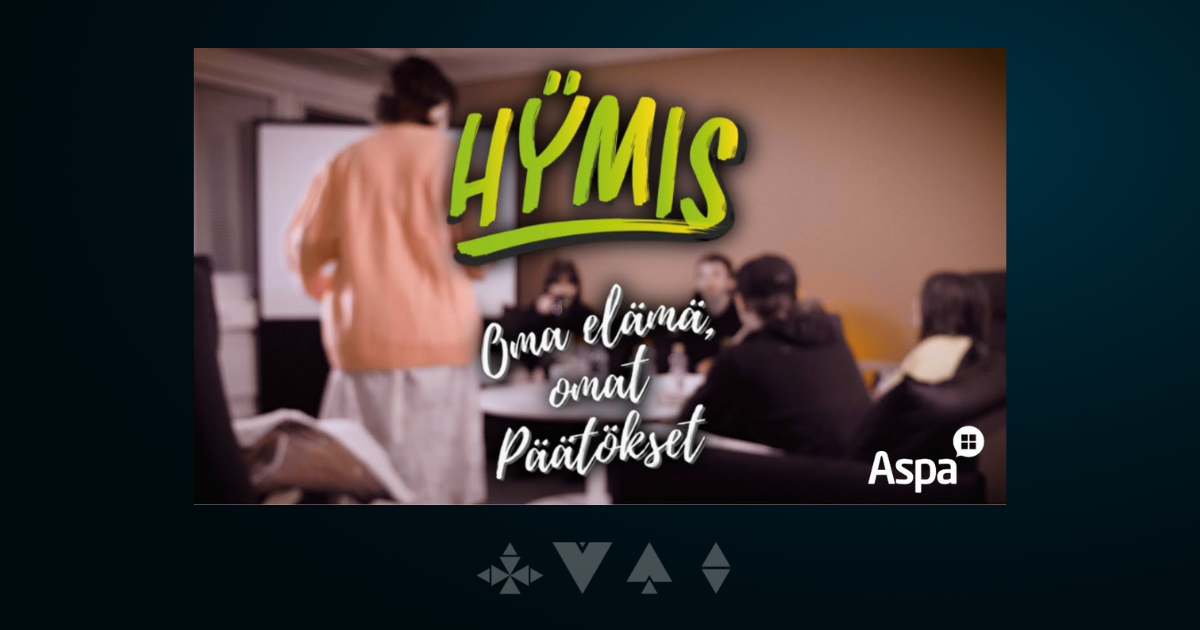
My Life, My Decisions is an accessible coaching programme developed by the Hymis project, aimed at young people. At the core of the coaching is the idea that young people must get to participate themselves, not just listen.
The themes of the coaching cover areas of life central to young people:
- Mental wellbeing
- Relationships and sexuality
- Hobbies and free time
- Studying and work
- Independent living
The topics are important, but also sensitive. That is exactly why a method was needed that lowers the threshold for bringing them up.
How was Topaasia brought in?
Topaasia is a digital game platform used as a tool for facilitation and engagement. In the Hymis project it was used as the load-bearing element of the coaching structure, not as an add-on or entertainment, but as the actual working tool.
In practice, the coaching proceeded like this:
The young people joined the game on their own mobile devices using a join code or QR code shared by the game leader. In the digital online environment, everyone saw the same themes on their screen and could choose for themselves which topics they wanted to discuss. The game also worked with a screen reader, which made it genuinely accessible.
What mattered was that the choice happened anonymously. No one saw who raised which topic. This detail changed everything.
The coaching worked both in face-to-face meetings and remotely; the only requirement was an audio connection between the players and the game leader.
What did the young people experience?
The participants' experiences say more than any report.
One key observation came up repeatedly: gamification helped the quieter participants in particular. In a traditional group setting, a quiet young person may sit with their own thoughts and wonder: Am I the only one who thinks this way? Am I allowed to feel like this? Through Topaasia, those thoughts got to surface, without anyone having to be the first to dare say them out loud.
"There can be a real experience of loneliness with those things if you don't even understand that others are thinking about similar things. Gamification makes it easier to open the conversation and share things, even when the topic is difficult for one reason or another."
Genuine peer support emerged in the groups. When everyone participated through the same game, each person was seen and heard, not just the one with the most to say or the most courage to speak.
"Starting to play, that's a good way to open the conversation in general, it gets the conversation going about those difficult topics."
Anonymity was felt to be significant. A young person could raise a topic from the screen without others knowing it was important to them personally. This lowered the threshold for bringing up things they might not otherwise have dared to bring to the group.
"In the game you can, like, anonymously raise those different topics, you don't have to dare to ask 'hey, have you ever thought about this thing?' You can just pick something from the screen that you want to talk about. Then no one, like, finds out that you were the one who wanted to talk about it."
A sense of safety also came up, both trust within the group and the knowledge that things stay inside the group. When the young people knew that no one would carry their words outside, the conversation opened up in a completely different way.
"Talking about those topics together in a safe space, knowing it won't go outside. Having that kind of safe group where you can get good experiences of being in a group and speaking, and confidence in it."
What the game was not, and why that matters
One key observation from the coaching is how the game was positioned in relation to the coaching itself.
Topaasia was not the destination. It was the key.
"A good game works, like, exactly as a conversation starter, the game is a good starting point, but in the end you're no longer playing the game on your phone, you're playing it in the room, when you actually get to talk about those things. So it's used, like, as an aid and a tool."
This is an essential message for anyone considering gamification in their own work: Topaasia does not replace the instructor, the facilitator or the group setting. It makes them better.
Results and impact
The goal of the coaching was to strengthen young people's ability to make independent decisions. Strengthening decision-making capacity supports a young person's self-image, identity and journey to independence, things the Hymis project considers central.
The feedback gathered from participants was positive. The application was seen as clear, functional and technically easy to approach.
"In my opinion, using the phone and using the game isn't difficult. I think this app really works, it's really clear and accessible."
Perhaps the most significant result was that the young people themselves felt they had gained new perspectives and good conversations, and recommended the experience to others.
"I feel I've got a lot of good conversations out of this and good new perspectives on things. And I do believe everyone would benefit from having more conversations like this. I would definitely recommend this game to everyone."
Why does this work in projects?
The Hymis project's experience highlights a few things that make Topaasia especially well suited to project environments:
Accessibility. The game works on mobile devices, with screen readers and over remote connections. Participants do not need to be in the same place, which is a significant advantage, for example, when you want to reach people across Finland or people for whom travelling is challenging.
Low threshold. Gamification removes the stiffness of the traditional group setting where the same people always do the talking. Through Topaasia, everyone participates on an equal footing.
Anonymity around sensitive topics. When dealing with sensitive themes, anonymity can determine whether genuine conversation emerges or not.
Flexible format. Topaasia suits group and one-to-one coaching, face-to-face meetings and remote work. It is not tied to a particular place or space.
Easy adoption. A QR code or join code, that is all a participant needs. The threshold for technical use is low.
Collaboration with Topaasia
The My Life, My Decisions coaching was developed in collaboration with young people and Topaasia Oy, using service design methods. This meant that the content and structure of the coaching were shaped together, not with Topaasia providing a ready-made platform the project had to adapt to, but with the platform and content developed to meet the project's real goals.
If you work in projects and are wondering how to engage your target group through genuine dialogue, especially when the topics are sensitive, the participants are diverse or you reach people remotely, it is worth exploring what can be built with Topaasia.
Interested in collaborating? Get in touch and tell us about your project, and together we will look at how gamification can support your goals.