
Katja Sankalahti works as a development manager at the Finnish Institute for Health and Welfare (THL), where her role focuses on promoting a culture of network dialogicality. In this interview she talks about network dialogicality and the role Topaasia has played in advancing it.
What is network dialogicality?
The term network dialogicality is made up of two words - network and dialogicality. A network can be defined as an established social relationship between interdependent actors organised around a shared problem or resource base (Sotarauta, 2007). Dialogicality can be understood to mean equal conversation and guidance, a process in which something valuable is given, received and produced together, reaching a new shared understanding of the topic at hand (Aarnio & Enqvist, 2001).
Network dialogicality has been developed and promoted through co-creation by Katja Sankalahti's team together with municipal and regional partners for 20 years already. The concept describes an operating culture that aims at multi-actor collaboration and the promotion of participation. She explains what the concept means: “Network dialogicality is high-quality collaboration carried out in networks, and a network does not mean that we need to have a large number of different parties. Networks are always present in the dialogue inside our heads, involved and exerting influence. Dialogicality means striving for being heard, having opportunities to influence, respectful and equal encounters, and a multiplicity of perspectives”.
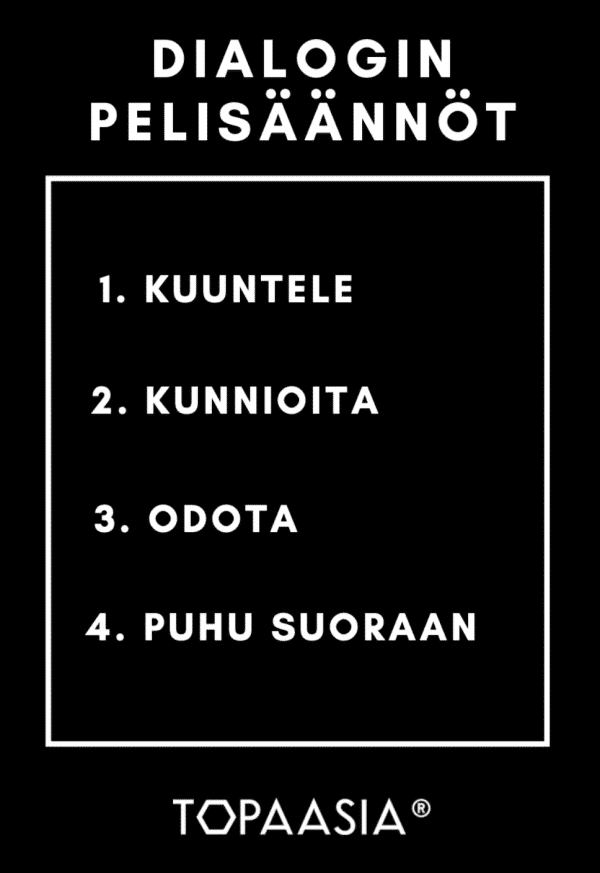
At the sources of dialogicality
Strong Finnish influences on Sankalahti's thinking are professors Tom Arnkil and Jaakko Seikkula. Arnkil has been a strong driver in developing Anticipation Dialogues and Seikkula in Open Dialogues, through which networks, multi-actor collaboration, equal participation and being heard have been a driving force for Katja.
Through many stages, Sankalahti has arrived at her current position. Different networks and dialogicality have been strongly present throughout her career path. Katja initially worked as a social worker, after which she moved on to become project manager of the Taking Up One's Worries project, which covered activities in twelve municipalities in the Kymenlaakso region and its surroundings. Through the project, Katja brought to the region the idea of multi-actor dialogic working methods. The collaboration with Stakes that began during the project later led to Katja being employed first by Stakes and, through a merger, by her current employer. Although THL has gone through many organisational reforms, Katja notes that the paradigm has always been the same: networked dialogic practice.
Dialogue and dialogicality
There are many ways to structure the activities and culture of organisations, and in the jungle of terminology it is important to understand what each concept means. In the context of network dialogicality, Sankalahti highlights the importance of understanding the difference between dialogue and dialogicality. “Dialogue is taking turns to listen and taking turns to speak, so it is more about interaction, but I see dialogicality as a way of thinking, a conception of the human being, an attitude or a worldview”, she specifies.
Through this perspective, network dialogicality can be seen as a context in which one operates, not merely a way of working. Part of this context are all the parties whom the matter at hand concerns. From her own field of social work, Sankalahti brings up a situation that challenges the dialogicality of a network: encountering an individual client, for example a family. In that situation she sees the danger that professionals define the family's situation from the outside, from their own perspective, and that the power dynamics between different professionals determine how things proceed in their situation. In a network-dialogic community, action starts from a different perspective: “The client defines what is, for example, a good, realistic or credible situation, and then we start building from there”, Sankalahti specifies and continues: “These are very small nuances that speak of appreciation, equality and the fact that the client really is the one we start from”.
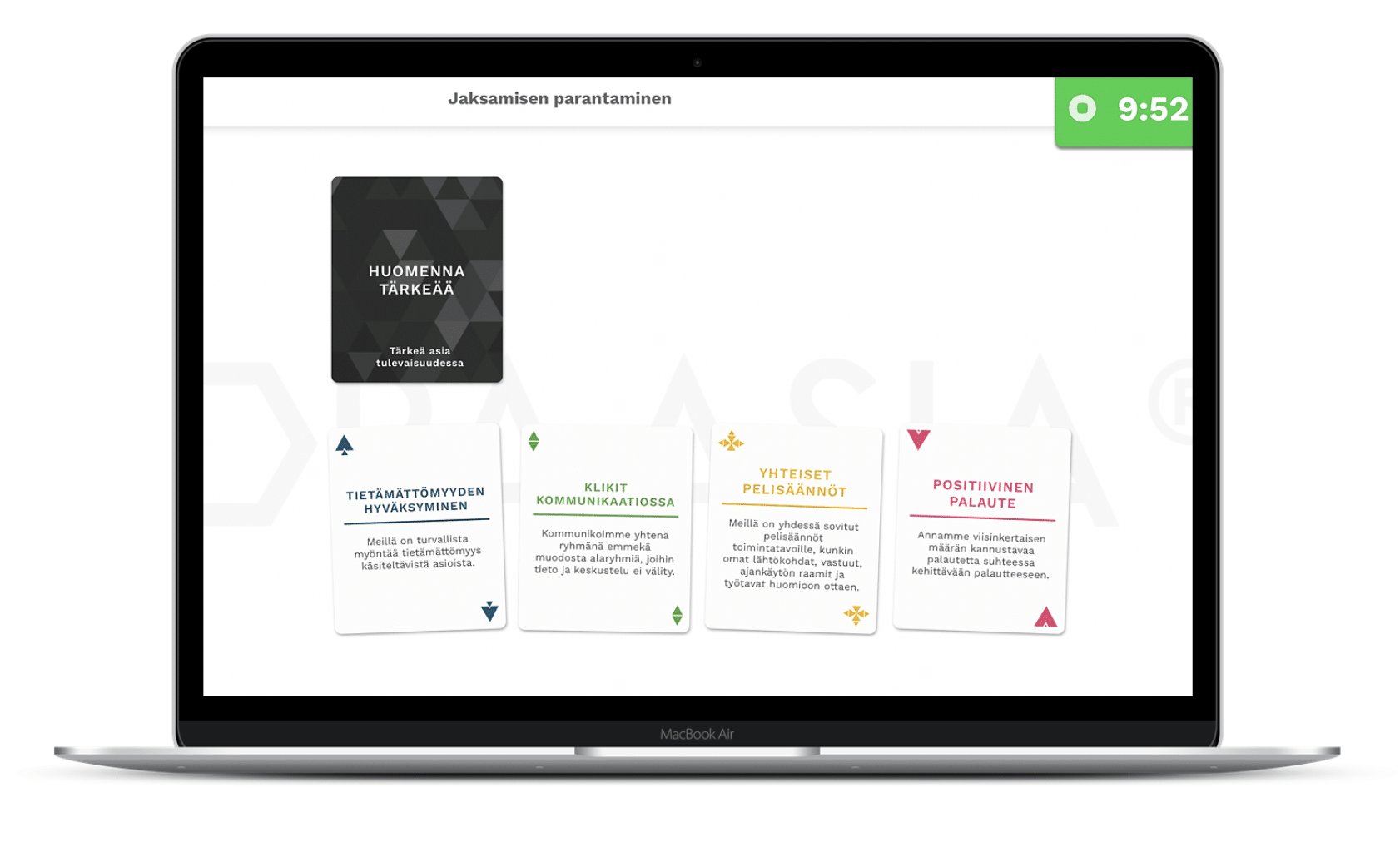
Topaasia in support of network dialogicality
At THL, Topaasia has been used to bring out different kinds of expertise and experience and to combine them. “That is, whenever we need other perspectives and notice that we cannot manage with our own possibilities for action alone, or with our own expertise alone“, Sankalahti describes. At its best, the expertise of the whole network is brought out and gathered together, which makes it possible for different stakeholders to avoid overlapping work and to create concrete added value through sharing.
As a game, Topaasia safeguards the participation of everyone involved. The players themselves determine how the game proceeds according to the chosen perspective. In other words, the players jointly define, for example, the good, realistic or credible situation Sankalahti mentions, as well as the means to achieve it.
In addition to participation, Sankalahti sees it as important to increase equality and shared understanding through conversation: “Everyone's perspective and thoughts are equally important, and when all those subjective perspectives are brought into the middle, something new and shared may emerge”. Regarding the outcome of the game, Sankalahti specifies: “The goal is shared understanding; you do not need to reach consensus, but rather to increase shared understanding.”
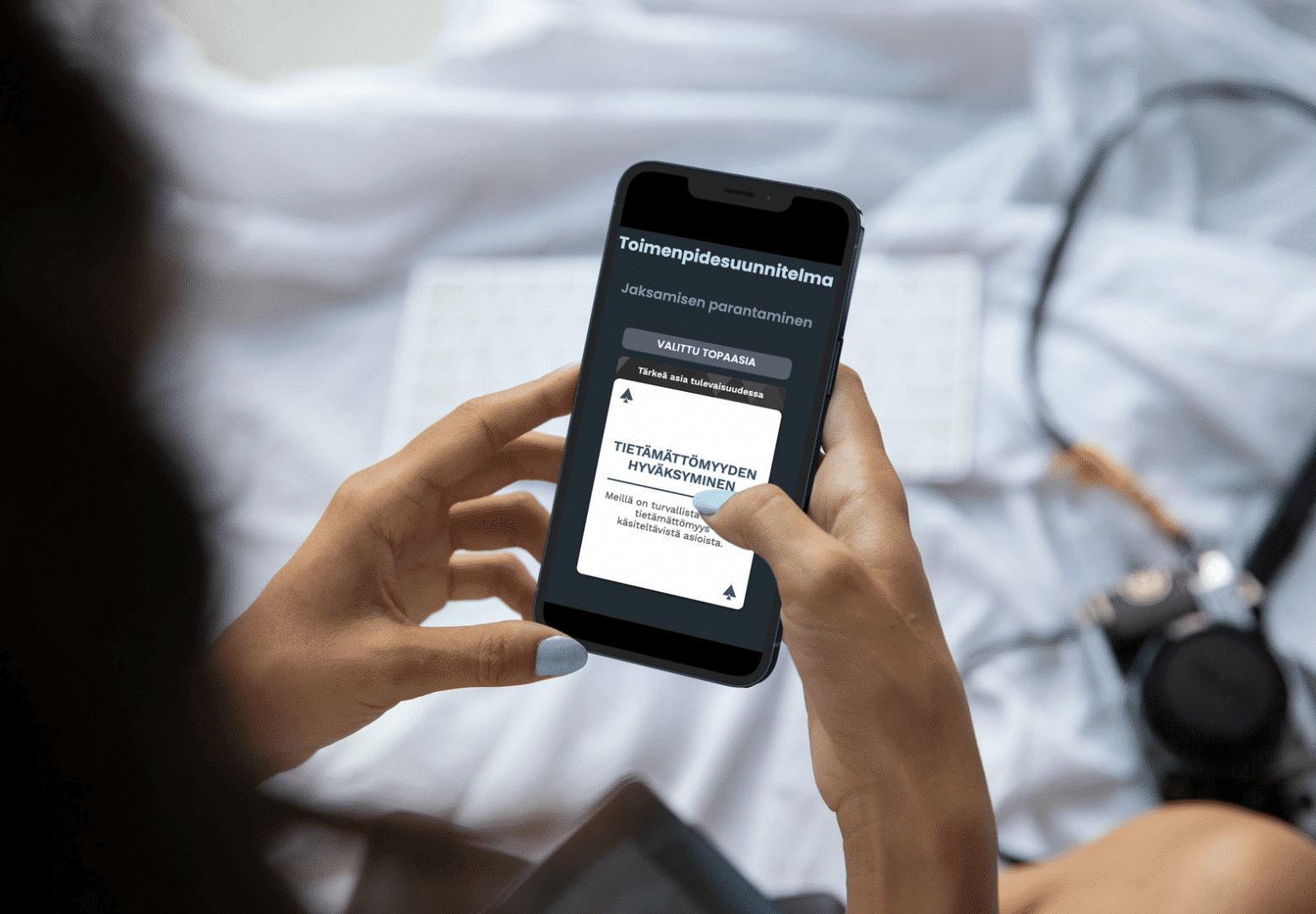
Dialogicality comes naturally to people
Sankalahti notes that dialogicality is a natural way for people to act, one that sometimes simply gets forgotten in a person's life. “After all, we are born into dialogue. A baby and mother are in dialogue right after the baby is born. The mother responds to the first cry by giving food or changing the nappy. Something happens on our journey to adulthood, and it is probably the cultural side, learned ways of doing things”, she describes. Dialogicality can be brought back into interaction with a little support, and Sankalahti mentions playing as one such support: “For example, the Topaasia game, or a person who guides that dialogue with a certain structure, a framework, makes it possible for us to remember again what dialogicality feels like and how to be in it. We have permission to be in dialogue. You do not need to defend your own perspectives; I have permission to produce my own thoughts, thinking aloud on equal terms.”
Sankalahti has found that Topaasia makes it easier for dialogicality to be realised in situations where the concept itself is less familiar to the players or the person leading the game. No experience is needed, because the game itself helps and guides the dialogue. Through Topaasia, every player's perspective comes out: “Regardless of what words are in the deck, everyone produces their own subjective perspective, in that very moment, with the help of the game”, Sankalahti describes.
In addition to guiding the conversation, in Sankalahti's experience Topaasia also supports the conversation in another way: “the card and the playing provide a sense of safety and the feeling that I can actually throw myself into talking even about difficult things, because I have that playing card there, as it were, as my protection.” She describes the game as bringing lightness and meaningfulness to a conversation that might otherwise be experienced as heavy. “When you have the game there as support, you are still not completely naked in front of people and, I don't know, it gives you a good feeling”, Sankalahti describes.
Topaasia compared to a traditional meeting
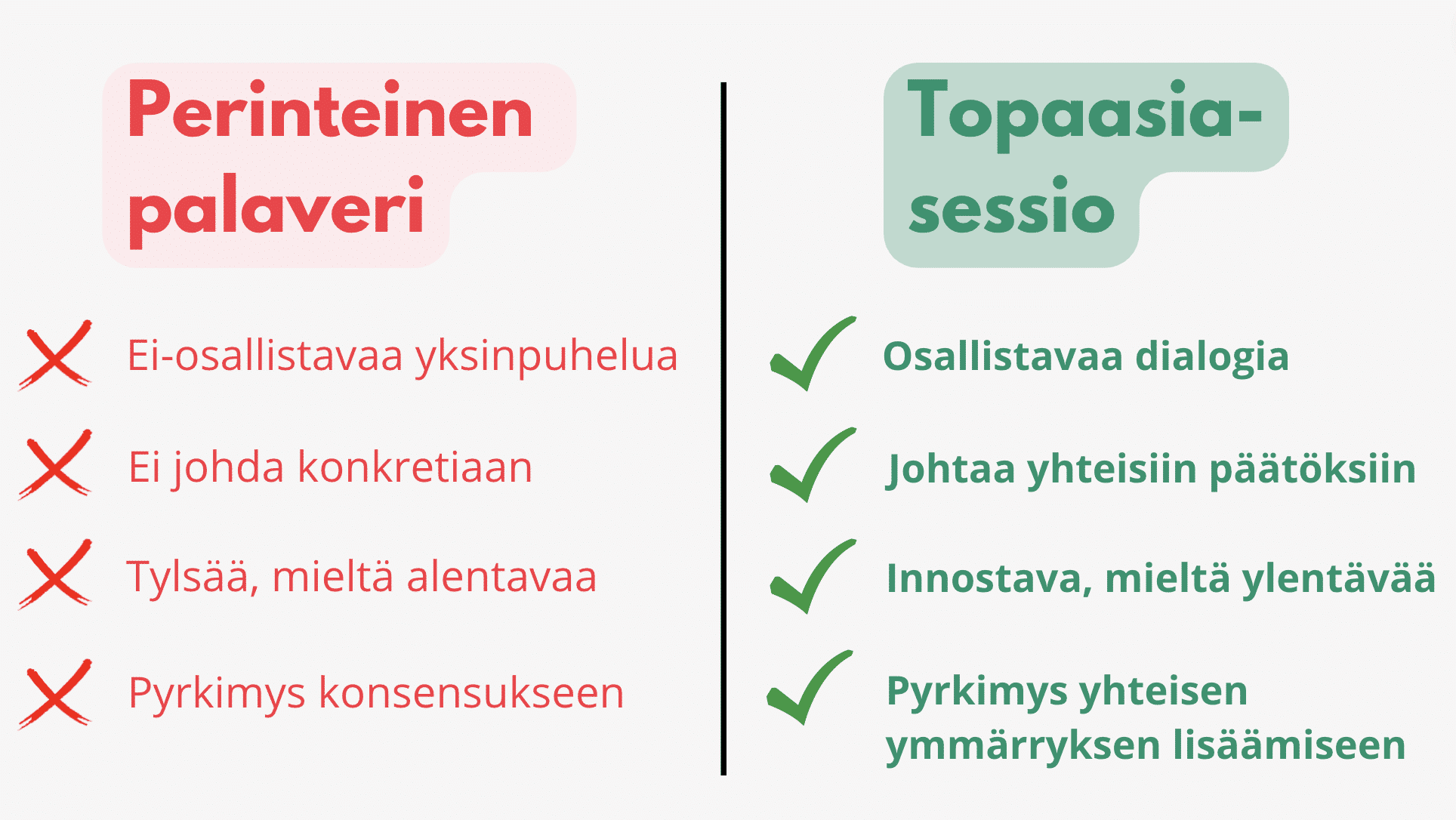
Compared to an ordinary meeting, Sankalahti recognises that Topaasia brings many advantages to the situation. “In a traditional meeting or network meeting you usually think about what I am going to reply to that person, or what I will say, how I will counter-argue or how I will sell my own perspective”, she describes the traditional meeting, and then continues: “In Topaasia, on the other hand, through the cards and the words you produce that particular thing, after which you become interested in listening to what the others say”.
In feedback collected from players, enthusiasm has come up, which relates on the one hand to interest in what others say and on the other to the method itself. “This is new, a new way. Even though you are naked with your own thoughts, you have a role as a player, and because the playing card, as it were, commands you, your task is to produce thoughts”, Sankalahti describes the game. In addition to enthusiasm, the feedback has also included an experience of empowerment after the conversation held in the game. “Whenever we hear each other's thoughts and perspectives, it produces added value for us”, she describes, and sums up: “Whenever people are together in a positive way, talking constructively with an orientation towards the future, it always produces good. That is it.”
For example, the Topaasia game, or a person who guides that dialogue with a certain structure, a framework, makes it possible for us to remember again what dialogicality feels like and how to be in it. We have permission to be in dialogue. You do not need to defend your own perspectives; I have permission to produce my own thoughts, thinking aloud on equal terms.
—------------------------------------------------------
Thank you Katja! Read more: