
The purpose of the Fake News project is to offer adults a meaningful way to develop their own media literacy. The project has also aimed to raise awareness of the harms that fake news and disinformation cause to society.
In the project of the Junior Chamber of Aurajoki, which began in spring 2021, a digital game was created in collaboration with Topaasia, offering a meaningful and fun way to develop one's own media literacy.
Game sessions have been held in many different towns during the autumn. The game has been well received by participants and has gathered plenty of positive feedback. One player said they were particularly pleased with how the game is built:
The deck contained really good cards and topic areas. As someone who works with disinformation myself, I was delighted by how comprehensive the game was.
The game has also been praised for how easy it is to start discussing a difficult topic in depth right away, when the cards provide stimuli for the conversation.
The conversation was really interesting and the game was easy to follow. The cards helped us discuss the topic and sparked a lot of thoughts.
Interaction and listening are indeed natural to the games played on the Topaasia platform. Everyone gets their turn to speak, and together, through discussion, the group considers what is significant and what is less so. Gamification and participation work well when dealing with questions like fake news and disinformation, where there are no clear right and wrong answers.
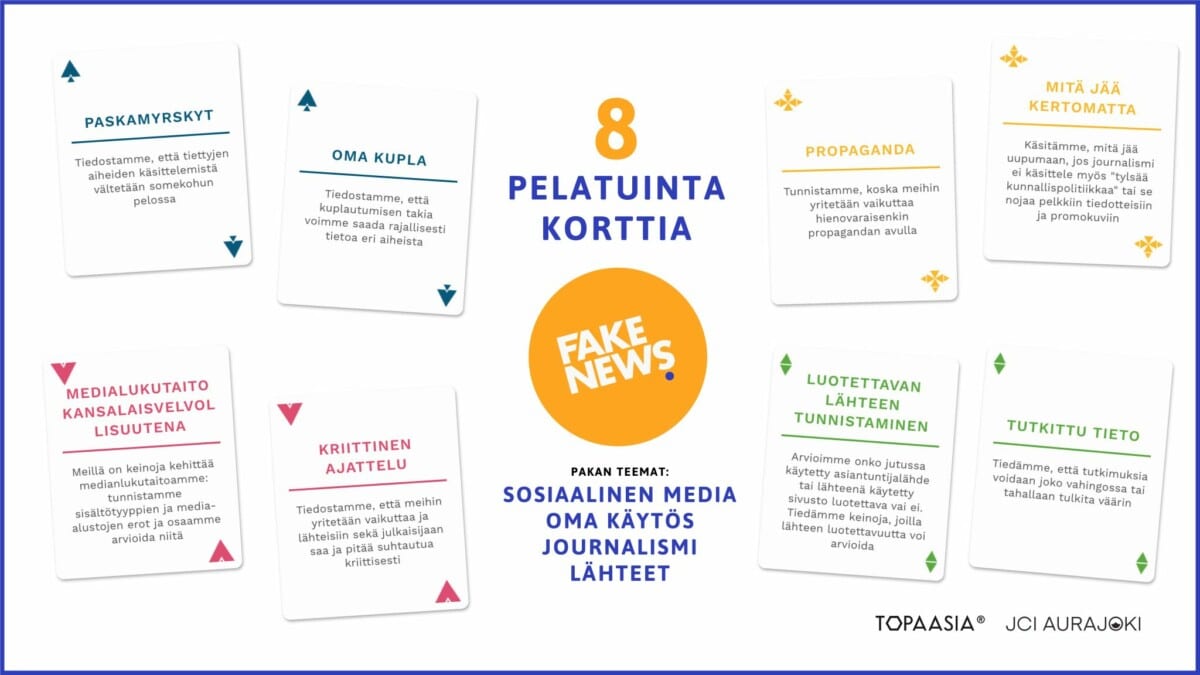
The Fake News deck consists of four themes: Social Media, Journalism, Own Behaviour & Sources. Each suit contains 13 different cards.
Critical thinking takes you far
In the conversations held during the game, a shared concern about the harms of fake news has come up in particular. The two most played cards relate to practising critical thinking and becoming aware of one's own cognitive biases. When you are aware that you have biases, it is easier to interpret and critically reflect on content circulating online. Why do I react to this matter in exactly this way?
The project is due to be completed at the beginning of December, but going forward anyone can play the game on the Topaasia platform free of charge.
A light one-perspective game session works well as a programme item for a pre-Christmas party, for example, suggests project manager Eveliina Sillanpää from the Junior Chamber of Aurajoki.
The content of the Fake News deck was created in content collaboration with Minna Uusivirta and Eveliina Sillanpää
Although the project is coming to an end, the project team hopes that the deck will be widely used in the future as well. Within the project, educational institutions, organisations developing civic skills and other organisations will be informed so that they can, if they wish, adopt the game to support their own activities. And best of all, the deck is available on the Topaasia platform free of charge, so go ahead and give it a try!
Text: Eveliina Sillanpää