
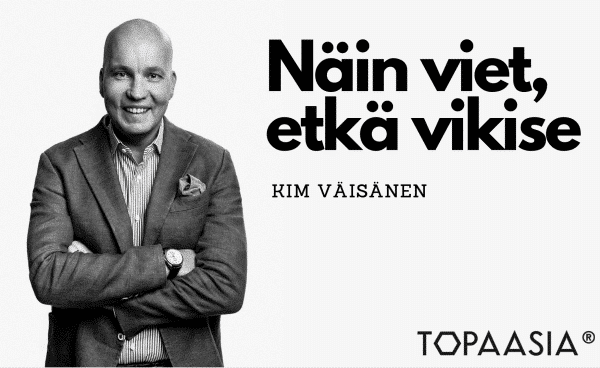
The networked, global and digital world is an open playing field, also for Finnish SMEs. Yet only a few success stories of successful exporting are seen from Finland. What could be done better or differently? What should be left entirely undone? One person who knows about succeeding in exports is Kim Väisänen: a startup investor with Eastern Finnish roots, entrepreneur, serial failure, non-fiction author, board amateur, keynote speaker, and two-time winner of the internationalisation award granted by the President of the Republic. In this interview Kim opens up his thoughts on Finnish exports and the new Topaasia: Export game. The game has been made in collaboration with Kim, and it is designed to help companies do better thinking and make better decisions about exporting.
What is Finnish export?
Kim defines export as all commercial activity that takes place outside the home market. For some firms the home market may be Oulu, and for them exporting is more or less coming to Helsinki.
"In practice, Finnish companies' exporting means mainly exporting to some nearby countries, for example Sweden. I always warmly encourage companies to start exporting by selling to countries whose legislation and society are similar, because it makes things easier. The further you go, the harder it gets. The amount of difficulty is the square of the distance: when the distance doubles, the difficulties quadruple", Kim says.
Finnish exports come with stereotypes and mental images, especially concerning knowledge of other cultures.
"Lenita Airisto once said that you recognise Finnish exporters out in the world by the fact that they are there wearing tennis socks. Perhaps on a larger scale she was referring to the fact that we were not culturally, linguistically or otherwise prepared, that we were a bit hapless. But that is not true. Finnish exporters and salespeople have many strengths of their own. Whenever you go into another culture, you have pluses and minuses", Kim recounts.

Väärää vientiä - Kim Väisänen (2018)
Kim's export history
Kim has been involved in many export ventures for 25 years. He has taken to the world, among other things, remote control systems for car engine block heaters, computer data erasure software, and office phone booths. Through the success of Blancco and Framery, he has also received national recognition as an export expert. Although Kim has long experience in exporting, he does not want to elevate exporting into a value in itself:
"Exporting in the beginning was like the Wild West: we shot in absolutely every direction, because foreign revenue felt better than domestic revenue. But that is not how it is. Money is money; foreign revenue or an export euro is not one bit fancier. I could say that from those days of shooting blindfolded with two Colts, we have moved to shooting with a sniper rifle, very deliberately, in one direction".
While an entrepreneur at Blancco, Kim travelled a lot; to Japan alone he racked up around fifty trips. He describes the early export days of Blancco, which sells data erasure, as spraying shots with enthusiasm and foolishness, but over time the export work began to sharpen.
"In Japan we started with one reseller. Then there were a few resellers. Then in the end we had our own office in Tokyo's most expensive districts and about ten employees. By the way, downstairs there was a Tesla showroom back when Tesla was still a brand-new company. Next door they sold Lamborghinis and all the rest", Kim says of the Japan days. Since then, exporting has been done all around the globe:
"In the beginning we toured the States with a backpack, going from one customer to another, saying "buy, buy". We could have done a lot more thinking there too. If I did that same career again, I might not go to Hong Kong at all. I might skip Australia. Then towards the end the work started to sharpen. We thought about how many computers there were to be wiped in a given country and what kind of attitude environment and atmosphere there was. We made more considered decisions, instead of being on a plane on the way there as soon as someone sent an inbound enquiry from some country".
Thanks to his extensive experience and the background work for his book Väärää vientiä (2018), Kim has formed views on what goes wrong when thinking about exporting and getting started with it.
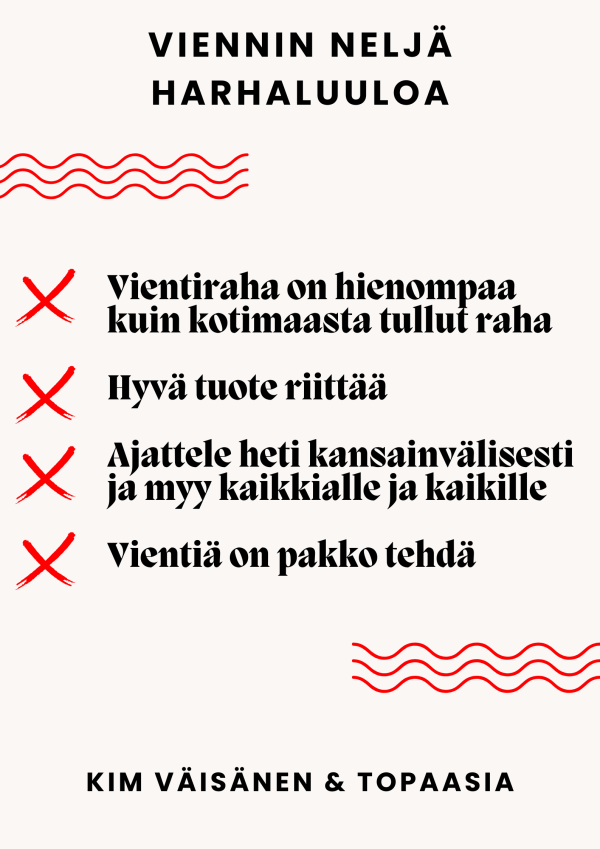
The four misconceptions of exporting
The biggest misconceptions about exporting
In Kim's experience, there are four common misconceptions about exporting:
- Export money is fancier than money earned at home
- A good product is enough
- Think internationally from day one and sell everywhere and to everyone
"Very few products suit absolutely everyone. We once pondered which products suit everyone. We came to the conclusion that toilet paper. Then someone laconically noted that in India, for example, little toilet paper is used. In quite a few countries of the world, toilet paper is not actually used. So it was not, so to speak, a global market after all. This kind of Go global thinking is misleading in my view, if it leads to trying to start sales, marketing and exports to every country everywhere all the time. If you have scarce resources, you have to do a lot of thinking and try to fire those targeted shots instead of spraying with a Colt in every direction", Kim sums up.
Kim says that you learn to export better after you first notice you are creating waste. Similarity of society and culture makes export work easier. He recounts how, at the start of his own export career, he tried to sell his product to Hungary, Hong Kong and Australia, for example:
"There would have been customers a bit closer to home too, but it was really nice to collect Finnair Plus points. Then when you understand things a bit more, you start to sell and operate more sensibly and you notice that Sweden is not such a daft country after all. That it really is worth selling there".
- Exporting is compulsory
It is worth starting to export if it supports the company's strategy, in other words if the strategy defines that the company cannot depend on domestic sales alone. For some firms the home market can fill up, or the market may be dying, for example due to changes in legislation.
"Think of Framery, for instance: even if Framery sold phone booths into every available space, they will not sell a hundred million euros' worth in Finland. But it has to come from the company itself, so that exporting supports the company's goals", Kim stresses.
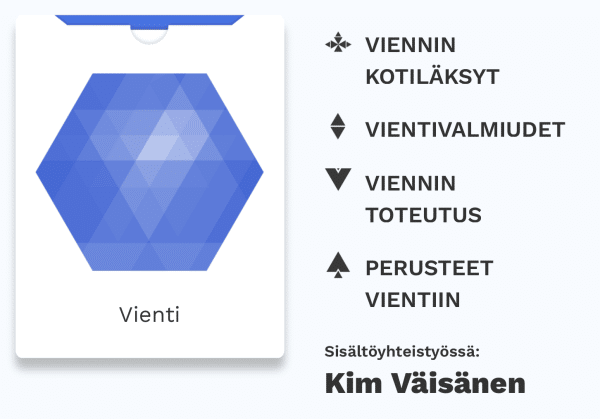
Topaasia: Export - A game deck for export thinking
The Export game content has been made in collaboration with Kim. The game is a deck of cards, and like a normal deck of cards, the Export deck also consists of four suits: Foundations of exporting, Export homework, Export capabilities and Export execution. The deck has 52 cards, 13 cards in each suit.
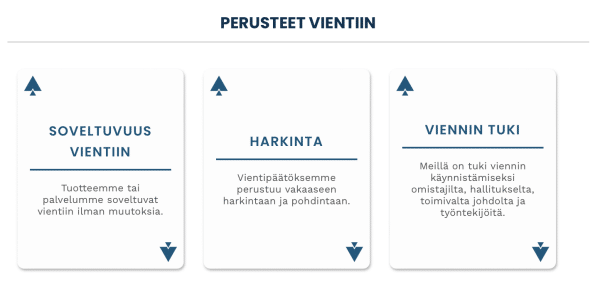
#1 - Foundations of exporting
The Foundations of exporting theme and its statements deal with the fundamentals of exporting: the company's strategy, decisions, will and markets."Some just want to export simply because it is fancier and more pleasant and you get to tour the world a bit. But there are firms for whom the home market is quite enough. The domestic market is large enough for that firm to achieve its goals", Kim says.
You should always first think about what you are doing. Then, once you have thought carefully about what you are doing, only then start executing. In the end, the capacity to execute determines whether exporting is successful. It gets you nowhere either if you plan too much and do nothing.
"John Lennon said that life is a thing that happens while you are busy with making other plans", Kim enlightens.
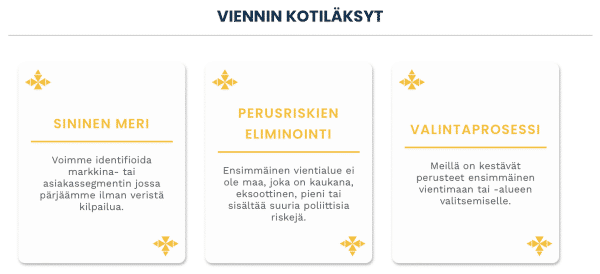
#2 - Export homework
Export homework means doing the thinking on concrete export-related themes, relating to markets, customer segments and your own productisation alike."I will say that far too little thinking is done. If you intend to start exporting, you have to do your homework. You have to think about which country we can find suitable customers in, which customer segment we can find suitable customers in, what the means are by which we reach the customers, and what the means are by which we communicate the added value we produce", Kim stresses.
"As worn out as it sounds to do market research, an enormous amount can be done via the internet. You can find competitors, competitors' customers, customer segments, pricing, added value, how they operate. The best example is SaaS companies that sell purely online. Good SaaS firms have their prices right there online: if you are this size, it is this many euros per month. Think of Pipedrive, for instance: if they were like "I won't tell anyone what it costs", there would probably be less demand", Kim says.
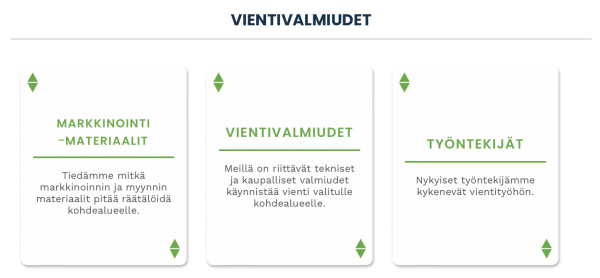
#3 - Export capabilities
Once the company has its strategy and export homework done, attention must turn to the capabilities the current team has and what new capabilities are needed. If basketball players are put to play ice hockey, the result will probably not be good, and the same the other way round. Kim emphasises recognising your own limitations and capabilities:"Do we need to hire a Topias or a Tiina who speaks Swedish, for example, and can talk with local customers in Sweden in their own language? It is funny how people often imagine that of course we will do this with our own crew. Well, you don't. At Blancco, in the final phase, Finnish employees were a minority of the crew".
Beyond competence, capabilities also relate to the company's other resources. The company's financial situation determines what kinds of decisions are made: whether subsidiaries and associated companies are set up abroad, or whether you sell from home directly or through resellers. Kim stresses that resources are an essential factor: "With scarce resources you should make even better decisions. When you have more resources, you can afford to make some wrong decisions too".
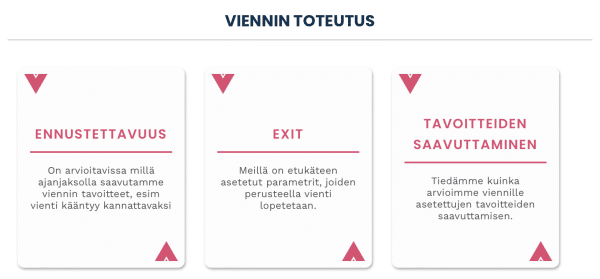
Suit #4 - Export execution
When exporting, you must keep clearly in mind that it is not a sprint. The further you go from your home country, the harder it is to achieve results."Anyone can make plans, but few can execute them. For example, I will run a marathon in under three hours. Anyone can make a plan like that. But who has the stamina to go running and put in the work for it? Ultimately, all good ideas are decided by the capacity to execute", Kim sums up.
The Export deck is meant for doing the thinking when you set out to export. For considering really carefully whether we need exports at all. The first question of Colin McPowell's doctrine is "Do we have to export? Could exporting be avoided?" Alternatives could be, for example, expanding at home into other customer segments or making new products for the domestic market.

Karelian pasties and other treats at the Topaasia office.
Finally: Kim, what Finnish thing would you like to export abroad?
"I have always wanted the Karelian pasty to become a worldwide fast food. It can be vegan and it can have any filling. Especially since the Karelian pasty comes from North Karelia. An absolutely brilliant fast food. Sometimes I wonder whether I should embark on a project to internationalise the Karelian pasty", Kim says.
Thank you, and by all means get in touch with Kim about excellent Karelian pasty ventures!
Kim's homepage Kim Väisänen - Twitter Kim Väisänen - LinkedIn Väärää vientiä - Book by Kim VäisänenWould you like to try the Export game with your own teams?