
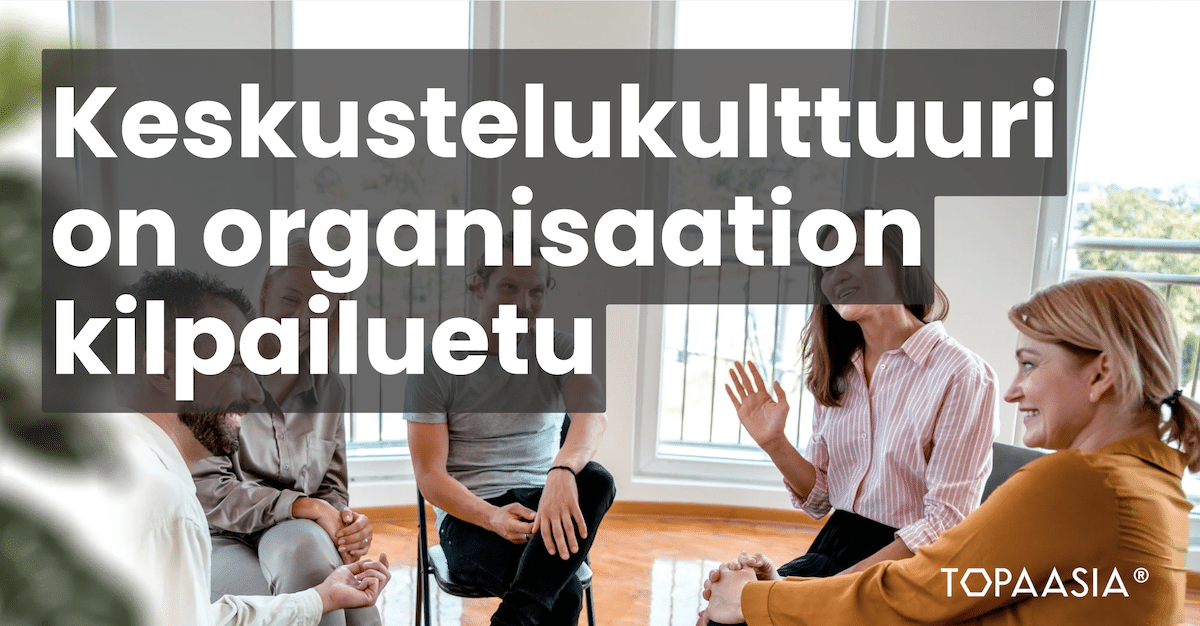
”Our conversation culture expresses and creates the reality in which we work. Generating insight from within work communities must be a strategic choice.”
Anna Kaisa Ojala, Work Ability Manager, City of Turku
Are dialogue, participation and conversation culture just employer-brand fluff, or serious strategic leadership choices?
The research literature is surprisingly unanimous: when people get to influence and to talk, the organisation learns faster, makes better decisions and prevents potential mistakes more effectively. Conversation culture is thus a strategic choice for the organisation and a factor in its competitiveness.
Conversation culture determines the level of development and whether risks reach the table in time
Leadership research describes a phenomenon called voice: whether staff propose improvements and whether employees dare to raise problems. The way managers and leadership listen and react shapes this behaviour decisively, as a constructive and interested attitude increases both the quantity and the quality of suggestions (Detert & Burris, 2007). The consequences are concrete: through conversation, small collaboration, interaction and process problems get fixed before they swell into costs that erode delivery reliability or the customer experience.
Likewise, the studies of Woolley et al. (2010) show that teams in which speaking turns are distributed roughly evenly and which react sensitively to each other's signals perform better than others. ”Collective intelligence” appears to arise from how the conversation is organised.
Below, picked from LinkedIn, Lauri V. W. offers his own take on how organisations function and how leadership turns into action:
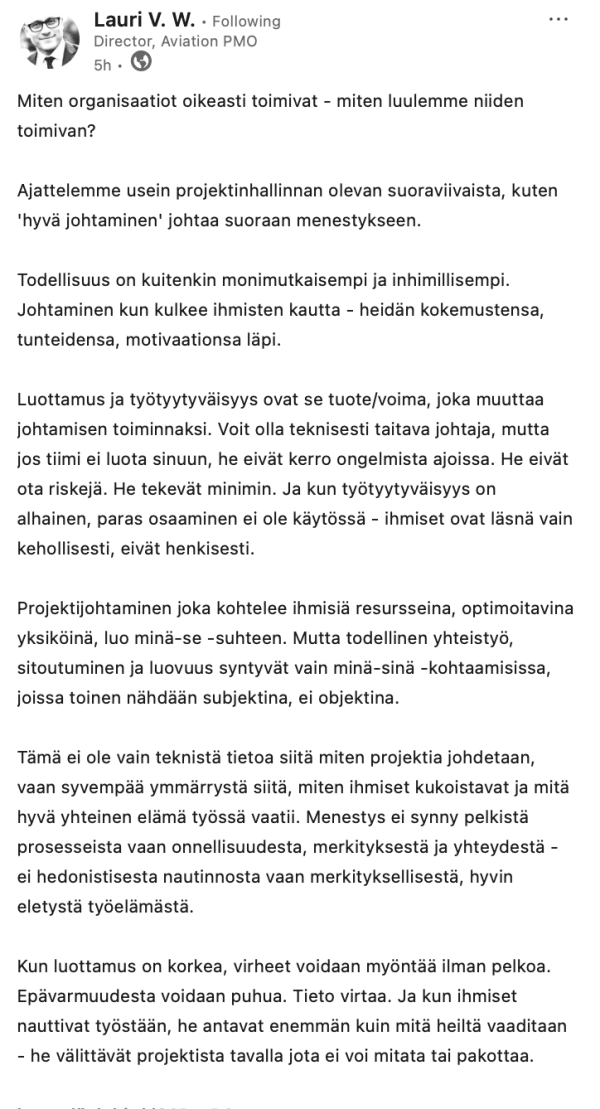
Lauri V. W. talks a lot on LinkedIn, but he talks sense.
A house built with participation stays standing better
Reviews of organisation-level interventions tell a similar story: staff participation in planning and implementing work-related content improves the psychosocial work environment and lays the foundation for performance. Dialogic organisation development emphasises the same principle: change progresses when people understand why, get to influence how, and can test the new in everyday work.
The established concept of psychological safety in work psychology describes a state in which an employee dares to present unfinished ideas, admit mistakes and question routines without fear of punishment. Edmondson's research shows that this kind of climate is linked to team behaviour and quality: mistakes surface earlier and get corrected faster if they can be discussed openly. The rest of the literature repeats the same conclusion: psychological safety is not a nice bonus, but a basic prerequisite for results.
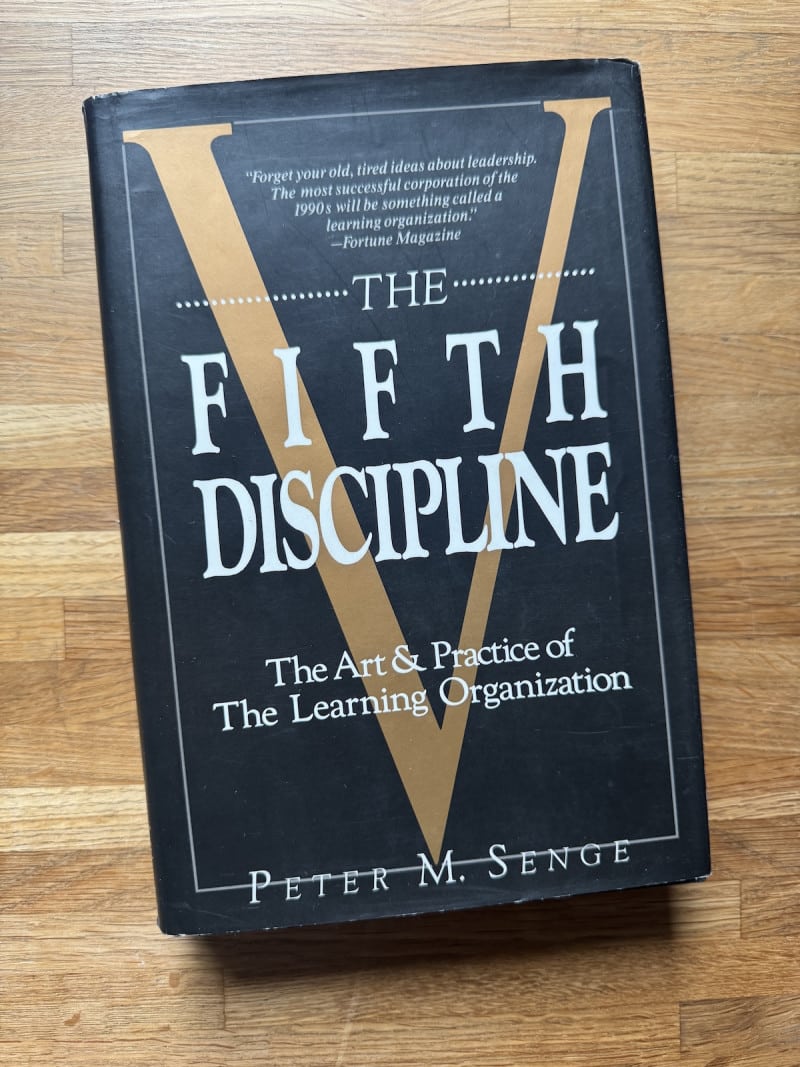
Peter Senge wrote about the learning organisation as early as 1995. The book remains a widely read classic of organisation development to this day.
Conversation rituals give rise to a learning organisation
On a practical level, organisations that regularly set aside time for teams' and groups' development dialogues seem to reap the benefits steadily: monthly 60–90 minute pauses that dig into a few important themes with an even distribution of speaking turns are simple but effective.
It is important to distinguish between dialogue that builds understanding and a decision phase that makes choices; both need their own time (Bushe & Marshak, 2015). A written ”silent round” before the spoken discussion can level the playing field and surface knowledge that would otherwise remain in the shadow of the loudest voices. Such varied practices have been found to be linked to better team performance.
The risks of developing conversation culture
Conversation culture is a strategic choice. When making this choice, the first fear is often whether the time allocated to conversations is really worth it. That we do not just "talk without anything changing". This is best avoided by giving both the dialogue and the decision-making their topics, phases and time limits. Another typical problem is the dominance of strong voices: without guided distribution of speaking turns, psychological safety may not be realised and thoughts stay inside people's heads.
A third risk is token participation, a situation where staff are asked for their views but their actual influence remains murky. Practical guidance emphasises transparency: it must be stated in advance which matters are decided together, which by leadership alone, and where employees have real influence.
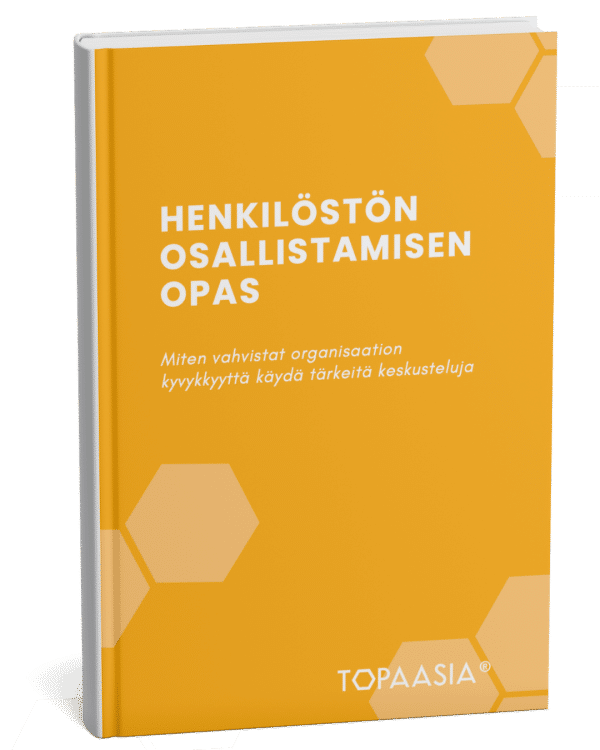
You can explore developing conversation culture in more depth by downloading the staff participation guide
Summary: culture is how we talk, decide and ultimately act
Conversation culture is not the organisation's soft background mobile; it is a concrete factor that raises the level of collaboration and performance. It is social glue, an enhancer of collaboration, but a frustratingly invisible and hard-to-measure thing. When conversations are kept up and speech within them is evenly distributed, critical knowledge surfaces in time and experiments move forward. Research suggests that this kind of everyday life is born from conscious choices: from time, from rituals, and from how the organisation's leadership reacts to its people. Participation is thus both a means and an end at once: a way to make work smarter and strategy real.
READ HOW TO INVOLVE PEOPLE IN CONCRETE TERMS: DOWNLOAD THE STAFF PARTICIPATION GUIDE
Sources:
- Edmondson, A. (1999). Psychological Safety and Learning Behavior in Work Teams.
- Edmondson, A. (2018). The Fearless Organization. Wiley.
- Detert, J. R. & Burris, E. R. (2007). Leadership Behavior and Employee Voice.
- Woolley, A. W., Chabris, C. F., Pentland, A., Hashmi, N. & Malone, T. (2010). Evidence for a Collective Intelligence Factor in the Performance of Human Groups.
- Knight, C., Patterson, M. & Dawson, J. (2017). Work Engagement Interventions: A Systematic Review.
- Bushe, G. & Marshak, R. (eds.) (2015). Dialogic Organization Development. Berrett-Koehler.
- Aust, B. et al. (2023). Organizational-level Interventions and Psychosocial Work Environment: Systematic Review.