
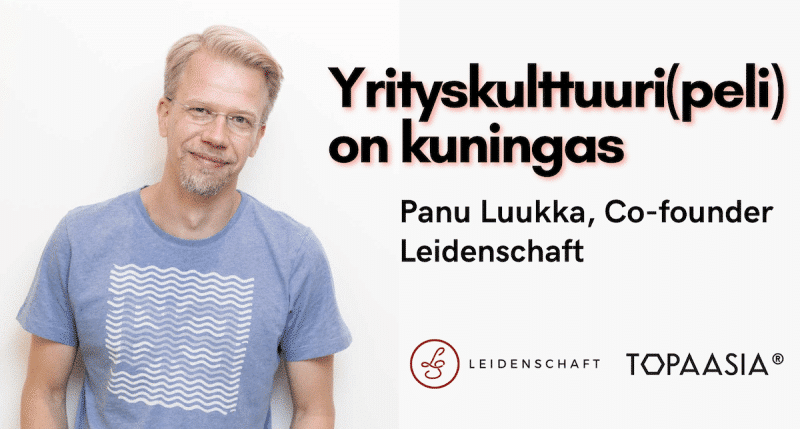
Panu Luukka is the founder of Leidenschaft Oy, Finland's first company culture agency, and the author of the book Yrityskulttuuri on kuningas (Company Culture Is King). This article digs into what makes a good company culture, and into the new Company Culture game that Leidenschaft and Topaasia have created together for understanding, working through and developing company culture.
Panu Luukka has become known as an advocate for company cultures and the founder of the Leidenschaft company culture agency. But long before founding his company, people and culture in working life fascinated Panu. At an earlier workplace he saw the concrete effects of leaders' view of people on the company's operations:
"In the mid-90s I worked at a travel agency. The CEO changed. People had previously been cared about, and after the change they were seen only as elements and performers of production. This led to good, skilled professionals leaving, and they were replaced with newly graduated employees who did not have the skills or the knowledge, and did not commit to that organisation the way the original people did", Panu says of his travel agency days.
Panu says he was left with a mental scar when he went to talk to the CEO about the situation and the answer was an order to focus 'only on his own numbers'. At the same time Panu was doing research on political extremist movements and saw how people achieve remarkable things and put their own future on the line when they work for a cause they believe in and think is right.
"There is an incredible power in getting a person to commit and believe in something. I thought, why couldn't we achieve strong commitment and belief in working life too, so that people would truly do much more than just show up at work and perform their seven and a half hours", Panu says, and continues on the significance of people for how organisations work:
"An organisation's success is always made by people. People are the organisation's central maker and enabler of change, in both directions. Culture is the tool with which people are guided to do the right things from the organisation's perspective."
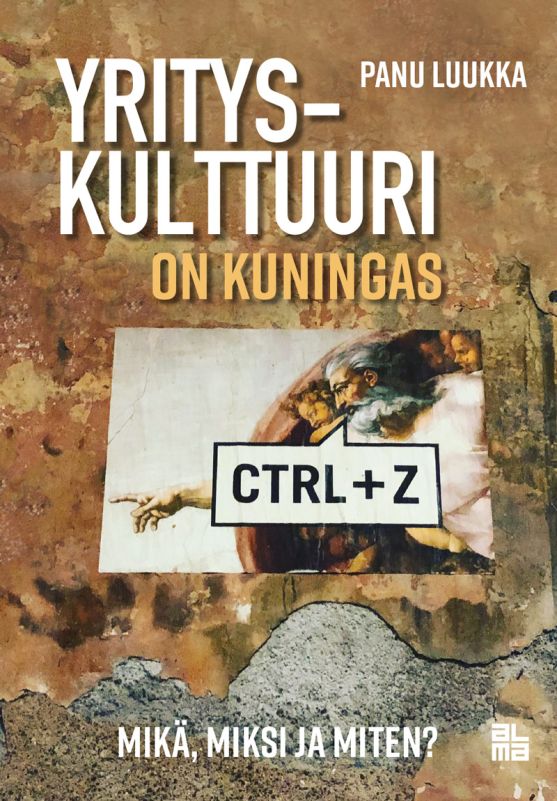
Yrityskulttuuri on kuningas (2019), Alma Talent.
Company culture is king
"At the start of my career I talked about employee motivation, engagement, wellbeing and so on. There were all kinds of isms and steering and management systems. At some point I gained the understanding and the words for it: what we are talking about here and what we are doing here is company culture. Culture is the way we act and what we believe in. When you start thinking of culture as its own thing, it becomes something that can be led", Panu explains.
Panu has written the book Yrityskulttuuri on kuningas (2019), in which he has defined company culture extensively. According to him, the best definition comes from William Wolfram, who defines culture as what happens when no one is watching. According to Panu, there are two perspectives you can take on the importance of culture:
"The primary perspective on company culture is that culture has no intrinsic value. Culture is not an 'end in itself'; the most important thing for an organisation is not that it has a good, nice and pleasant culture. Culture is a tool, and the central task of that tool is to fulfil the organisation's mission and enable the organisation to reach the goals it has set, that is, its vision. You could say that culture is a tool whose task is to ensure the organisation's success.
From the second perspective, that of people, every organisation is built of people, and culture's task is to attract the right people to the organisation, get them to stay in it, and get these people to give their best for the benefit of that organisation", Panu says of the significance of culture.
What does an excellent company culture look like?
Every group of people and every workplace has some kind of culture. According to Panu, cultures form in two ways: either unconsciously, in which case no attention is paid to it and it forms under its own weight, or it is formed consciously through action and leadership. At the core of culture, according to Panu, is voluntary commitment, that is, the desire to work in that organisation, the desire to be its member, the desire to advance its goals and give it your best. Panu compares a good company culture with an average one:
"In many organisations, people show up to deliver obedient work performances and do what they are told. Obedience, after all, is the basis for paying wages. In many organisations, obedience is the maximum you get out of people. People arrive at work on time, do the minimum performance so they cannot be fired, and then leave as soon as they can and are allowed to. That, slightly exaggerated, is Finnish working life. But then there are those organisations where the culture is such that it gives you things, and thereby also gets you to give more."
In a good culture and workplace, employees give of themselves to the organisation and work with passion. That kind of behaviour cannot be forced. Panu describes an employee's thoughts when working in such a company culture:
"You start thinking about the things that advance the team's success. You start thinking about things that are not strictly your responsibility but that would improve the unit's ways of working or the customer's experience. You start advancing something you believe is good for the organisation, even if advancing it is difficult", he lists.
A strong company culture attracts
Many company cultures are nondescript and do not help people define what kind of place the company really is. Panu calls for making a company's culture strong and recognisable, so that it attracts the right people and saves everyone's time in recruitment.
"Our central message at Leidenschaft is that culture should be made strong enough. So that already at the recruitment stage the applicant would know whether this is a culture they want to belong to. Right now the majority of cultures are ones you cannot get any grip on, and then once an employee has been in the house for a year, they realise they do not want to be in that environment. Because the organisation's operating environment and the world change, the culture should also be so strong that it chews up and spits out the people who genuinely cannot succeed there", Panu describes.
Changing culture is slow
And what if the organisation has existed for a long time and no one has ever consciously paused to consider its culture? According to Panu, this is not a problem, but you must be aware that changing a culture later is slower and harder than creating or developing a fresh company culture.
"Change is always slow, and that is why our message is: pause around your culture early. Think from the start about what kind of culture lies at the core of our success, because it is easier to build at that stage. Still, the talk that culture cannot be changed is nonsense. Of course culture can be changed. The bigger the organisation, the stronger the culture, the longer the legacy, the harder that change is. But it is a change process, just like any change process. It requires communication, communication and communication. It requires various means of rewarding, thanking and intervening. And it requires systematic work, and it further requires communicating all of these actions taken", Panu says.
According to Panu, the majority of culture change initiatives fail for two reasons. The first reason is that the firm wants to see results quickly, often as early as the next quarter, even though changing a culture is a slow process, sometimes taking years. The second reason is that the leaders driving the change are inside the company culture, and they may not notice the changes happening in the culture. This can lead to a mistaken interpretation that the change is not progressing, and the efforts to develop the company culture are stopped.
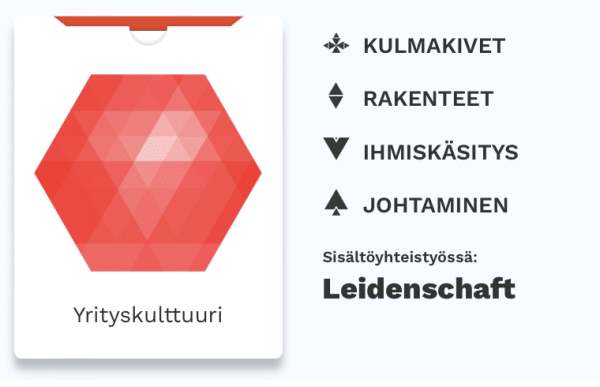
The Company Culture game for understanding and working through culture
The new Company Culture game was created in collaboration between Leidenschaft and Topaasia. The game is available as part of Topaasia's digital service and as a physical deck. Why was this game made, Panu?
"The Company Culture deck was made because the biggest challenge with company culture is that it is hard to get a grip on. Culture is, especially for Finnish engineer-leaders, a difficult thing to grasp and understand. We made the culture deck so that there would be a way to talk about that company culture. It is a way to focus and to understand why culture is important, what themes it is made of, and everything that fits under that culture. And where all the actions taken affect that culture. So the culture deck was made so that we would have a way to talk about, work through and understand culture in our organisation", Panu sums up.
When Leidenschaft was building the Company Culture game, the greatest difficulty turned out to be choosing the umbrella themes, that is, the game's suits.
"The trickiest part of building a Topaasia deck is that it is based on the same logic as playing cards. The biggest wrestling match was over which things are so important that they form the four umbrella themes, the suits. After lengthy discussions we ended up choosing leadership, the cornerstones of company culture, structures and the view of people as the umbrella themes", Panu describes.
The view of people is a theme that can be seen as belonging a little under all the themes. It is nevertheless a central matter that gets bypassed in the majority of culture-related conversations or initiatives, and for this reason it was raised into an umbrella theme of its own.
"It is easy to polish structures or talk about mission, vision and strategy, but the view of people, that is, what the organisation believes about people, defines the culture. If the organisation's underlying belief is that people are lazy or need strong management, that defines the culture in a truly fundamental way. At the other end of the spectrum, the organisation's belief about people can be that people want good things for each other and their organisation, and that they want to grow and develop. The effect of that kind of belief on the culture is incredible", Panu says.
----------------------------------------------------
Thank you Panu and Leidenschaft!
Read more:
Panu Luukka - LinkedIn
Leidenschaft
Try the Company Culture game free of charge for 30 days in digital Topaasia