
Agility Part II - an interview with Ville Marjusaari, Solita Oyj
In the Agility blog series we interview Ville Marjusaari. Ville works at Solita as an agile coach and specialist. Ville has been involved in creating the Topaasia® Agility game, and in this interview he talks about the agile way of working and its importance in a rapidly changing world.

What exactly is agility?
At the core of agile work is producing customer value under uncertainty. Agility is the best risk management strategy. In agility, unnecessary work is minimised and the focus is on producing customer value in changing situations at a sustainable working pace, not by flogging people through endless days.The key question is to identify and understand your own operating environment. Surprisingly often, when developing a system that sounds very simple, it turns out that we do not know enough about the problem to be solved, or the available technology does not work as expected. In that case we are operating in a complex environment. Which brings us to the question: why work in an agile way?

Car factory vs agility
A good analogy from a colleague is the car factory. A modern car is a truly complicated machine. It has parts, widgets, kilometres of electrical wiring and all sorts of things. A complicated whole, and yet when it starts down the production line, despite its complexity it always comes out the same, repeatably. Manufacturing can be planned in advance.
In a complex environment, by contrast, we do not know precisely in advance what the solution to the problem is or how the solution should best be implemented. Technology changes, people and their needs change, and dependencies, competencies and working days change in knowledge work. In everyday work you have to be able to maintain an understanding of what is being done and what is genuinely valuable. When you have worked a month ahead, you notice that what seemed valuable a month ago no longer is, and value actually comes from somewhere else entirely. It no longer holds that you design a process in advance and get exactly a certain kind of outcome out of it.
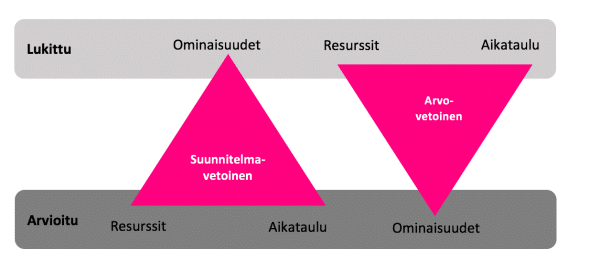
The project triangle for understanding the agile way of working in a project (c) Ville Marjusaari
Agility as a way of working is the answer to the fact that everything changes and we cannot always operate according to defined processes
Agility is grounded in empirical processes and work is steered through learned knowledge, not through assumptions. We care less about opinions and instead run experiments and build increments. Experiments are always, to a greater or lesser degree, leaps into the unknown. Based on what is learned, an idea emerges of what kind of whole should be built.Experiments should be run according to your tolerance levels. Then you examine: did this experiment take us in the direction we wanted? Did it produce learnings, and which ones? How did our way of working perform? How well did we do? Do we need to change something from a systems perspective? And then the next step is adapted based on what was learned.
The traditional waterfall model is risky if both the original operating environment and the problem to be solved were defined wrongly. Then those 6 months are a hell of a big investment if it turns out that a fundamentally wrong thing was built.
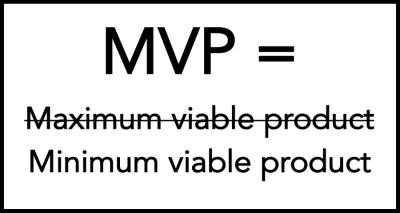
MVP, or minimum viable product, is a term often misused in big companies. There is often a certain spirit of building a minimum set of features, but it may still mean 2-3 months and in practice a trimmed-down full set. I see the definition more as: the smallest possible output on the basis of which you can learn more about the problem to be solved. That means building something far smaller than months of work.
Agility feeds motivation and meaningfulness
Agility and agile methods are extremely important for motivation and the meaningfulness of work. In the nightmare scenario, work can be such that someone hands you a plan from the outside: Hey, over the next 2 months these and these things need to be done. At worst this goes so far that you do not even understand why these things are being done. In agile methods, by contrast, you are building that understanding together with the team:Hey, someone has a problem. They want to invest money in solving that problem, and we too understand why solving it matters. What do we ourselves get out of it? How can each of us grow along the way?
Through this, agility has a strong link to the meaningfulness of your own work and to why you come to work in the morning.

The most common stumbling block of agility
The common stumbling block is usually that organisations try to become agile by adopting only the tools and methods without understanding the agile mindset, values and principles. That raises the question: are the principles of the agile software development manifesto still relevant? In my view they all are, to some degree. They can be applied beyond software development, because they are principles. Just swap the word "software" for product or system or whatever is at hand.A concrete example of a stumbling block could be adopting some digital tool and the Scrum framework without understanding why, and on which values and principles it rests. Then you end up in situations where people say: this role cannot work in our environment, and this particular Scrum framework event feels stupid, such as planning the next iteration. In that case they do not understand why it is there. So it gets dropped and turned into something different.
Changes to frameworks can sometimes be necessary, but first you must genuinely understand why the different things are there, and at the start it even pays to play by the book, follow the instructions. Only then challenge the ready-made model, once you understand that it exists because... and for us it works like this... After understanding, the challenging should be done with the thought for us this would work better like this, because....
Thank you Ville!
Do check out Ville's social presence: LinkedIn, Twitter Check out Solita www.solita.fi
Read the first part of the Agility blog series with Jonne Seppä here
You can buy the Topaasia® Agility game from our online shop www.topaasia.com You can also call and think out loud into the ear of game man Jussi Galla on 040 0246626