
Agility, part I - Interview with Jonne Seppä, Solita
Topaasia® - Agility was created together with the people of Solita, the travel guides of digital Finland. The Agility game creates discussion about the essence of agility, and the game helps players understand and decide how they themselves could act in a more agile way. Game man Galla interviews Jonne Seppä, Solita's Head of Culture and Competence.
Why is agility an important thing to discuss?
Our world is changing all the time and at an accelerating pace, and we somehow need to operate in our everyday work so that we are constantly ready to change and develop. Agility is the answer to how changes get adopted quickly in our own heads when something unexpected happens with the customer or in the outside world, in other words when situations change. Another thing I like about agility is the human-centred angle. In agility, clarity of a person's work, purpose and autonomy are present. It is a modern way of working, a way of our time.Why was this particular content chosen for the Topaasia® Agility game? -
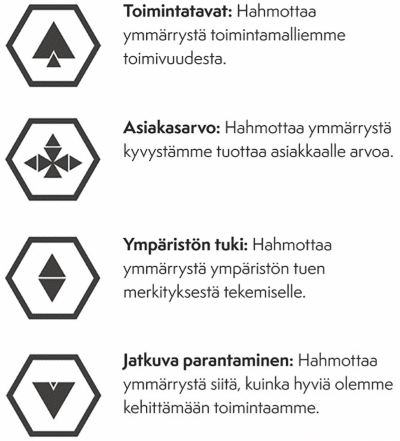
This contains everything essential related to agility. The most important thing we aim for is creating customer value. Doing something smart, something that creates more value, or more meaningful value, for the customer. The three other suits are then means. With what ways of working, with what kinds of everyday mechanics, do we get that customer value created? What does the group of makers or the agile team need from its environment in order to make good progress? And an essential point is the whole idea of agility: in everyday work we experiment, learn, measure and change ways of working. That is continuous improvement.
I see this four-field so that there are three ways or areas that produce customer value. In my view these are very logical, although it is a boring answer to say these make sense, but that really is what agility is about.
Next, let's dig deeper into each suit.
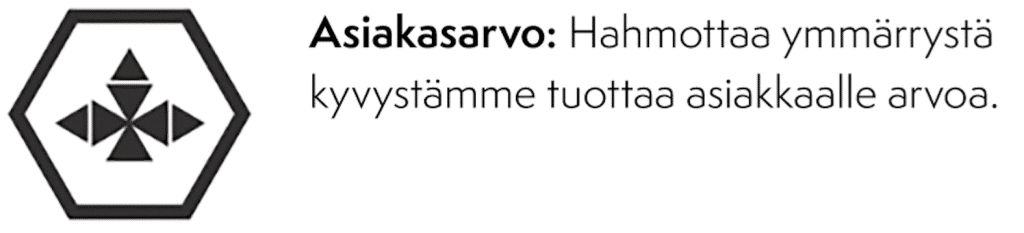
Customer value - what everything aims at
In customer value, we work out what are we actually doing right now? What is the valuable thing? Surprisingly often it is somewhat unclear.This deck strongly emphasises creating customer value quickly. Doing small things, measuring customer value, being ready to change direction, and constantly trying to home in on where the real value might be. This is not based on us knowing what the brilliant value-creating thing for the customer is; rather, it is discovered, as it were, during the process.
This suit includes, for example, the card Splitting, where things are broken down into smaller pieces and value is produced quickly. We do it continuously, measure, verify and constantly gather feedback. Creating customer value is a kind of cycle. Traditionally, of course, the thinking is that customer value is known in advance, but here it is more like a secret that is revealed during the work.
A company always exists for the customer. However, you cannot always know what is, or could be, valuable to the customer. Then you have to test in an agile way. Then the work is based less on assumptions and more on us having some hypothesis. Then we measure it, experiment and evaluate that value. Of course this must be done quickly, so that a huge amount of time is not spent on it.
Continuous improvement is reflection
We must be able to question and change the ways in which we do our daily work. What we do today, how we hold meetings, what tools we use and so on. These are things people easily perceive as static, and we assume we can guess in advance what the best way would be. Continuous improvement means working with discipline and with agreed ways of working, but from time to time reflecting with different questions:- Is this smart?
- How could we improve?
- What kinds of problem situations have we had?
- How were those problem situations solved?
- How can we develop this and how can we learn from mistakes?
Ways of working make it easier to make smart choices
This suit contains the principles of an agile way of working. When you follow, for example, cards such as Seeing things through, the point is to recognise that this kind of behaviour is a good thing in the first place. Or the card Prioritisation, that is, always doing the most important things first. This suit is more of a toolbox that helps you make choices that are likely to be smart.This suit contains many important individual things: tracking the work and gathering as a group, doing quality work and feeling shared ownership. Not so that we all have only our own exact roles, but that we also have a shared goal. In my view, the cards in this suit are tools or perspectives on what you need to think about and take into account in order to operate as an agile team. These cards are, as it were, claims that working this way tends to produce good results.
Support from the environment, the humane angle
This, in my view, is the humane angle of the whole. Earlier we covered the topics customer value must be created, we must act so that creating customer value is possible and we must continuously develop as a team. They are all very demanding. This deck talks about everyone getting to take part in decision-making, carrying responsibility together, and the importance of our group having good motivation. But much of this suit is about the fact that as a team we have the right to demand something from the environment. Here there is, for example, the Workload card: if our workload grows too large, it is OK for us to say so. It is OK to speak up if things feel unreasonable to us. It is the environment's job to react to that!This suit emphasises that it is smart to say if we feel our tools do not fully support our work. We have the right to say that we would make better progress if our environment were better. And it is OK to say if the team does not feel it gets enough feedback. This suit tells us that the team also has the right to task the environment it works in. Take, for example, the Encounters card: it is also support from the environment that there are workstations and surroundings where you can easily see others. If it feels like our team sits scattered and the customer is spread across four sites, then we can say: This just isn't working like this. Please, environment, make us a better environment, and we will make you more customer value.
As a whole, it is good that there are demands both on the team and from the team towards the environment. Agility does not mean assuming teams are so autonomous that you can tell them There's a war over there for you. Go and die. But of course rather: There's a package over there for you. Go and build it, and whatever you need, this environment will then be shaped accordingly.
Of course, you must remember that when playing a Topaasia game, the outcome cannot always be greetings to the environment, you are bad; you must remember how you yourself could communicate and influence things if the environment is not automatically receptive. It is not constructive conversation for a team to only discuss how good they themselves are while everyone else around them is not. That is just outsourcing your problems.
---
Thanks to Jonne for the interview!
Do check out Jonne's social media profiles: linkedin, twitter
News from Solita: https://www.solita.fi
If you want to use the game yourself, which creates a shared understanding of the state of agility and its next development steps, order Topaasia® Agility here