
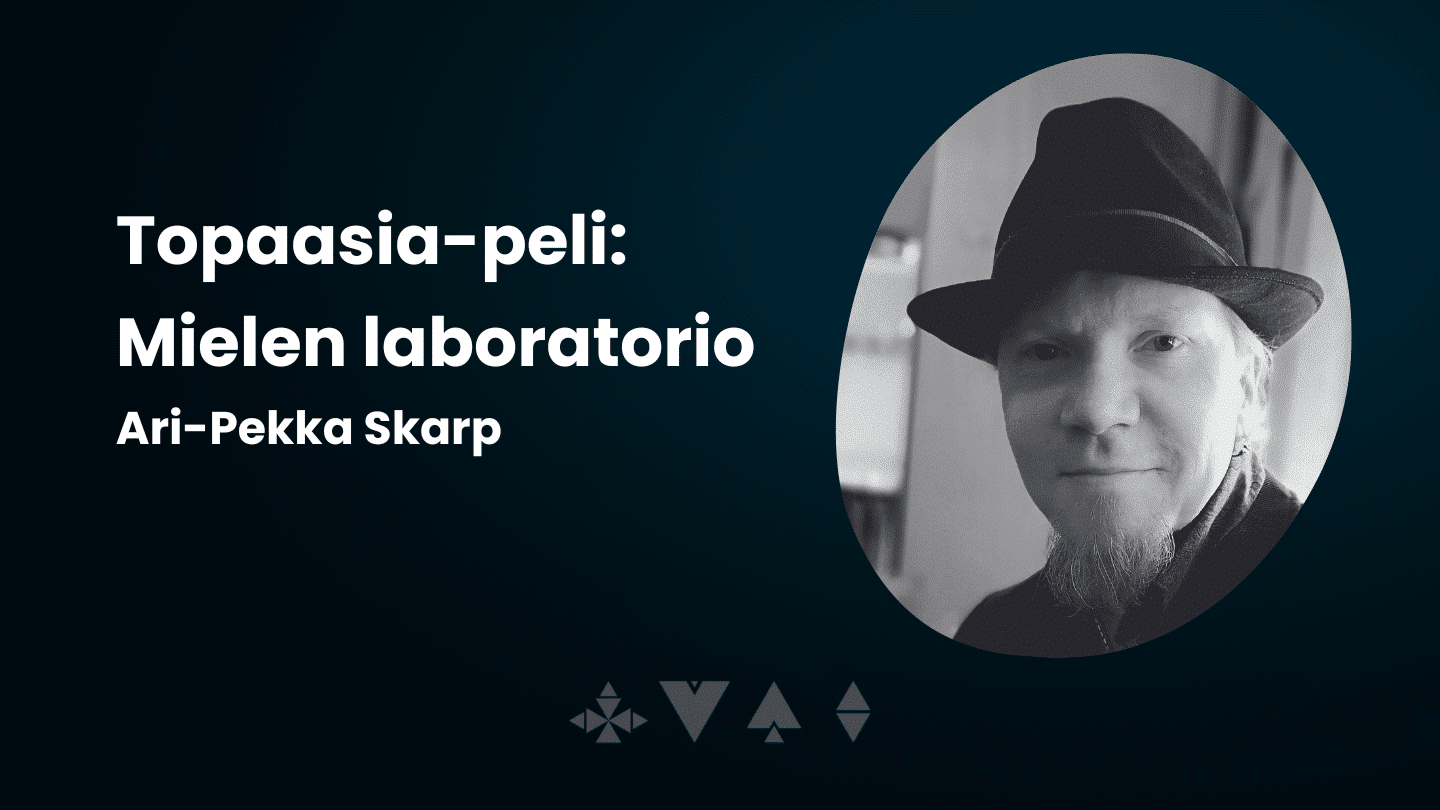
Ari-Pekka Skarp is a psychologist and psychotherapist focused on organisational development, who has also made a career as an engineer, software developer and coach. What has united these different career paths is the pursuit of understanding work, organisations and people as a whole, and thereby helping people and organisations develop how they work and operate. Together with Topaasia, Skarp has developed the Laboratory of the Mind deck, whose background and uses are covered in this interview.
The Laboratory of the Mind - The result of a thought process spanning over ten years
Skarp has always been interested in the human mind and interaction between people. "The most interesting thing of all is the human mind as a whole, which I have wanted to understand ever more deeply and holistically."
This passion also gave rise to Skarp's non-fiction book, Mielen laboratorio, tietoisuustaidot ja taitava vuorovaikutus, which examines the mind from different perspectives and leads the reader to insights about how the mind works.
If the mind were completely detached from all interaction, it could not really exist at all.Social interaction is central to how the mind works. Skarp's starting point is that, at its core, the human mind can be seen as social, arising in interaction. "If the mind were completely detached from all interaction, it could not really exist at all", Skarp says. He sees the mind as a nexus of social interaction.
The book, which condensed a thought process of over ten years, was later complemented by the Mielen laboratorio podcast, which explores the mind through various conversations and interviews.
In addition, in collaboration with artist Pekka Homanen, Skarp has created activity cards, whose goal is to increase people's understanding of themselves. Most recently, the book Mindfulness, mielenselkeys ja myötätunto has been published, which builds a practice path for navigating today's complex and hectic world. The Laboratory of the Mind deck, created in content collaboration between Skarp and Topaasia, also draws on the themes of this book.
The Laboratory of the Mind game has four different perspectives that build on each other
Topaasia's Laboratory of the Mind deck has four perspectives: mindfulness, clarity of mind, compassion and resources. "The idea is that in order to be able to observe our environment and ourselves at all, we need certain skills and abilities for it", Skarp describes the deck.
Mindfulness: Mindfulness is the basic skill of managing one's own attention. Through it, it is possible to be present and direct one's will and attention towards the desired objects. Mindfulness is the foundation for being able to see clearly.
Clarity of mind: On the foundation created by mindfulness it is possible to build clarity of mind. "When you have a realistic picture of where I am, what I am experiencing, what I am feeling, what this environment is and what is happening here, you can focus on what is important", Skarp says. Clarity of mind means being able to understand which things are meaningful and important to a person. It is the exploration of inner motivation and one's own sense of meaning through the management of attention.
Compassion: Compassion is where a naturally progressing, healthy development path leads. When there is mindfulness and clarity of mind, we naturally begin to build the kind of common good that is necessary, useful, functional, sensible and humane for ourselves and others.
Resources: The deck's fourth perspective, resources and resource factors, are the things we already have within ourselves or that we can develop. They help in skilful action that moves towards compassion. Resources are energy on top of which we can build action.
The deck's perspectives in brief:The Laboratory of the Mind deck is an excellent tool for resource-oriented conversationsMindfulness is the basis for seeing clearly. Through clarity of mind we see the bigger picture, what our task is in this world. Through compassion we begin to orient ourselves towards the good that clarity of mind has shown us. Resources are the energy and means by which we are able to keep acting.
Topaasia's method provides the opportunity for dialogue, for understanding meanings, for seeking new perspectives and for forming shared understanding.
Skarp thinks the deck's themes are particularly important when we are in the midst of everyday life with a great deal of complexity; when it is hard to perceive what is important, or important things are in danger of being buried under busyness and stress. The game works for both individual and group conversations.
Instead of examining everything that is wrong, we examine what we would like to see happen in this world, what we would like to be moving towards.The deck can work well, for example, as a path that starts from mindfulness, proceeds to clarity of mind and moves towards compassion. The work can also help identify those particular resource factors that would be especially important in the very situation we are in right now.
Skarp points out that the deck is indeed rather resource-oriented. "It is not necessarily the best possible tool for starting to look for, say, the most frustrating thing." It is worth entering the conversation with a strengths-based attitude. "Instead of examining everything that is wrong, we examine what we would like to see happen in this world, what we would like to be moving towards."
Explore the themes further: https://www.mielenlaboratorio.fi/ https://podcasters.spotify.com/pod/show/mielen-laboratorio
Try the Laboratory of the Mind game: order a free 30-day Topaasia trial
Would you like to use Topaasia in your own content? Book a Topaasia demo